
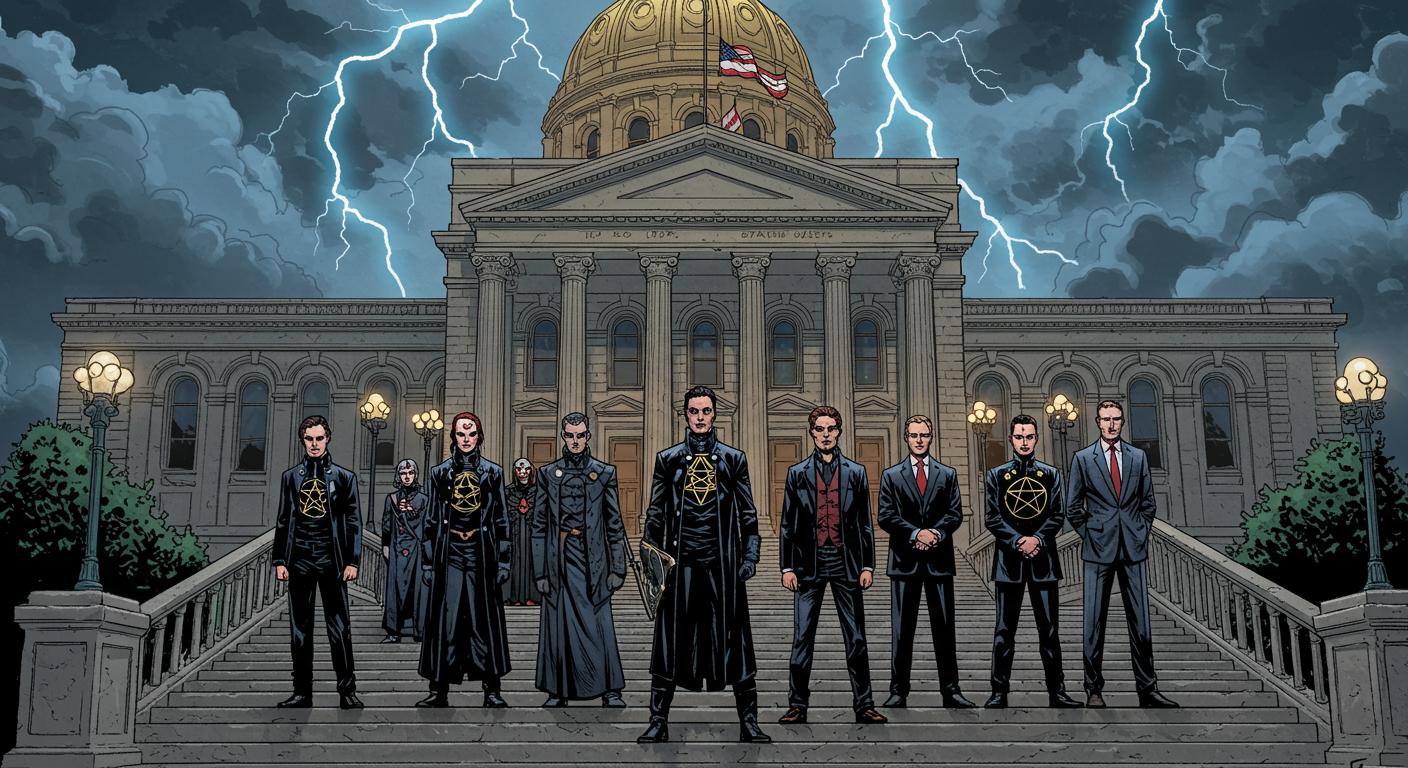
When it comes to the intersection of church and state, Iowa has recently found itself playing host to what can only be described as a theological tug-of-war, with an ensemble cast featuring the state’s highest officials, the American Civil Liberties Union, and none other than the Satanic Temple Iowa. If you assumed that disputes over religious displays in government buildings were a solved issue, well, the universe has a penchant for the delightfully unpredictable.
Satanic Displays, Bureaucratic Gatekeepers, and Christmas Tree Neighbors
As AP News reports, the origins of the current controversy date back to a relatively festive December at the Iowa State Capitol. In 2023, the Satanic Temple Iowa received permission to install a holiday display in the rotunda, where it coexisted with a Christmas tree and other religious installations. Their display—a depiction of the horned deity Baphomet—briefly shared space with nativity scenes and holiday paraphernalia until it was destroyed by a Mississippi man, an incident that drew national attention and added a layer of drama to an already uneasy gathering of faith-based décor.
Following this, the Satanic Temple Iowa applied for another display and a family-friendly event for December 2024. However, as outlined by AP News, their application was denied by state officials, prompting a formal complaint of religious discrimination. The complaint, described in the AP’s report, alleges that Governor Kim Reynolds and Department of Administrative Services director Adam Steen denied the group access not due to any procedural violation but because of the group’s religious identity.
The Child Question and Costume Armament
Governor Reynolds justified the denial in a public statement included by AP News, asserting that state Capitol policies “reflect the potential impact on children and families,” especially considering the frequent visits by minors. She went further, stating, “This satanic event, which specifically targeted children, would have been harmful to minors and so it was denied.” The state’s response, as explained in the article, leaned heavily on perceived risks associated with the proposed event: Steen cited concerns about “obscene materials and gratuitous violence” and focused on costumes that included sticks, which he argued could be “used as weapons on children” and thereby position the event as harmful to minors.
The Satanic Temple, as summarized by AP News, contends these were “absurd, unfounded concern[s]” invoked as a pretext for religious discrimination. Their application had specified that the event would be family friendly, and the group maintains that the safety concerns were exaggerated and not consistently applied to other holiday displays.
ACLU Papers, Open Records Mysteries, and the Christmas Season Paradox
AP News further documents that the ACLU of Iowa filed Tuesday’s complaint on behalf of Mortimer Adramelech, described as the minister of Satan for the Iowa Satanic Temple congregation. Rita Bettis Austen, ACLU Iowa’s legal director, is quoted as saying this complaint is the necessary first step before a legal claim of discrimination can be filed in court. Simultaneously, the ACLU of Iowa has an ongoing lawsuit after records requests regarding the display and event were withheld or redacted by the governor’s office, with the state citing executive privilege.
Citing open records included in their complaint, the Satanic Temple alleges that the governor’s office and Steen met at the time to coordinate responses regarding the display, implying that the rationale for denial was shaped behind closed doors. As previously reported by AP News, the complaint explicitly argues that the real motive is to prevent the Satanic Temple from obtaining “the same access to the Iowa State Capitol as other ‘mainstream’ religions, in particular Christianity, and in particular during the Christmas holiday season.”
Describing organizational background, the AP notes that the Satanic Temple, founded in 2013 and based in Salem, Massachusetts, describes itself as a “non-theistic religious organization” advocating for secularism rather than a belief in Satan. It is separate from the earlier-founded Church of Satan.
Reflections from the Gallery
One can almost imagine the founding document drafters peering over bifocals, exchanging confused glances about the sheer scale of legal energy spent mediating disputes over sticks, costumes, and who gets to put up what next to the Christmas tree. Does the presence—or absence—of a horned deity actually impact the spiritual or moral well-being of minors who pass through those Iowa rotunda doors? Or is this simply the latest rematch in an ongoing, centuries-old pageant of American pluralism, where public space serves as both battleground and backdrop?
If state opposition is truly about material safety (beware the stick-wand!), we might expect the same scrutiny applied to candy cane props or plastic manger animals. If, instead, the concern is the theological dissonance—well, the courts may soon get to determine whether “family friendly” can make room for goats and angels alike.
Either way, according to the thorough reporting by AP News, Iowa’s December festivities are unlikely to get any less interesting. The real question: Is this dispute an outlier, or a preview of the next chapter in America’s long, winding relationship with weirdness, worship, and public squares?