
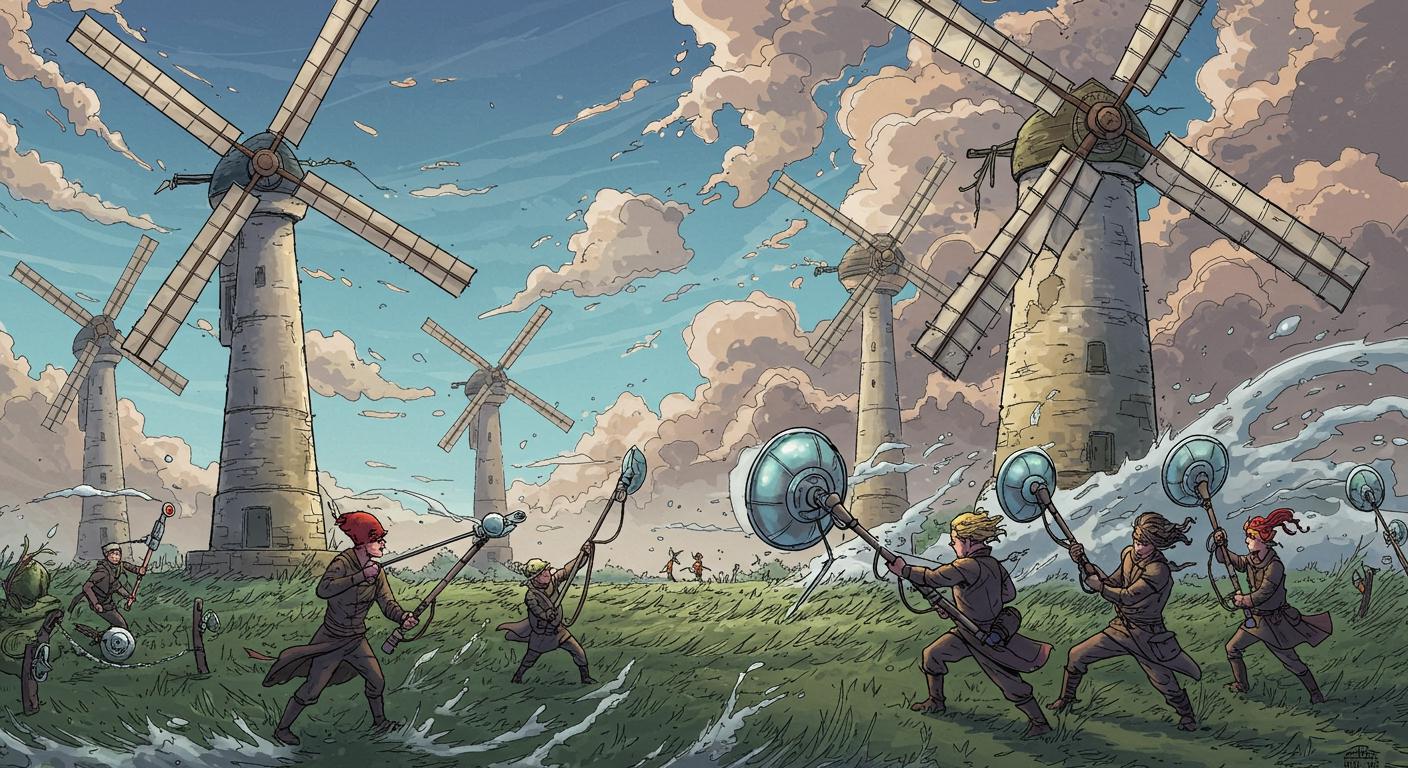
Just when it seemed like Europe had engineered most of its disputes into history books and Eurovision scoresheets, the winds of controversy are, quite literally, picking up across the North Sea. As The Times reports, Belgium stands accused—at least semi-seriously—of stealing wind from Dutch turbines. This isn’t a metaphor for flat land political maneuvering; it’s about actual air currents being “shaded” by a national neighbor’s blades.
Sails, Shadows, and Surplus Sarcasm
The core of the issue lies in the phenomenon atmospheric scientists call the “wake effect,” or, less poetically, “wind shadow.” According to The Times, Belgium’s offshore wind farms sit southwest of the Dutch installations, directly in the path of prevailing winds from that direction. When wind turbines extract energy from the air, there’s literally less wind left behind—a detail explained by Remco Verzijlbergh of the Dutch weather forecasting service Whiffle. He told Belgian state broadcaster VRT, as cited in The Times, “Behind a wind farm with many wind turbines close together, you really see lower wind speeds,” and with most gusts arriving from the southwest, Belgian turbines are often the first to enjoy them. The upshot: Dutch wind farms can lose up to 3% of their generating power to their Belgian neighbors, a shift that, while modest, is apparently enough for the Dutch to take notice.
If you’ve ever wondered what cross-border resource squabbles might look like in a decarbonized 21st century, consider the almost bashful scientific accusation, “So you often steal some of our wind.” It’s the kind of complaint rarely raised outside of board games, yet as The Times details, the sheer scale of wind farm construction in the North Sea is turning what was a theoretical hiccup into a diplomatic draft.
A Patchwork of Turbines, a Gentle Jockeying
The story gets even more interesting in light of how much wind power is at stake. The Times outlines an agreement among nine nations—including Belgium, the Netherlands, Britain, Germany, and several others—to turn parts of the North Sea into the world’s largest offshore wind power zone. These states have pledged to boost combined wind capacity from about 30 gigawatts today to 120 gigawatts by 2030, planning a tenfold increase by 2050 at an estimated cost of €800 billion. Britain, for its part, already operates the biggest array, boasting 45 offshore farms and plans to increase capacity from 14 to 50 gigawatts within five years.
With so many turbines rising offshore and the promise of even more “wind sharing” in the near future, these atmospheric aftereffects are suddenly everyone’s business. Wind farm wakes can extend for tens of kilometres, meaning that geography—more than border treaties or neighborly goodwill—can determine whose turbines get the best gusts. Reflecting on this, Verzijlbergh warned, according to The Times’ coverage, that we could see a “race to the water, where whoever builds first gets the most favourable wind.”
Who Owns the Wind, Anyway?
Of course, none of this involves actual theft in the conventional sense. There’s no criminal mastermind tethering Belgian turbines to Dutch ones under cover of North Sea fog—just the immutable laws of physics playing out over an €800 billion megaproject. For the Dutch, long regarded as admirably canny engineers, it must sting a little to see their southern neighbors take advantage of upstream positioning—a twist on an age-old story, only now the current is measured in kilowatts rather than canals.
So, who exactly owns a gust born hundreds of miles away? Is it time to redraw borders in the sky? As The Times points out, as turbines proliferate and the space for virgin wind runs out, such questions are no longer purely hypothetical. Perhaps wind rights will become the next major legal battleground, nestled uncomfortably among North Sea fishing quotas and debates over Belgian frites versus Dutch patat.
Final Gusts
Unlike most international incidents, this one is refreshingly free of bluster or impending sanctions. Instead, it’s a gentle reminder that our shift to renewable energy comes with a new set of cross-border entanglements—ones that swirl invisibly above our heads. The Times underscores that as the North Sea grows ever more crowded with turbines, both literal and figurative wind shadows loom ever larger.
Maybe, after all, the future of European diplomacy will be less about drawing lines on maps and more about keeping an eye on those Southwesterlies. Who knew the air itself would one day merit careful neighborly negotiation?