
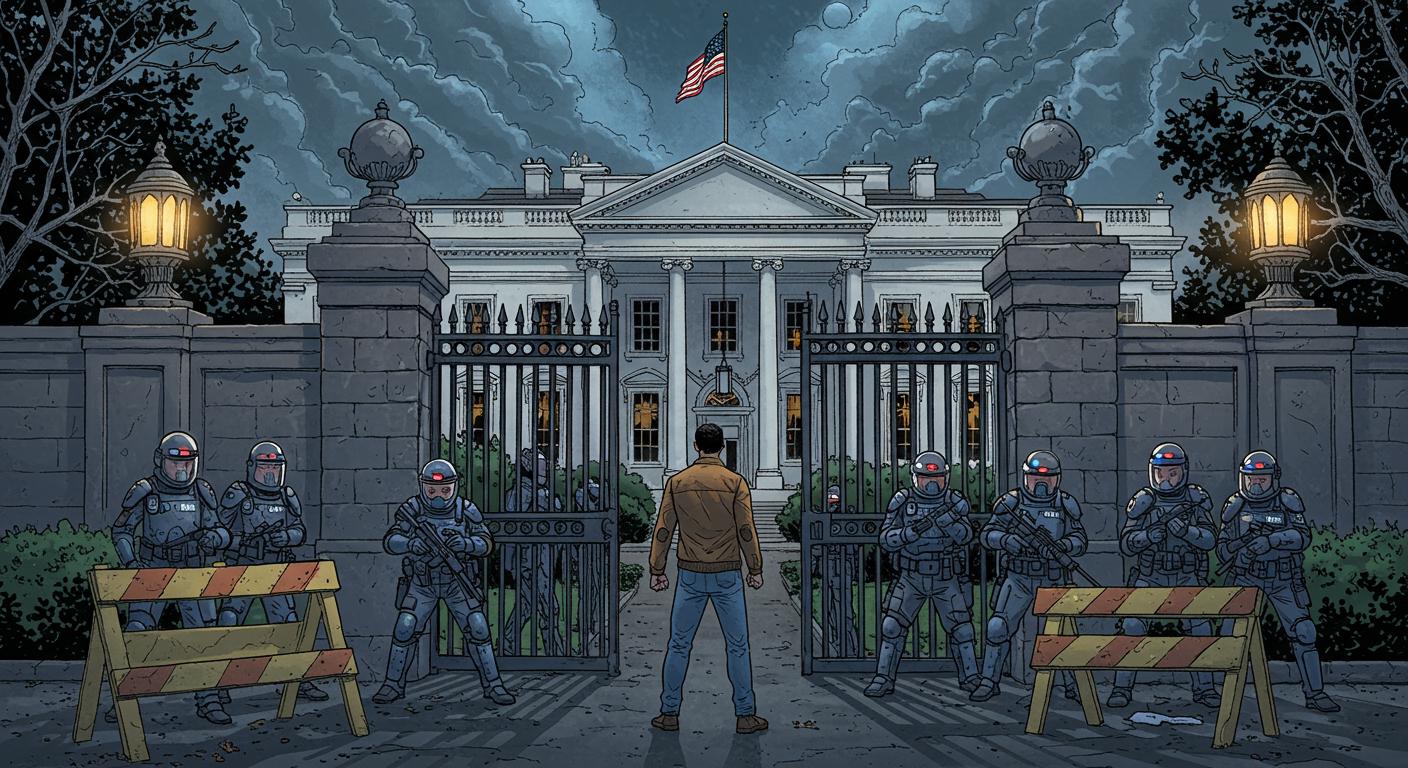
If you thought American political theater had peaked, recent events suggest the script keeps getting stranger. In a plot twist seemingly lifted from a parallel universe, two men convicted for their roles in the January 6th Capitol riot moved from prison cells to the West Wing—appearing at the White House mere months after presidential pardons. Even for a country that regularly harvests the peculiar, this itinerary manages to surprise.
Pardon, Photo Op, Repeat
Shortly after President Trump issued sweeping pardons for January 6th offenders, Shane Jenkins and Dominic Box found themselves touring the most secure grounds in America. Social media posts shared by the men show them grinning at the lectern in the White House press briefing room—a turn of events that might earn a double-take from even the most jaded observer. NPR reports that while the visit was memorialized with plenty of selfies, the circumstances remain as opaque as the visitor logs themselves. Since retaking office, the Trump administration has chosen not to publish those logs, leaving an open question as to who exactly hands out invitations these days.
Jenkins, who was sentenced to seven years in prison for assaulting Capitol police with an impressively eclectic arsenal—including, as “prosecutors said” and NPR notes, “a flagpole, a metal walking stick, and even a spear-like piece of broken wood”—took the opportunity to thank Trump on camera for “setting us free.” The outlet also highlights Jenkins’ unambiguous stance on remorse; he told NPR via message that he’s “thankful no one was hurt by what I did but am I sorry, f[*] no!” His lawyer had previously argued that Jenkins was swept up by the “poisonous propaganda of a former president,” only for Jenkins to later disavow the statement.
Dominic Box, the other guest, had his own brush with criminal justice. He was convicted of felony civil disorder stemming from the Capitol breach, yet managed to avoid sentencing thanks to Trump’s mass clemency order. As cataloged by NPR, Box also accumulated a Florida DUI charge in 2023—during which police records detail him using racial slurs in the squad car, a moment he later downplayed, saying the language wasn’t, in his words, “the hard r.” He insisted to NPR he wasn’t racist and cited his diverse social circles as evidence. The narrative meanders from misdemeanor to White House tour with almost absurd smoothness—Box, brimming with enthusiasm, summed it up himself: “Never would have thought in only a few short months I would be going from the big house to the White House.”
Both men refused to spill details about how their White House field trip materialized, citing an unnamed “friend” within the Trump administration who had extended the invitation. Box, as quoted on a livestream, simply thanked the anonymous benefactor for making the jaunt possible. Notably, this all happened on a Sunday—outside the official public tour schedule.
According to a Secret Service statement supplied to NPR, standard security protocols were observed: “Mr. Jenkins and Mr. Box were subject to a rigorous security screening prior to their entry being approved.” Box himself, streaming live from inside, mused that agents “weren’t looking at us like we were suspicious.” There’s something quietly surreal about ex-inmates praising the convenience of White House security.
Settlements, Martyrs, and Inverting the Narrative
While Jenkins and Box gleefully documented their unexpected audience with the seat of power, another reversal was quietly worked out in the courts. The family of Ashli Babbitt, the woman shot as she attempted to breach a barricaded hallway inside the Capitol, will receive a $5 million wrongful death settlement from the federal government. As detailed by the New York Daily News, the payout resolves a much larger $30 million lawsuit brought by Babbitt’s estate, which argued that the shooting by Capitol Police was unjustified.
Capitol Police leadership wasn’t pleased. Chief Tom Manger, quoted in both outlets, denounced the settlement as sending “a chilling message to law enforcement nationwide, especially to those with a protective mission like ours.” It’s a sentiment echoed by many in federal law enforcement, still reckoning with the aftermath of an event that left, as DOJ estimates cited by NPR indicate, over 140 officers injured.
The settlement comes despite earlier findings, recounted in court records reviewed by Daily News, that cleared Lt. Michael Byrd (the officer who fatally shot Babbitt) of wrongdoing—both federal prosecutors and an internal review determined Byrd acted in self-defense while protecting lawmakers during the riot. Nevertheless, the legal tide turned, and a multi-million-dollar deal was inked.
In a detail that feels almost tailor-made for this era of narrative whiplash, Babbitt has been lionized by Trump and his supporters since the incident—her family’s unexpected windfall only adding to her posthumous notoriety. The Daily News also notes that Babbitt and the other January 6th rioters were described in the suit as victims, rather than perpetrators, a framing amplified in social media and by the former president himself.
From Big House to White House, and Beyond
One can almost hear the archivist in the back row shuffling papers and muttering, “wait, what?” The sheer oddity lies in the official embrace now extended to individuals once charged with violently attacking the heart of American democracy. NPR’s investigation places this firmly in the context of Trump’s characterization of January 6th defendants as “political prisoners,” while gestures like public pardons and White House invites reinforce a conversion of the riot into a cornerstone of contemporary political mythmaking.
Enrique Tarrio, former Proud Boys leader, made a brief appearance in this revolving door as well—meeting the president at Mar-a-Lago as described by Tarrio himself on social media; he offered thanks for “giving me my life back,” to which Trump is said to have replied, “I love you guys.” That such meetings occur, with the participants openly documenting every handshake and hug, seems both profoundly modern and oddly inevitable.
There’s a flavor of historical inversion here—riotous violence recast as civic obligation, criminal charges as stepping stones to the VIP room. Even Jenkins’ neck tattoo (“MAMA TRIED,” noted at trial) feels like a footnote delivered by the universe’s own dry-wit committee. It raises the question: how did conviction for attacking police with homemade javelins become an entry on the guest list?
Reflecting on the Odds
Are these scenes anomalies, or are they the latest examples of America’s fast-and-loose approach to reinvention and rehabilitation? The public record—now complete with press-room selfies—grows ever more confounding. When the country’s founding history offers up the phrase “more perfect union,” did anyone imagine that phrase encompassing this kind of itinerary?
Perhaps there’s some comfort in the fact that even archivists and professional oddity-collectors are still being surprised. If the details seem implausible, it’s only because the updates are coming faster than anyone can file them. Maybe the most reliable tradition here is the nation’s penchant for recasting controversy as celebrity, penance as performance, contrition as content—one unexpected White House field trip at a time.