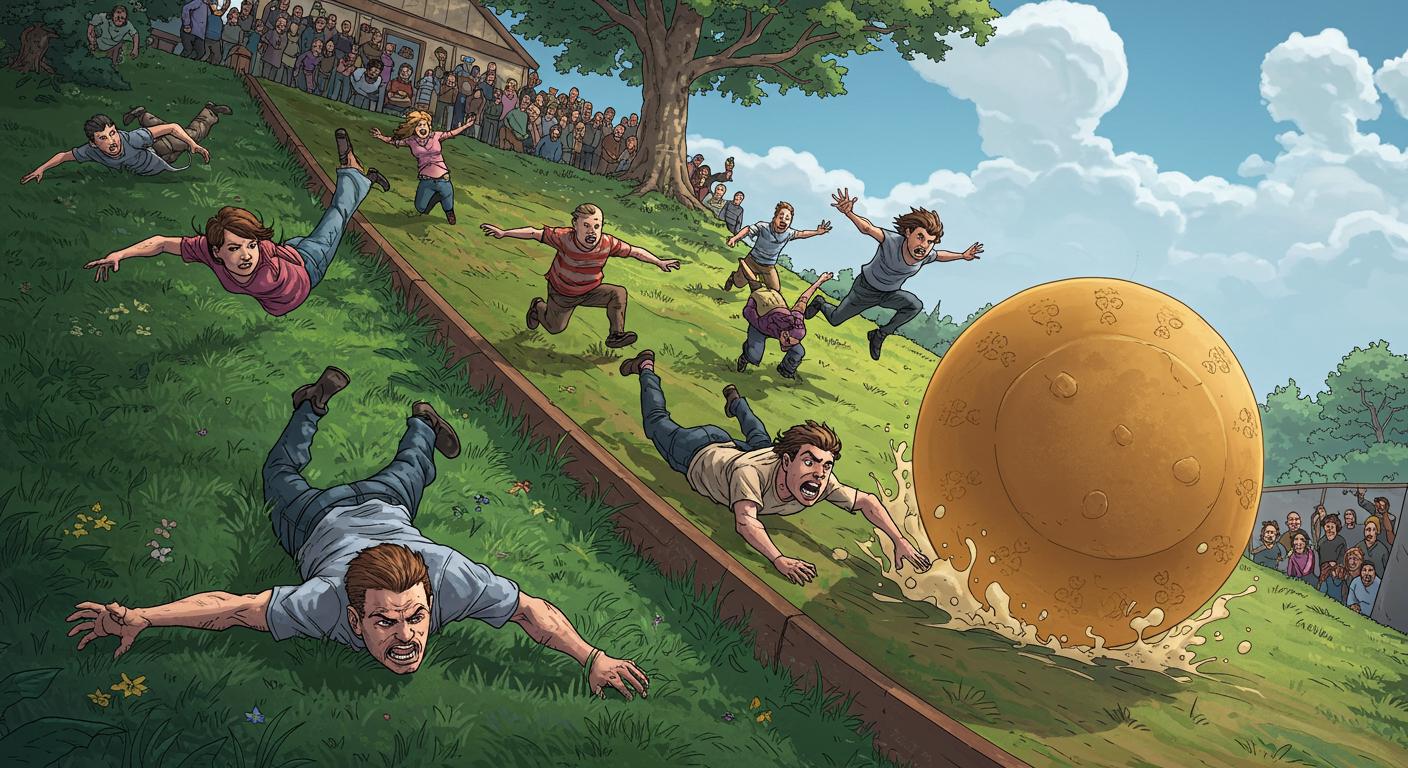
Every spring, in a ritual that gleefully snubs both common sense and light orthopedic advice, the slopes of Cooper’s Hill in Gloucestershire become home to one of the world’s more improbable competitions: cheese rolling. While most traditions evolve or gently fade, this one persists, as if propelled downhill by its own unyielding momentum—and perhaps by a crowd that has never found the idea of watching people chase runaway dairy less than hilarious. As Sky News documents, this year’s contest offered the same blend of committed competitors, dubious strategy, and the enduring promise of bruised shins.
The Art of Cheese Pursuit
Legions of adrenaline-seekers (and at least one cheese skeptic, but more on her later) assembled atop Cooper’s Hill this May Bank Holiday, each eyeing the eight-pound Double Gloucester cheese with the kind of tenacity usually reserved for, say, limited-edition Beanie Babies or a good cup of coffee at a library conference.
Participants quite literally threw themselves into the contest, sprinting, sliding, and tumbling down what the Daily Mail pegs as a 180-meter, 1:2 gradient slope—that would be ‘comically steep’ on any scale. Due to recent dry weather, Sky News highlights that the course was particularly hard and perilous this year, amplifying both speed and the likelihood of a mid-course friendship with the turf.
As for why? The prize is, as tradition dictates, nothing but a wheel of Double Gloucester—a cheese both strong and savory. No gold medals or life-changing sum here. Just cheese, and all the risk that comes bundled with it. What drives someone to pursuit of such a trophy? A search for meaning? A fondness for chaos? Possibly just because it makes a fine story to tell at dinner parties.
Notable Victories and Gravity-Defying Moments
Observers this year were treated to an international roster: Tom Kopke, a YouTuber from Munich, nabbed the men’s title for a second consecutive year. As Sky News and the Daily Mail both recount, Kopke described his approach with a certain abandon: “I shut off my brain and went for it… I risked my life for this. It’s my cheese. Back to back.” Evidently, self-preservation is a secondary impulse on Cooper’s Hill.
Meanwhile, the women’s race introduced a delightful twist—Ava Sender Logan, a London university student, clinched victory despite admitting she doesn’t actually like cheese. As she recounted to the Daily Mail, the whole experience was something of a blur: “This is my first time. I thought it was such a tradition, and I will probably feel it tomorrow. I can’t believe it… then I hit my head. I’m down, that’s what matters. I’m fine.” There’s something peculiarly British about risking one’s neck for a dairy product one is largely indifferent to, simply out of respect for “such a tradition.”
The spectacle doesn’t end with simple sprints, either. Luke Preece from Gloucester charged downhill in full Superman costume to win a men’s race, later remarking to the Daily Mail on the “absolute buzz” and the family history—his dad had participated before him.
International ambitions were also satisfied, as Byron Smith from New Zealand took the final men’s race, redeeming his second-place finish the previous year.
Would you sign up for a contest where the cheese you chase can hit speeds of up to 70 mph? The Daily Mail references a 2006 National Library of Medicine article, which noted not only the competitors’ enthusiasm but also the physics-defying trajectory of the cheese wheels themselves.
Tradition in Freefall
Of course, not everyone regards the event’s spectacular lack of risk mitigation as charming. Since 2010’s official cancellation due to health and safety fears, what unfolds on Cooper’s Hill is an unofficial affair, with local police “keeping a watchful eye” but mostly leaving the mayhem unregulated, as Sky News explains.
The Tewkesbury Borough Safety Advisory Group has consistently classified the event as unsafe, voicing concerns over everything from the inability of ambulances to reach the race site (proven problematic in 2023 when the women’s race winner was knocked out cold and only learned of her victory upon waking in the medical tent) to the annual inevitability of injuries. The Daily Mail notes that in 1993, 15 people were injured in a single year’s races, four seriously, and decades of similar incident reports haven’t dulled the excitement or turnout. What would local heritage be if it weren’t at least a little perilous?
Yet for all the warnings, the race barrelled on—pun intended—and continues to draw participants from across the globe. The event has even sparked consideration for formal acknowledgment as national heritage; the UK government, as covered in the Mail, has recently solicited public nominations for an official Inventory of Living Heritage, and cheese rolling seems well-positioned for inclusion. What better encapsulates community spirit, collective history, and an irrepressible fondness for the absurd?
An Origin Story With Loose Ends
Both outlets delve (albeit with a researcher’s caveat) into the event’s possible roots, and even after centuries, the answers remain… endearingly vague. The Daily Mail combs through archival evidence suggesting the event can be traced back to at least 1826, but it was already considered ‘longstanding’ back then. Speculation ranges from pagan rites to secure a good harvest, to practical rituals around maintaining common grazing rights. Either way, it survived (and thrived) by adapting to whatever rationale best suited the times: sometimes a fertility rite, sometimes just a chance to hurtle with abandon.
The hill itself, like the cheese, remains constant—a backdrop to a rotating cast of thrill-seekers, pranksters, and local legends. Past champions such as Izzy John and Steve Brain (with more than thirty cheese wheel victories tallied between them) were honored in this year’s memorial races, further securing a sense of legacy that, it seems, officialdom can neither endorse nor entirely suppress.
Why Do We Keep Rolling?
Each year, you might wonder: does the real draw lie in the dairy, or in the chance to become part of something gloriously unhinged yet fiercely communal? Everyone knows the risks, the medics know they’ll have work, and still the crowds assemble, rain or shine. The tradition persists not because it offers great reward, but because it offers great story—a tumble that, win or lose, ends in unforgettable memories and maybe a slab of strong cheese.
Would the event survive with a new prize? Would participants still come if the cheese were, say, a modest hunk of cheddar? Or is it the sheer history, the dust on the hill and the bruises, that lures people back each year?
Some customs are kept for comfort. Others, for the satisfying crunch of gravel and pride in a challenge met shoulder-to-ground.
So when the last wheel has rolled and the bandages are applied, maybe the true heart of Cooper’s Hill is neither cheese nor adrenaline, but the proof that, just occasionally, the best traditions are the ones that make even the most reserved among us ask, “Why not?” And then, without much further thought, hurl ourselves wholeheartedly (and perhaps a little headlong) down the nearest hill.