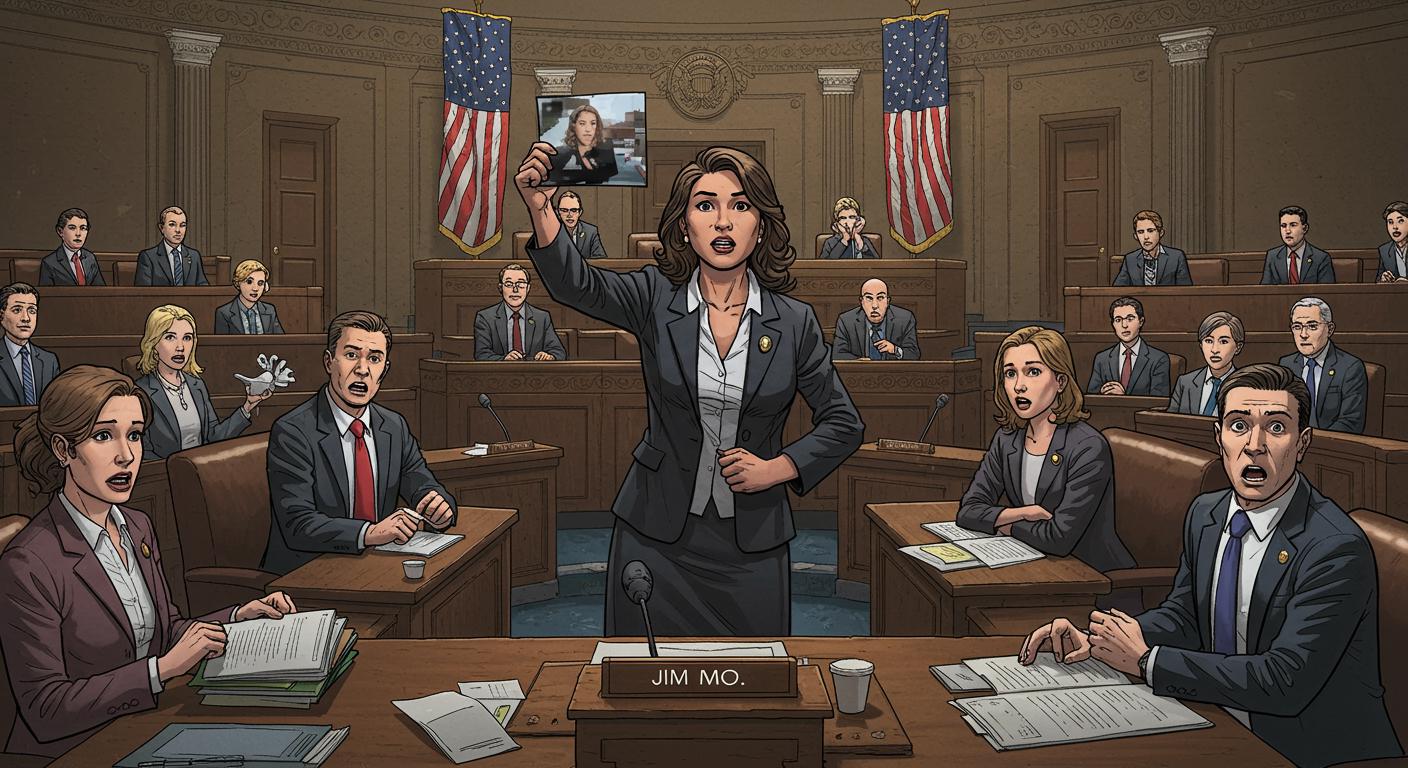
Some days, Congress offers the subdued thrum of procedural debate. Others, it hands out something a little more… unforgettable. Case in point: Representative Nancy Mace’s decision to display what she said was a nude image of herself—claimed to have been secretly recorded—right in the middle of a House Oversight subcommittee hearing. As far as congressional show-and-tell goes, this one sets a high-water mark for “unexpected.”
House Oversight Takes an Unfiltered Turn
During a session ostensibly focused on “surveillance in private spaces,” the South Carolina lawmaker projected a still image onto an easel, explaining that it was a screenshot from a video taken without her knowledge. According to Newsweek, Mace said her former fiancé, Patrick Bryant, had recorded her and other women without consent, retaining the footage for years.
The moment was both deeply personal and pointedly public. Mace stated from the dais, as reported by India Today, that she was unaware she had been filmed and did not permit it. She went so far as to indicate the part of the image allegedly showing her, remarking on the violation of her privacy.
Bryant responded in real time, releasing statements to multiple outlets characterizing the allegations as “false and outrageous.” He flatly denied any wrongdoing, framed the claims as attempts at character assassination under congressional immunity, and insisted—per statements reviewed by Newsweek—that “multiple witnesses” contradicted Mace’s account. Interestingly, the South Carolina Law Enforcement Division has confirmed to Newsweek and IJR that Bryant is under investigation, yet the scope and details remain vague. The legal repercussions, as with most things on Capitol Hill, are still pending clarification.
Privacy Rights, Illustrated
Mace’s testimony, if one can call it that, wasn’t just about her own experience. She framed her dramatic exhibit as evidence of a larger problem. Drawing on the experience, she argued that the proliferation of hidden cameras has “erased liberty in pixels”—a sentiment she voiced during the hearing and highlighted on social media. As IJR details, she linked these invasions of privacy to constitutional rights, specifically the Fourth Amendment’s “reasonable expectation of privacy.”
Pushing further, she used the opportunity to promote two pieces of proposed legislation, the Stop VOYEURS Act and the Sue VOYEURS Act, both introduced earlier this year. These bills are designed to enhance legal recourse against those who engage in surreptitious recording. In her telling, “Freedom is not a theory; it is the right to breathe, to dress and undress, to sleep without someone’s camera filming your naked body.” It’s not every day the conceptual meets the corporeal so directly on the House floor.
Rhetorical props in Congress are almost cliché—charts, photos, dramatic readings—but it’s rare for the evidence to be the lawmaker’s own body. Whether such an approach was necessary, or whether a less explicit demonstration might have sufficed, is a question one imagines lawmakers and their staffers had never seriously pondered. As India Today underscores, Mace made it clear she intended the act as a singular illustration of the invasiveness and lasting harm of nonconsensual recording.
Ongoing Allegations, Escalating Fallout
For those trying to follow the full plot: In February, Mace had already named Bryant and three other men during a House speech, labeling them as predators on a very literal posterboard and accusing them of various sex crimes. Newsweek documents how these accusations sparked a complex legal drama, with at least one of the accused filing a defamation suit, and counter-lawsuits and public denials abounding. Musgrave, one of the three other men accused, claims in court filings that he was not present for any of the alleged incidents and did not participate in unlawful filming.
Each public step seems to spawn further legal maneuvering, statements, and televised sparring. If it feels like each revelation turns up the volume, that’s probably not accidental. One can almost appreciate the symmetry: the more public the accusations, the more pointed the denials, and the greater the pressure on both legal processes and public opinion.
Public Reaction and the Boundaries of Advocacy
Responses from outside the hearing room came quickly. Observers ranged from supportive to unsettled, with some critics—such as, as documented by Newsweek, the editor-in-chief of MeidasTouch Network—questioning whether the explicit imagery was essential to make the point. The choice to bring such a visual to a congressional setting clearly invited unease among even some of Mace’s usual sympathizers.
Meanwhile, Bryant’s public rebuttal leaned heavily on the idea that such accusations should be fought in court, not via congressional immunity or televised hearings. He argued—through statements reported by multiple outlets—that if there were real evidence, Mace would bring it to authorities outside the chamber. The underlying question lingers: What is the proper place for fighting these kinds of battles? And are there limits to what should be revealed in the service of a legislative cause?
Legislation by Example
Stepping back, what remains is the dual purpose at play. Mace’s story, and unconventional evidence, were offered as support for a legislative agenda targeting digital voyeurism and stronger protections for victims of nonconsensual recording. As IJR notes, the bills she promoted are direct responses to the type of alleged exploitation she described.
Yet, there’s no denying that the method of advocacy has become part of the story. When a lawmaker seeks to legislate privacy by making a spectacle—albeit a calculated one—of her own lost privacy, it blurs boundaries between evidence, activism, and personal vulnerability. In a world accustomed to public oversharing but still uncertain about digital rights, it’s an uncomfortable juxtaposition.
Endnotes on Privacy When Nothing Is Private
What does it mean to wage a campaign for privacy by giving up another sliver of your own? Is this the price of attention in a hyper-noisy era, or the unavoidable outcome when legal remedies lag behind technology? Congress, never one to shy from spectacle, seemed—for a moment—divided between earnestness, discomfort, and unresolved questions about where the lines now run.
Most of all, the hearing prompts a lingering puzzle: In a time when the boundaries between public and private keep dissolving, is it possible to draw any line clear enough for everyone to agree on where it belongs? Or, in a twist likely to puzzle future archivists and policy students alike, does the very act of drawing that line require pulling aside the curtain just a little bit more—on national TV, no less? The exhibit may change, but the dilemma, evidently, remains.