
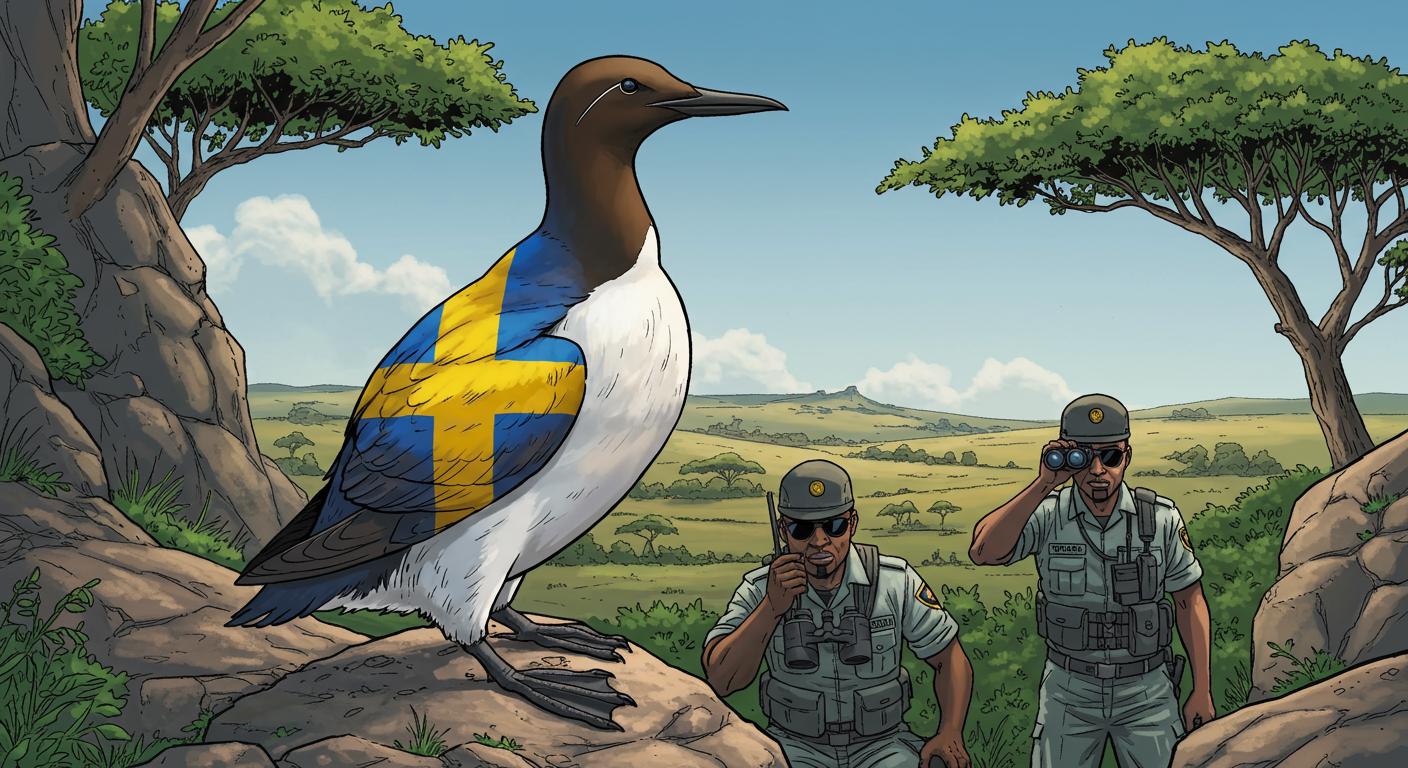
Sometimes the most peculiar diplomatic incidents don’t involve briefcases or encrypted phone calls—instead, they flap in on weary wings. Case in point: the saga of a Swedish guillemot, captured in an Ethiopian village after its winter getaway and swiftly accused of being an avian secret agent. As detailed in the Sweden Herald, this episode began as an unremarkable leg of the bird’s migratory journey but quickly took a turn into the realm of international espionage, fueled by local suspicion, a mysterious device, and a cascade of puzzled emails sent northward to Sweden.
Where Biology Meets Bureaucratic Suspicion
According to the account collected by the Sweden Herald, the guillemot—actually a Swedish merganser—was intercepted in Ethiopia while returning from its southern wintering grounds. On its back? A small transmitter meant for migration research, part of a project tracking guillemots and skuas. While such devices are routine tools for scientists, the sight of blinking hardware strapped to a foreign bird understandably set off alarm bells in a region where international tensions and distrust are not rare. The outlet notes the transmitter was mistaken for potential spying equipment, with local speculation running to Egyptian or Eritrean origins.
The commotion didn’t end with the bird’s arrival. Because ornithologist Niklas Aronsson was listed as the contact on the transmitter, the Herald records that he became the unintentional protagonist in this farce. Suddenly, his inbox was inundated by several hundred emails from villagers in Ethiopia, each demanding an explanation. Aronsson himself told TV4 News, as quoted in the Sweden Herald, that he did his best to clarify the situation to his virtual correspondents, writing back to urge them to release the bird since it needed to continue its journey north to breed. Still, despite his efforts, response from the local side remained conspicuously absent.
The Case of the Vanishing Transmission
The fate of the guillemot remains, at least for now, an open question. The Sweden Herald chronicles how, not only did the email conversation stall, but the transmitter attached to the bird ceased sending any signals—effectively leaving both researchers and curious onlookers in the dark. The same source details that the transmitter is part of a years-long migration study that has included the tagging of around 150 guillemots altogether, so the abrupt loss of contact isn’t just an isolated technical hiccup; it’s a small but telling casualty of international misunderstandings.
Could our feathered “suspect” have slipped away unscathed, or did it become entangled in official procedures no seabird could have anticipated? The available details offer no clear answer, leaving the story as unresolved as it is surreal.
Lost in Translation—Or Just Lost?
What stands out here isn’t just a seabird accidentally starring in an espionage drama—though the image itself borders on comic. It’s the collision of normal scientific practice and the wary contexts that research sometimes enter. As highlighted by the Sweden Herald, research tools and intentions that seem mundane back in Scandinavia can become cryptic and fiercely scrutinized when encountered unexpectedly in far-off settings. When even an innocent tracking device finds itself at the intersection of scientific progress and geopolitical anxiety, it’s clear that context is everything.
Given the outcome, you might wonder—do ornithological research teams preparing binational projects ever draft protocols for cross-border confusion? Could a multilingual, laminated explainer securely attached to the next transmitter help, or simply deepen suspicions? And does a researcher in Sweden, whose primary worry is usually avian migration data, ever imagine facing a flood of panicked emails from halfway across the world?
A World Both Big and Bizarre
Depicted throughout the Sweden Herald’s reporting, this episode is a gentle—if feather-ruffling—reminder that even the most carefully designed scientific efforts can flutter headlong into the unexpected. Our avian protagonist, unwittingly plunged into intrigue, is a stand-in for all the moments when a globalized world leads to wonderfully unpredictable collisions of misunderstanding and curiosity. As research continues and the tagged birds of Sweden venture into new territories, one has to ask: What other border-crossing mishaps await, and will they be resolved—or left as stories for someone’s inbox and another day’s headlines?