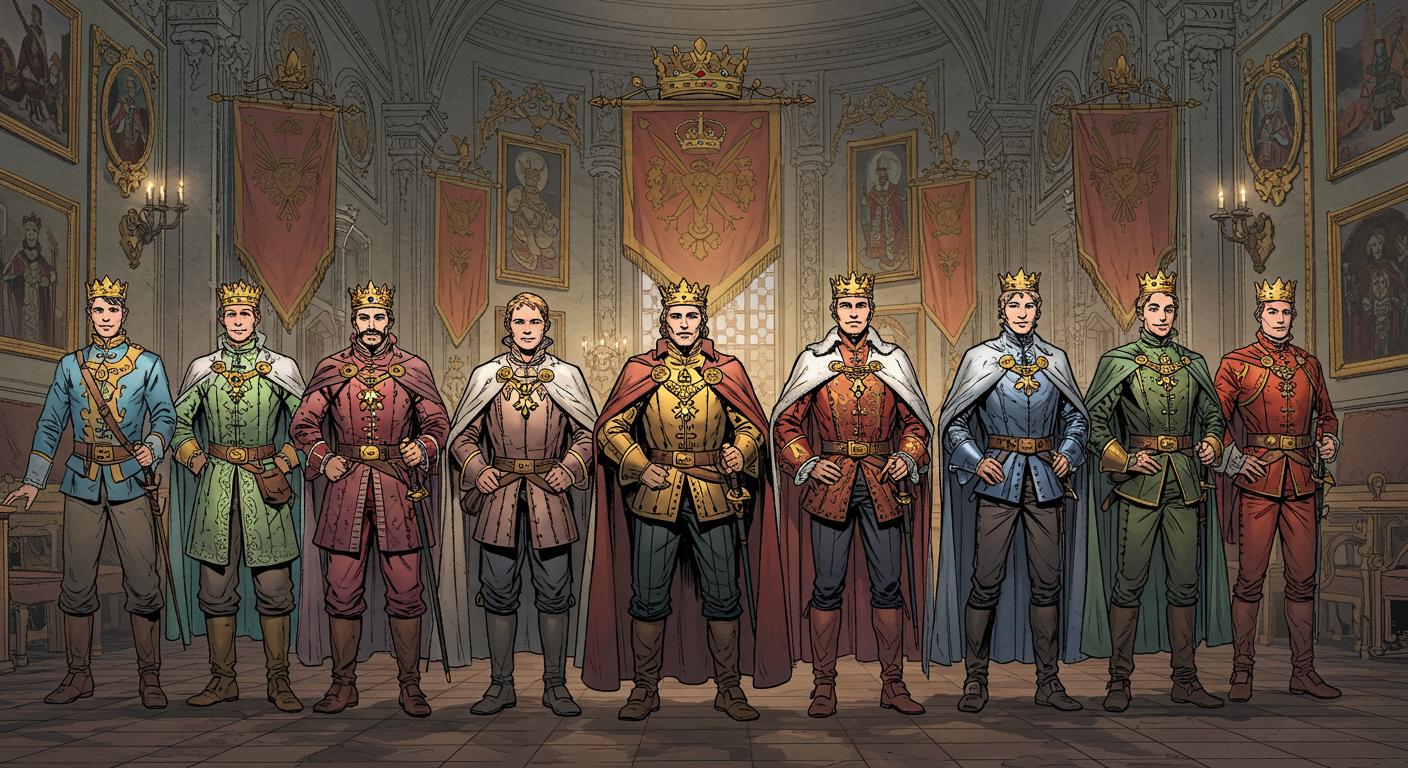
In a European landscape crowded with dynasties recycling their favorite names, the House of Reuss has quietly set the gold standard (or should that be the Heinrich standard?) for predictability. As described in La Brújula Verde, every single male Reuss, from the 13th century to the present day, has been christened Heinrich. Yes, all of them. If a Reuss boy has been born in the last 800 years, his name is Heinrich—no exceptions, no quirky middle names, nothing that might sow confusion at the family reunion.
Rules of Engagement: The Heinrich Protocol
The roots of this mass-monomial commitment stretch back to around the year 1200. According to the publication, legend holds that the tradition began as a tribute to Emperor Heinrich VI Hohenstaufen, acknowledged for apparently handing over generous tracts of land to the family. While emperors drift into the mists of history, the Reuss devotion to Heinrichs endured—surviving everything from princely squabbles to post-WWI reorganization.
There was, as the outlet notes, a tactical split in the 13th century. The family branched into Elder and Younger Lines. The Elder Line managed Upper and Lower Greiz, while the Younger Line took command in the larger Reuss-Gera. Both lines enjoyed reigning status until 1919, when, as noted in La Brújula Verde’s review of the princely saga, Thuringia folded their territories into the modern German state. After that, the House continued—title-rich but throne-poor—as a sovereign non-reigning family, comparable to Hesse, Hanover, and the better-known Romanovs.
Heinrichs by the Numbers: The Century Shuffle
Now, if every prince is named Heinrich, how do you keep track during roll call? By numbers—a system that, at first, sounds logical but rapidly descends into an excel spreadsheet with light existential overtones. The Elder Line, according to information provided by the source, starts numbering with Heinrich I and motors on up to Heinrich C (100, for those not brushing up their Roman numerals over breakfast). Then—reset! Back to Heinrich I.
The Younger Line, meanwhile, takes a slightly less aggressive approach. Instead of tallying across centuries, they restart the sequence at the start of each new one. So the first male child of the 20th century? Heinrich I. The second? Heinrich II. Reach the end of the century, and it’s back to one. This sidesteps the whole Heinrich CCXXVI problem while introducing its own brand of confusion.
Interestingly, this numbering creates moments where the head of the family might be Heinrich XIV, but his predecessor was Heinrich IV, and a Heinrich XLV lurks in the not-so-distant past. The outlet details that these numerals reflect the order of male births within the century, not rank or inheritance. Hence, Heinrich XIV was the fourteenth male Reuss born in the 20th century (in 1955), while his eldest son, born just before the millennium, is Heinrich XXIX (the twenty-ninth of that century’s club). The family’s next generation begins anew: Heinrich V, born in 2012, is simply the fifth male Reuss to grace the family tree since 2001.
Branding With Relentless Consistency
This means that, for the Reuss, deliberating baby names is mercifully brief. No debates over tradition versus innovation—there is only Heinrich. Gift shopping, on the other hand, must be a study in either resigned minimalism or strategic monogramming. What could possibly say “personal touch” in a house where every sock, tie, and towel could belong to five other relatives, past or future?
La Brújula Verde points out that behind this apparent simplicity lies a formidable genealogical labyrinth. Tracing lineage here isn’t for beginners. The repeated numbering, periodic resets, and habit of producing a robust supply of Heinrichs result in a registry that would make even the most intrepid family historian reach for the headache tablets. Yet, as also noted in the outlet’s commentary on the family’s enduring status, the tradition has persisted even after its rulers became noble outliers—suggesting a certain loyalty to the ritual for its own sake, or at least for the pleasing order of it all.
Footnote in Royal Oddities
There’s a philosophical edge to this family quirk: as principalities vanish and thrones gather dust, the assurance of yet another Heinrich being introduced at every christening offers a strange comfort. A name might not hold a country, but it can certainly hold a story—especially when the story has been looping for eight centuries with no sign of fatigue. And who’s to say that “Heinrich the nth” won’t someday take the tradition to new numeric highs, just as their ancestors did (and redid), century after century?
It raises its own peculiar questions. Is this relentless recycling of Heinrichs the ultimate act of royal humility—sharing the glory evenly for generations? Or just the world’s most complicated way to save time filling out family birthday cards? There’s something quietly delightful about not having to guess who Heinrich is at the party, even if, paradoxically, it means you never really know.