
If there’s a perfectly round pebble on the riverside of official correspondence, it’s the assumption that the US Secretary of Education has at least a passing acquaintance with basic grammar. For those reading the headlines this week, that pebble just got kicked into the pond.
A Federal Missive, Red Pen Required
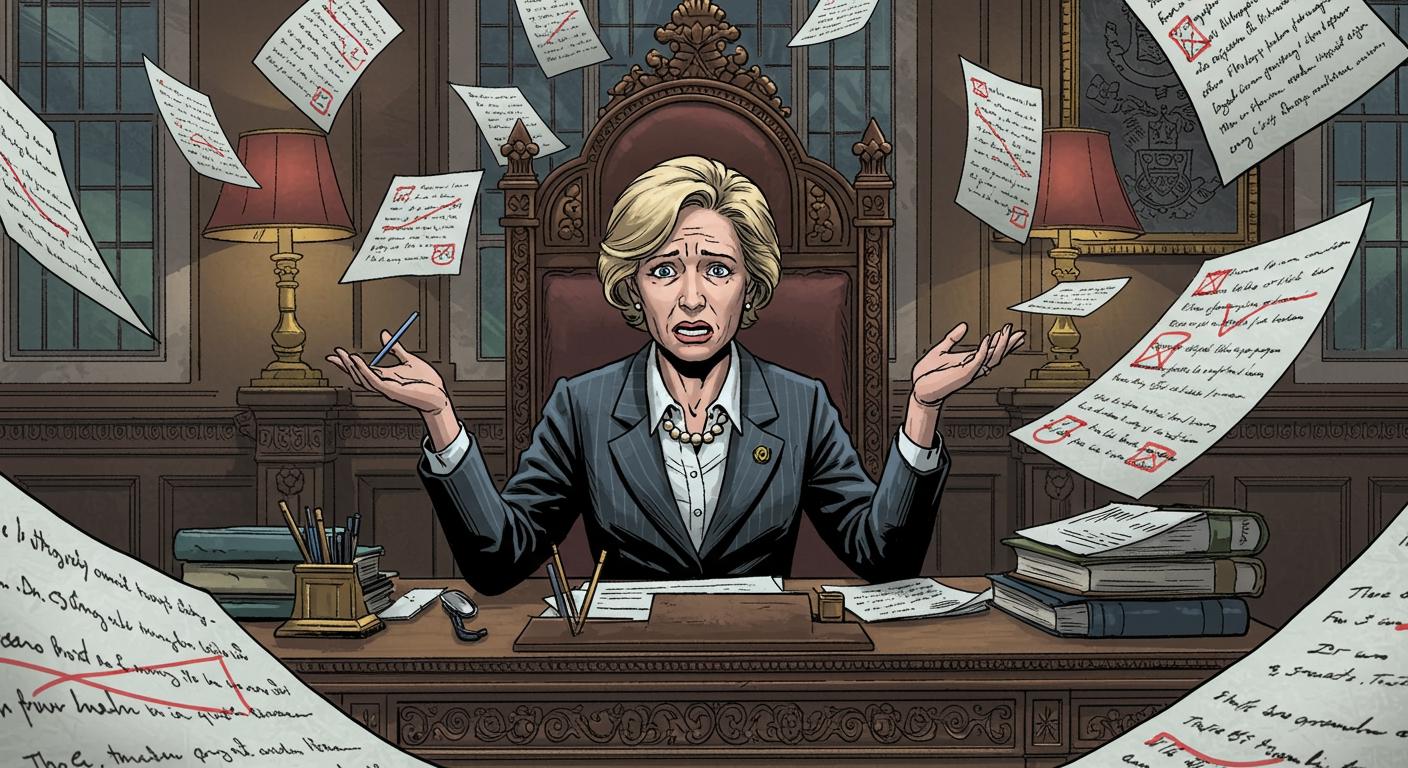
The scene unfolded with the delivery of a formal letter from Secretary of Education Linda McMahon to Harvard’s president, Dr. Alan Garber—except it wasn’t the accusations of “harbouring foreign students who ‘engage in violent behaviour’” and claims of “no semblance of academic rigour” that dominated the response. Instead, the prose itself took the spotlight. As NDTV documents, what was meant as a stern warning—informing Harvard its eligibility for federal grants was revoked—was rapidly annotated by internet critics wielding digital red pens. Social media users circled spelling errors, awkward turns of phrase, and mysterious capitalisation choices.
Within hours, the letter was trending for all the wrong reasons: “A chaotic mess of bad grammar and illiterate rambling,” one commenter called it. Another, quoted by both NDTV and The Economic Times, bluntly asked, “Did a high school kid write this?” It’s not often that a federal communication is met with parody letters along the lines of:
“Dear Harvard,
You dumb, me smart.
Me no give you money any more.
Unless you give me more money.
Me very smart.”
That particular parody, as NDTV details, became one of many memes that seemed to ask—seriously or not—how someone at the helm of American education could produce such a letter.
“Did You Use A1 to Write This?”
The online attention was more than a fleeting joke. As The Economic Times reports, McMahon’s thousand-word diatribe criticized Harvard’s handling of antisemitism, admissions, staffing—and, by implication, basic mathematics. Eleven words into her talking points, however, people stopped reading for policy and started wondering about sentence structure. Reporter Roger Sollenberger, for instance, ribbed McMahon for confusing “AI” (artificial intelligence) with “A1,” the steak sauce—a detail also recounted by The Express.
The Economic Times groups together several withering assessments, including The Independent’s Andrew Feinberg describing the letter’s author as “barely literate,” and podcaster Fred Wellman’s rhetorical, “You poked the bear and you’re too stupid to even know it.” Harvard Kennedy School professor Maya Sen weighed in on the odd justification for government funding bans, noting the Secretary seemed to be penalizing the university, at least “in part because a Democrat sits on its board”—an observation also included by The Express.
Annotated and Returned to Sender
Adding another layer of irony, The Express notes that McMahon’s letter was “received back with spelling errors corrected in red pen”—likely the handiwork of a Harvard student. The amended document then circulated online, a sort of involuntary workshop in remedial business writing: misplaced dashes, run-on sentences, and the aforementioned errant capitalisations all got a thorough (if public) markup.
The Express also highlights McMahon’s fixation on Harvard’s supposed standards. She queried: “Why is it, we ask, that Harvard has to teach simple and basic mathematics, when it is supposedly so hard to get into this ‘acclaimed university’? Who is getting in under such a low standard when others, with fabulous grades and a great understanding of the highest levels of mathematics, are being rejected?” The overall effect, as was reflected in social media, was less about academic standards and more about basic communicative ones.
Policy Versus Prose
Amid the syntactic storm, the substance of the letter risked being overlooked. NDTV points out the policy stakes were high: McMahon announced a freeze on federal grants, part of a larger battle between the Trump administration and elite universities over student activism and government oversight. Harvard’s official response, as cited in NDTV, stressed that cutting these funds would harm “life-saving research and innovation,” and called the threat “unprecedented and improper.”
One wonders, though, if anyone involved expected the main public discourse to revolve around commas and grammar instead of campus protests or research funding. The Express includes yet another online jest: “Whoever wrote this is barely literate.” When the nation’s top education official’s letter receives more comments about proofreading than policy, is any message getting through?
Lessons in Irony
The scramble to annotate a federal missive in real time is perhaps peak internet: an era where holding Harvard to account is sidetracked by the comic relief of watching an education secretary stumble over homophones and punctuation. Watching policy get upstaged by participles is, if nothing else, a testament to the power of the written word—whether wielded skillfully or not.
Is the country better off when typos eclipse ideology? Or does the form, in these rare moments, tell us as much as the content? It feels like a teaching moment—for someone, at least. Maybe the next time a cabinet official drafts a letter, they’ll remember: the red pen cometh for us all, but some a little more than others.