Every now and then, someone from the tech world tosses a conversational grenade and the internet reacts accordingly. This week? Luis von Ahn, founder and CEO of Duolingo, lobbed his latest on the No Priors podcast: “Ultimately, I’m not sure that there’s anything computers can’t really teach you.” In his eyes, schools as we know them may as well dust off their resumes for the childcare industry, because when it comes to education, AI is the new head of the class.
Fortune reports that von Ahn doesn’t think schools will vanish into obsolescence—just that their chief function might dwindle to one of supervision, with education itself shifting into the digital domain: “You still need childcare.” So here we are: the classroom as daycare, with nary a chalkboard in sight unless it has a chatbot attached.
When the Owl Outpaces the Homeroom
Duolingo’s ongoing AI push reads like a tech company’s fever dream. AOL documents that, back in 2024, Duolingo temporarily replaced its CEO with an AI avatar for an earnings call and, even more dramatically, announced last month it would permanently replace its contract workers with AI. With a community of 116 million monthly users and having run some 16,000 A/B tests, the company claims a uniquely data-driven edge. According to von Ahn, this wealth of learning data allows Duolingo to predict how well a student will do on a test before they even take it. AOL also notes that user engagement is carefully engineered: reminders are sent when a person is most likely to respond, while exercises are crafted to hit the sweet spot of just-difficult-enough.
Of course, the allure of endless quizzes and streaks doesn’t necessarily scale across all subjects. As von Ahn clarified on the podcast (and as highlighted by NDTV), disciplines like history may still require “well-produced videos,” a medium he says current AI doesn’t quite handle with finesse. Nonetheless, the driving force behind his AI optimism is scale: a human teacher managing 30 students can only offer so much individualized instruction. A digital tutor, by contrast, can track and adapt to each student’s needs in real time, fine-tuning lessons by the minute. “A computer can actually … have very precise knowledge about what you, what this one student is good at and bad at,” von Ahn remarked, according to AOL.
Meet Your New Teacher: Please Update Your Terms of Service
There’s something equal parts efficient and uncanny about the notion of AI delivering bespoke learning to students, while schools pivot mainly to crowd control. As described in AOL, some private institutions are already experimenting with this model. Alpha School, for instance, is a small chain where students learn for just two hours daily with AI guidance, while adults—called “guides” rather than teachers—focus on motivational and emotional support instead of delivering content. With annual tuition listed at $40,000 to $65,000, the promise appears to be that the human touch is now a premium add-on.
Meanwhile, NDTV outlines how Duolingo’s “AI-first” philosophy extends well beyond teaching and into other operational corners, like performance reviews and contractor management. In a company memo quoted by the outlet, von Ahn explained that headcount growth will only be justified where automation can’t be pushed further—a sentiment that perhaps doesn’t exactly warm the heart of anyone with a payroll number.
The Irony of AI’s “Empathy”
On paper, the appeal of individualized tutoring for every student sounds nearly utopian: an algorithm that recognizes struggling moments and offers help precisely when needed, as noted by Fortune. But is education really something that can—or should—be optimized and automated to this degree? If the future of schooling is adults supervising playtime in between algorithm-curated lessons, is the human experience being cleverly enhanced, or gently erased?
As discussed in AOL’s report, change won’t be instant. Von Ahn expects educational shifts to be gradual, noting that “it’s like government—it’s just slow.” Still, the idea of schools primarily serving as safe holding facilities—because AI can “know very precisely what you’re good at and bad at,” as NDTV puts it—quietly reframes centuries of tradition.
Is This the Future or an Open Beta?
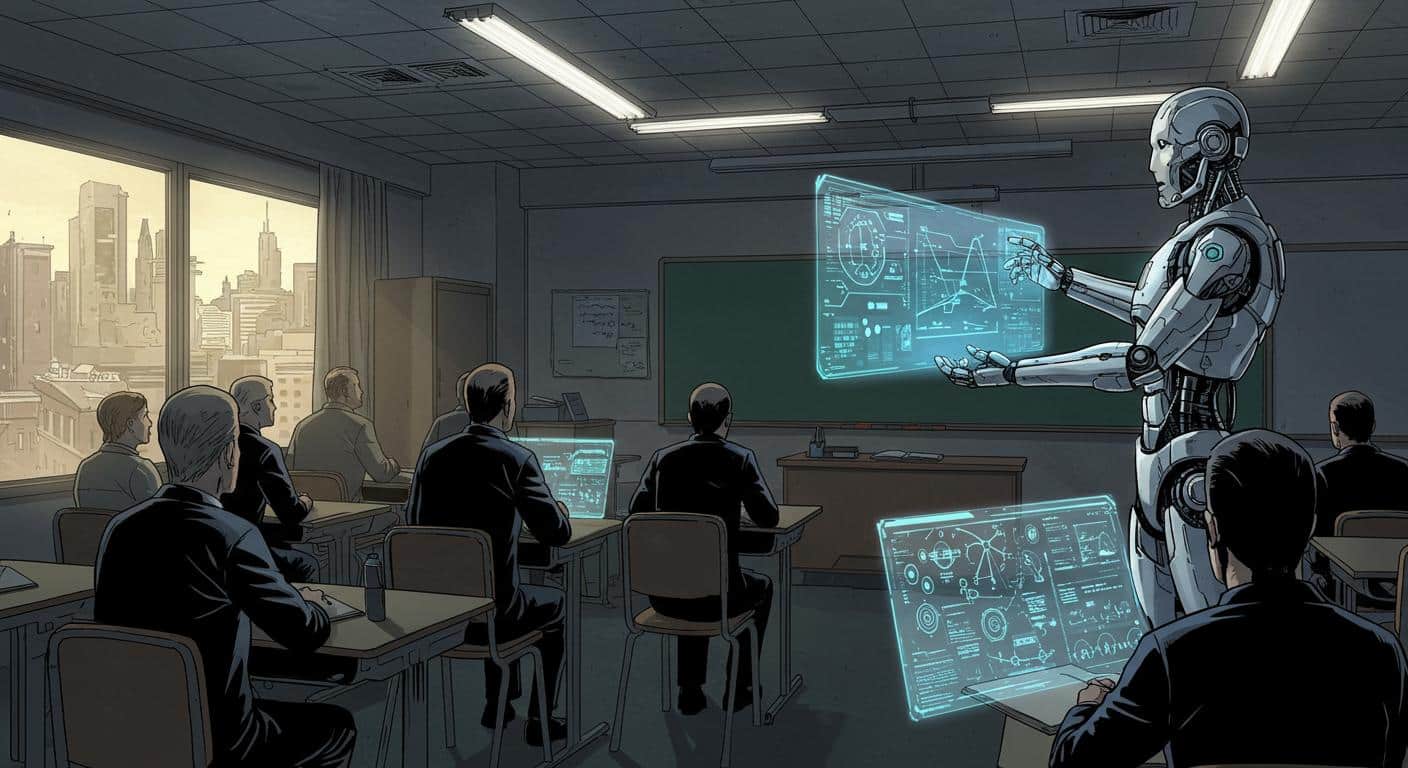
The image of a classroom transformed into a quiet, supervised waiting room for AI lessons is a strange one. Watching the CEO of a major edtech company suggest that schools are, at their core, glorified day camps, raises the question: is this truly the direction we want to take learning?
Maybe efficiency is king, and maybe there’s a genuine thrill in seeing a personalized lesson pop onto your screen at the exact moment your motivation dips. Still, there’s an odd sense of absence if the only chaos left in classrooms is the lineup for recess. Is the soul of education as quantifiable as Duolingo’s push notification streaks? Or are we missing something obvious, like the collective experience that happens every time someone drops their lunch tray mid-cafeteria? If the school of the future is just a holding pen while a chatbot leads the lesson, that’s a plot twist few of us saw coming. Then again, as anyone who’s survived a group project can attest, sometimes letting the machines run the class doesn’t sound all that bad.