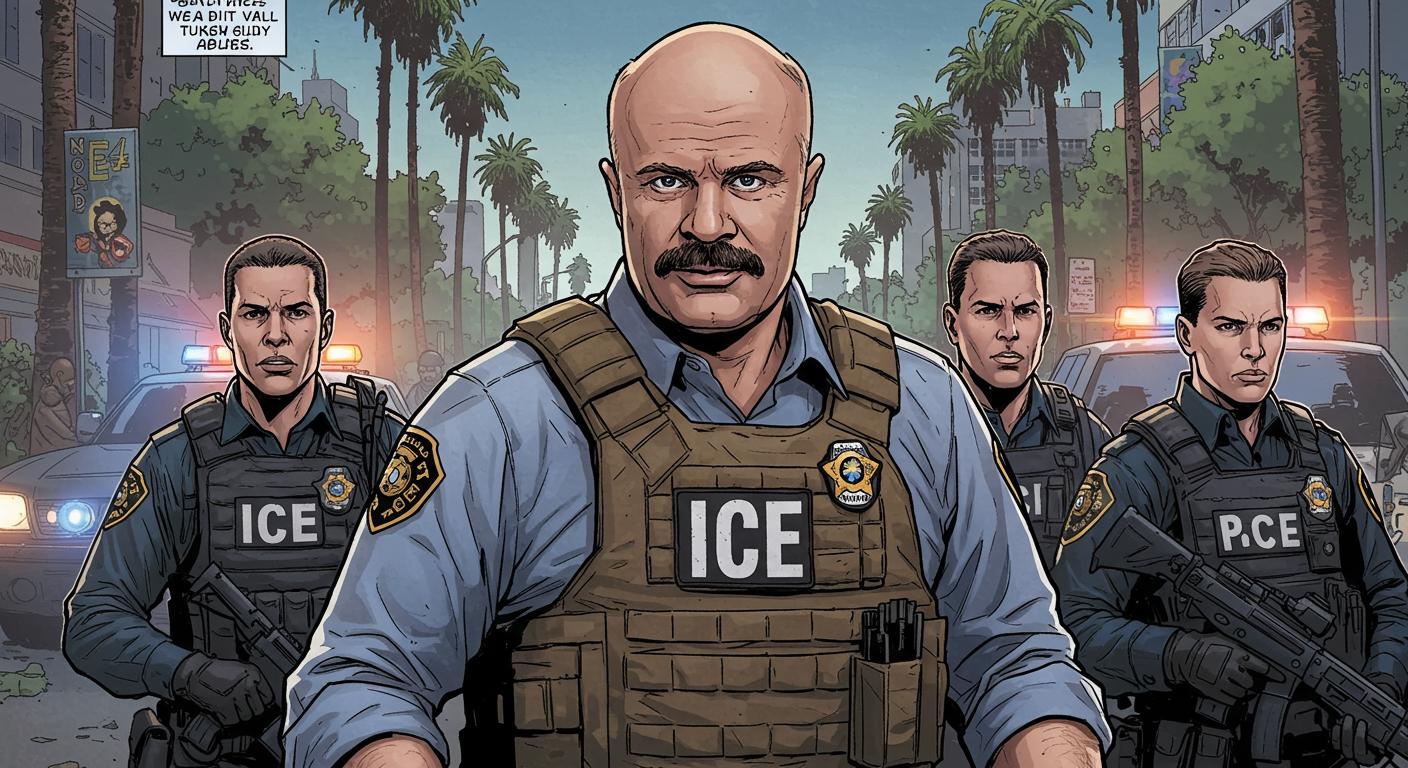
If you thought the intersection of daytime talk shows and federal law enforcement was the stuff of late-night sketches, recent events might have you double-checking the TV schedule. According to CNN’s reporting, Phil McGraw—better known as Dr. Phil—stepped away from his studio domain to get a front-row seat at Los Angeles’s latest round of immigration enforcement activity. With his camera crew in tow, Dr. Phil was present at the Homeland Security Investigations field office, observing federal agents as they prepped for a highly publicized raid.
Dr. Phil, Law Enforcement Spectator
Described both by CNN and The Guardian, Dr. Phil’s involvement was not quite a boots-on-the-ground SWAT team cameo, but close enough to raise eyebrows. MeritTV, Dr. Phil’s conservative channel, stated that he was present “to get a first-hand look at targeted operations,” but clarified he wasn’t embedded during the L.A. raids themselves. As a spokesperson explained to CNN, this was to avoid escalating already tense circumstances, so McGraw remained at the field office and conducted “exclusive” interviews with Trump’s border czar Tom Homan before and after the operation.
Both outlets note that while Dr. Phil’s L.A. experience might sound unprecedented, it’s actually part of a developing pattern. Back in January, as The Guardian details, McGraw participated in a more immersive ride-along during ICE raids in Chicago, reportedly even speaking with detainees, blurring the usual line between observer and participant. This isn’t quite Oprah’s Book Club material, but it does mark Dr. Phil’s second high-profile foray into federal enforcement circles in as many states this year.
Protests, Politics, and a Reality TV Feel
The unusual presence of a talk show host at an ICE staging ground wasn’t the only spectacle last weekend. CNN reports the Friday raids in Los Angeles resulted in at least 45 detentions and days of impassioned, sometimes chaotic, street protests—including confrontations between police and demonstrators on downtown freeways. California’s governor and LA’s mayor spoke out publicly in condemnation of the operation, adding their voices to a mounting chorus of critics, as covered in The Guardian’s summary of civic responses.
If the event sounded choreographed, that’s no coincidence. As CNN puts it, McGraw’s on-site reporting “reinforces the made-for-TV nature of Trump’s immigration crackdown.” Federal officials, including Homan and Homeland Security Secretary Kristi Noem, have made regular appearances on Trump-aligned media channels, with ICE operations receiving extensive coverage and commentary across both traditional and social media platforms. Trump himself, posting to Truth Social, described Los Angeles as “invaded and occupied,” promising forceful federal action—language several local residents quickly criticized as exaggerated, CNN notes.
Adding to the surreal, Dr. Phil’s recent trajectory has seen him weighing in on a series of hot-button political topics. The Guardian points out his vocal support for Trump in the 2024 election and appearances alongside figures like New York Mayor Eric Adams at public events. His self-declared “duty” to support various political causes—from immigration enforcement to international relations—suggests his career has taken a sharp turn from skeptical on-air counseling to something closer to political theater.
When News, Entertainment, and Lived Lives Collide
There’s something oddly compelling about watching pop culture repeatedly intersect with the machinery of government. CNN emphasizes how the Trump administration has sought to maximize TV and online visibility in its enforcement efforts, while The Guardian raises questions about the blending of spectacle and policy, especially when the stakes are measured in arrested lives and city-wide unrest.
For those who keep track of unusual patterns—media personalities drifting ever deeper into the realms of governance and enforcement—Dr. Phil’s latest cameo feels less like an isolated quirk and more like another chapter in the ongoing reality-show-ification of public policy. Is this just the logical endpoint of celebrity activism, or have we collectively decided that every major event needs its own face from syndicated TV? One wonders if, years from now, we’ll look back and marvel at just how blurred the boundaries between news, entertainment, and actual people’s livelihoods became.
Sometimes, the only honest reaction is a quiet “huh”—and the quiet hope that not every federal operation comes with a celebrity companion. Are we witnessing a new norm, or just another spike in America’s capacity for the bizarre?