
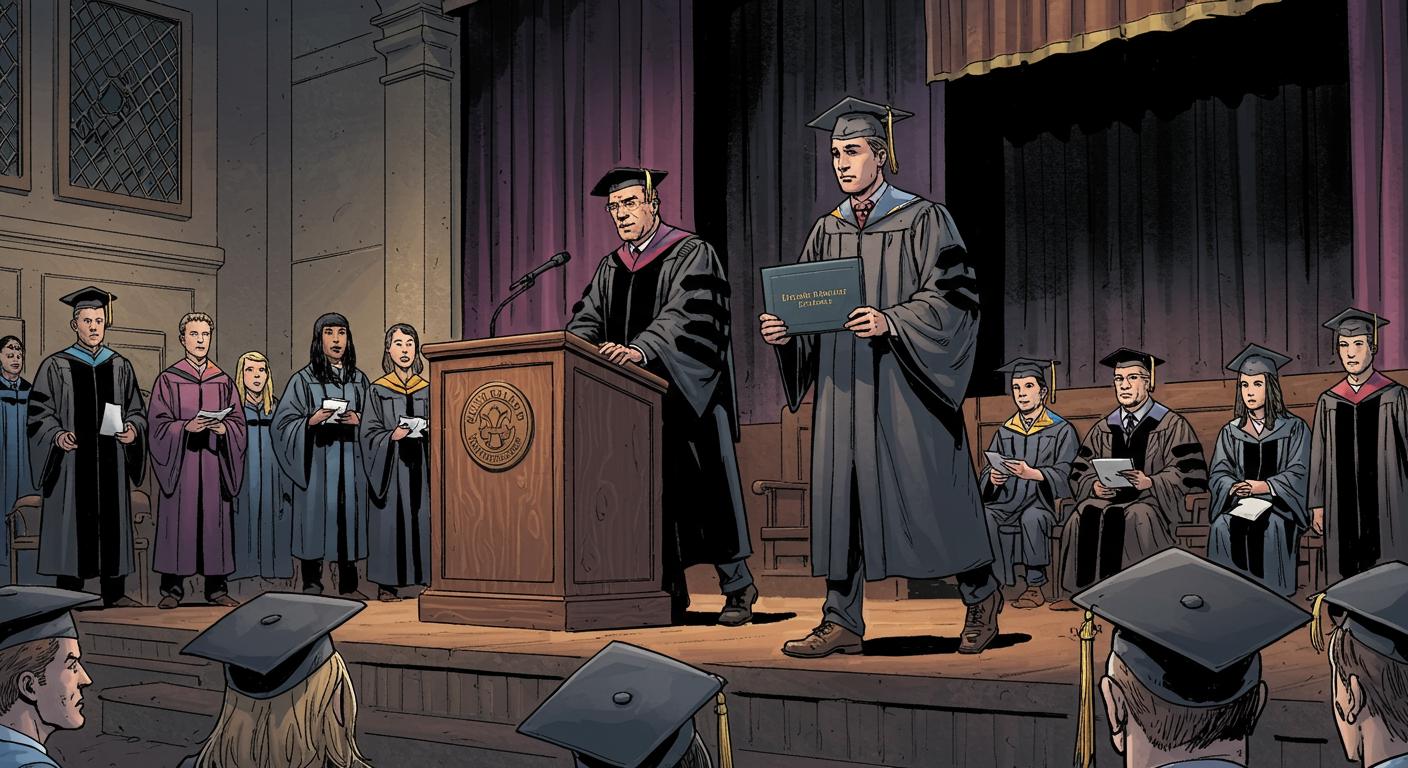
Unpredictable things can happen during graduation season—rain-soaked mortarboards, impromptu dance numbers, the usual roster of crowd-pleasing surprises. Smith College’s most recent commencement, as reported by MassLive, added an item to that list: a commencement talk that was itself the subject of news, not just fond memories.
What Actually Happened
According to details shared in an email from Smith College President Sarah Willie-LeBreton and cited by MassLive, musician and commencement speaker Evelyn Harris delivered a speech that “borrowed much of her speech to graduates and their families from the commencement speeches of others without the attribution typical of and central to the ideals of academic integrity.” The college indicated that following the ceremony and subsequent discussions, Harris acknowledged the issue and opted to relinquish her honorary degree.
A college spokesperson, in statements described by MassLive, pointed to Smith’s Academic Honor Code, which centers on careful and transparent credit for all sources of information—a standard that the college regards as non-negotiable. The spokesperson’s summary boiled down to a straightforward directive: cite your influences, even when you’re standing at the microphone in front of a sea of graduation gowns.
Evelyn Harris, known for her work as a vocal teacher, longtime member of the acclaimed Sweet Honey in the Rock, and as a global performer, was one of four honorary degree recipients. The others recognized at the ceremony included Danielle Allen—a Harvard professor—along with Admiral Rachel Levine and Preeti Simran Sethi, each with impressive résumés. No issues regarding plagiarism were referenced in MassLive’s account about these other honorees.
Handling the Fallout
President Willie-LeBreton, in an email that MassLive reviewed, acknowledged both the regrettable nature of the incident and Harris’s willingness to be direct and, ultimately, to return the honorary degree. The message emphasized gratitude for both the reporting of the issue and Harris’s decision to address it promptly—a response notable for its blend of candor and institutional formality.
This isn’t the sort of drawn-out saga one might expect from an academic controversy; based on MassLive’s coverage, there was no mention of lengthy investigations or public back-and-forth. Instead, the exchange appears to have played out over email and private conversation, before Harris’s honorary status quietly unraveled.
Academic Integrity, Live and Unplugged
The episode, as outlined by MassLive, opens up a set of classic questions for academic life: Does it matter if a speech—no matter how heartfelt—uses borrowed words? Does acknowledgment, or lack thereof, weigh more than emotional delivery? Smith College’s response leaves little doubt about its answer, reinforcing that intellectual credit is a nonnegotiable currency, honorary occasion or not.
There’s also an irony here: a musician with decades spent creating and performing, someone whose entire career rests on the creative blending of influences, found at odds with the very academic values being celebrated. Is it a cautionary tale about context—what might pass off-stage as inspiration requires footnotes at the commencement podium? Or perhaps it’s simply a reminder that even celebrated contributors are held to the same community standards, no matter how impressive the backstory.
Reflections in the Library Light
The incident, as described in the MassLive report, resolved with relatively little spectacle: no public denials or prolonged disputes, just an email, a degree returned, and a subtle sigh heard across the campus. Some might find the speed and simplicity of the outcome refreshing, especially given the labyrinthine handling these things sometimes attract.
So, what to make of it? Can the line between inspiration and imitation ever be as clear as the Honor Code would hope? And in an age of retweets, remixes, and mash-ups, is borrowing always a breach, or just part of creative tradition—provided, of course, there’s a nod in the right direction? For all its low-key drama, the Smith College commencement leaves these questions echoing down the marble halls, for the next class (and speaker) to consider.