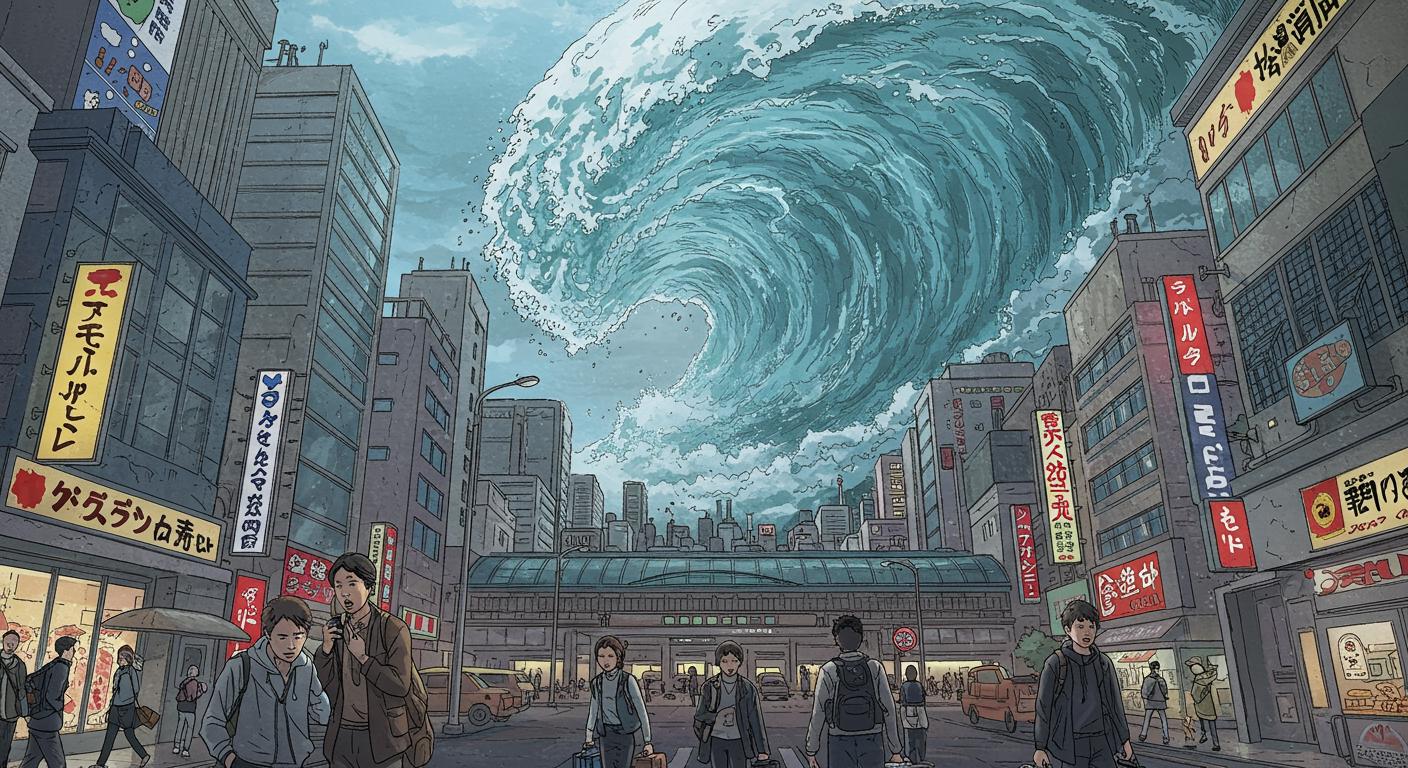
Japan, a nation well-versed in the uneasy realities of tectonic living, is currently facing tremors of a more peculiar kind—one measured not by seismographs, but by social media hashtags and the humble manga paperback.
Prophetic Pages and Panicked Plans
Recent coverage from CNN reveals the unlikely source of Japan’s latest tourism anxiety: Ryo Tatsuki’s manga, “The Future I Saw.” First published in 1999, the comic gained notoriety after it appeared to “predict” the 2011 Tohoku earthquake, with a storyline referencing a “massive disaster in March 2011.” Whether that’s psychic insight or a cosmic coincidence, it cemented Tatsuki’s reputation among fans in Japan, China, and across East Asia.
In her updated “complete” edition from 2021, Tatsuki goes on to sketch a new disaster: on July 5, 2025, a seabed fissure between Japan and the Philippines, followed by waves dwarfing even those of 2011. According to her publisher, the manga has found nearly a million eager readers, with many convinced Tatsuki’s dreams really do peer into the future. Tribune Online details how enthusiasts credit her with foreseeing events as varied (and vague) as Princess Diana’s death, Freddie Mercury’s passing, and the onset of the Covid-19 pandemic, though skeptics remain unimpressed by what they see as conveniently broad predictions.
What’s truly fueled this latest bout of collective unease isn’t only manga-inspired prophecy. Both CNN and Tribune Online document a supporting cast of self-styled psychics and feng shui experts fanning anxieties further. Prominent among them, Hong Kong’s “Master Seven” has publicly advised avoiding Japan starting in April, while a Japanese psychic’s failed April 26 Tokyo Bay earthquake prediction managed to trend—after the fact—on Chinese social media. It’s a remarkable modern twist: mass travel decisions driven by a blend of pop culture, old-fashioned superstition, and digital virality.
Earthquakes, Experts, and Echo Chambers
Seismologists find themselves thrust, once again, into the role of party-pooper. Both outlets underscore that earthquake timing remains as scientifically unpredictable as ever, regardless of what’s painted in the margins of a comic. In response to mounting unrest, Japan’s Cabinet Office recently used X to reiterate that no technology can currently forecast these events with certainty. Even Tatsuki herself, when asked by Japan’s Mainichi Shimbun, encouraged fans to “act appropriately based on expert opinions” and cautioned against being “overly swayed” by her illustrated dreams—a remarkably level-headed stance in a landscape where alarm sells better than advice.
Yoshihiro Murai, governor of Miyagi prefecture—no stranger to disaster after 2011—voiced concern over rumor-fueled disruption, arguing that the spread of “highly unscientific” stories on social media is casting a real shadow over Japan’s tourism fortunes.
For travel planners, the effect has been palpable. CN Yuen of Hong Kong agency WWPKG noted, in Tribune Online’s report, that bookings dipped by 50% during the Easter holiday, with clients from Hong Kong and mainland China expressing a desire to “hold off” until the waves of worry recede. As Yuen puts it, this unease is starting to feel “ingrained,” extending beyond China and Hong Kong to ripple through Thailand and Vietnam as well.
Cancelled Tickets or Crowded Streets? The Numbers vs. the Narrative
While firsthand accounts suggest an uptick in hesitancy—Samantha Tang, a Hong Kong yoga teacher who usually visits Japan annually, told CNN she canceled her Wakayama vacation because “everyone says so much about an earthquake coming”—statistics tell a more complicated story. Another frequent traveler, Oscar Chu, admitted to Tribune Online his bigger concern wasn’t the earth moving but the prospect of travel headaches should it happen: “It’s best to avoid it. It’s going to be really troublesome if an earthquake indeed happens.”
And yet, signs point to a country busier than ever. According to data highlighted by both CNN and Tribune Online, Japan hosted a staggering 10.5 million visitors in the first three months of 2025—a record. Chinese travelers jumped 78% from last year, and Hong Kong arrivals rose nearly 4%. March alone brought 343,000 Americans, alongside tens of thousands of Canadians and Australians, eager to experience the archipelago’s culture, cuisine, and, apparently, its ongoing history of dodging fictional prophecy.
Vic Shing of Hong Kong stands as an emblem for the unconcerned camp, noting in both outlets that he remains undeterred despite the “prophecy.” “Earthquake predictions have never been accurate,” he observes, and even if disaster were lurking, Japan’s long record of effective disaster response is enough to put his mind—and itinerary—at ease.
The Strange Gravity of a Good Story
All told, what’s happening here seems less a migration away from Japan and more an illustration of the mysterious power stories wield. As Tribune Online notes, the so-called “prophecy effect” is a bit of a black box: difficult to quantify, but undeniably present in behavior shifts, travel agency chatter, and the latest flurry of nervous posts online.
So: Is a comic book really responsible for emptying out bullet trains and sushi bars, or are we all just a little susceptible to the thrill of fate, coincidence, and the suggestion that tomorrow—this time—might truly be different? That a manga, some psychics, and a handful of viral videos could sway millions, even in an era that prizes science over superstition, says plenty about what genuinely moves us. Maybe the rarest phenomenon in this whole episode isn’t an earthquake at all, but just how easily the line blurs between fact, fear, and fascination.
Strange, isn’t it, how a prophecy from a cartoonist’s dream can shake up travel plans for an entire region? Let’s call it the world’s quietest stampede—one part imagination, one part uncertainty, and perhaps, the smallest part actual plate tectonics.