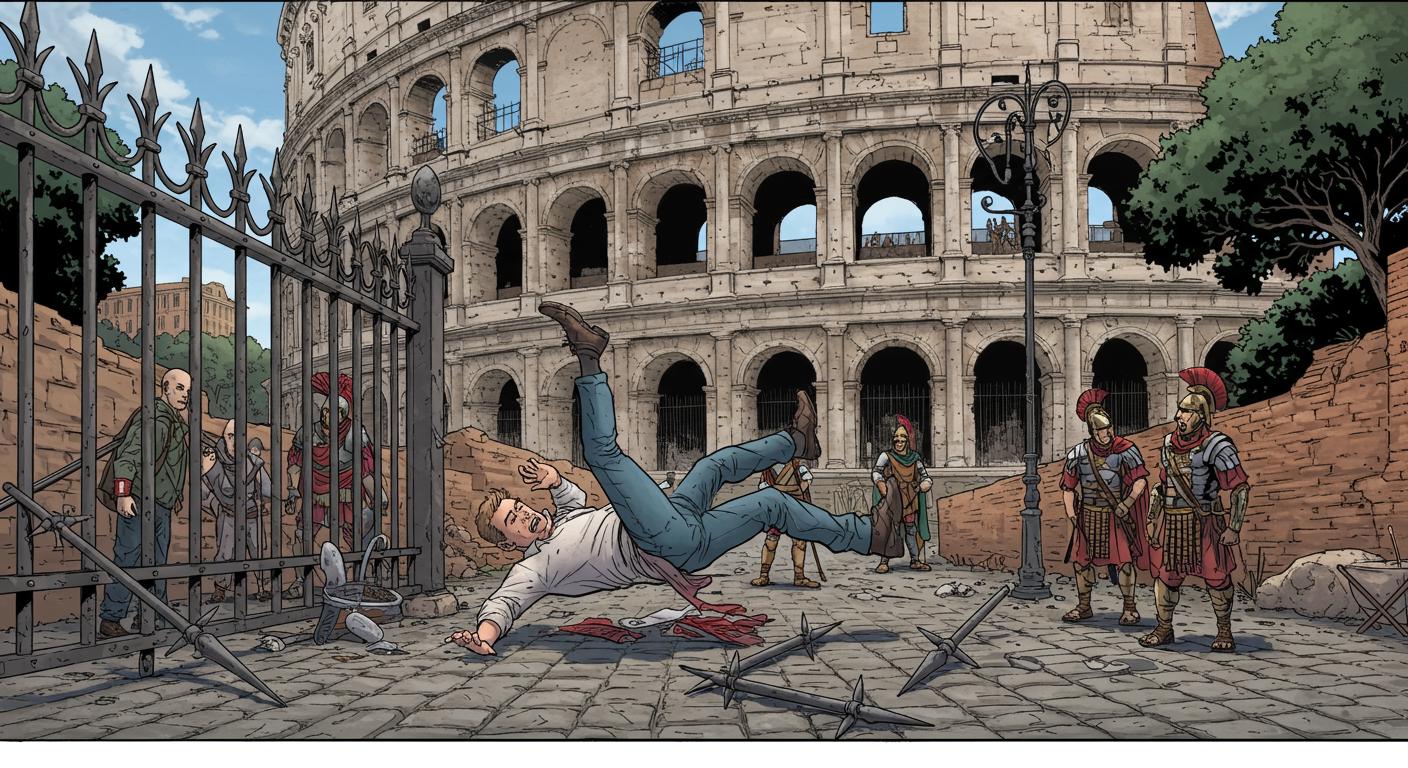
Every so often, the eternal city of Rome finds itself hosting a spectacle that wasn’t on the itinerary—this time, starring a 47-year-old American tourist and one of history’s more literal pitfalls. As first reported by Complex, what started as a sight-seeing excursion at the Colosseum veered sharply off-script when the visitor attempted to scale a protective railing, only to land—rather unfortunately—on the business end of an iron spike.
Up Close and (Far Too) Personal with the Past
According to multiple Italian news outlets referenced by Complex and further detailed by The Washington Times, the incident unfolded on Friday, May 2. The unnamed tourist, a U.S. citizen with residence in Taiwan, was reportedly visiting family in Rome. Accounts relayed from Il Messaggero and other Italian sources indicate that while trying to get a closer view of the Colosseum—or perhaps that elusive, envy-inducing selfie—he scaled a fence, only to slip and impale his lower back on an awaiting spike.
Witnesses, described in Il Messaggero and echoed by both Complex and the Times, recalled the man crying out and eventually losing consciousness while immobilized on the barrier. Paramedics spent roughly 20 minutes extricating him, ultimately sedating the patient and rushing him to the hospital. The Times highlights that the injury was extensive enough to require 80 stitches, and, in a detail flagged by Complex, a pierced spine was among the anatomical souvenirs of this misadventure. As of the latest reports, he is in stable condition—a small victory, considering the circumstances.
The Anatomy of a Tourist Trial
Motivations for the ill-fated climb seem to fall into the now-familiar category of “doing it for the photo.” Italian newspaper Il Messaggero, as cited in both U.S. sources, floated the theory that a close-up shot or memorable selfie might have tipped the balance between safe observation and hazardous participation. Yet, as relayed by those traveling with him—quoted by the Times—no one could offer a clear account of what inspired the moment’s spontaneity.
There’s a certain recurring irony here: in a city where layers of history are always tantalizingly at arm’s length, the engineered barriers serve not only to protect ancient stones but also to save tourists from their own overzealousness. Clearly, those spikes aren’t just a decorative flourish. One can’t help but imagine the moment: balancing on the edge of a two-thousand-year-old monument, imagining a triumphant photo—and instead, finding oneself needing a medical team and a very awkward travel insurance claim.
A Snapshot with Lasting Impressions
As the episode is under investigation—Italian authorities awaiting convalescent testimony from the patient himself—media coverage, including that from Complex, reflects on the collision between tourism and self-preservation. The man, who lives in Taiwan but claims the U.S. as his home country, now has a story superseding any standard travel slideshow. It’s not every holiday that leaves you with 80 stitches and a cautionary tale tailored for nervous family members and future guidebooks everywhere.
Interestingly, this ancient-meets-modern mishap took place just days after enormous crowds descended upon Rome to mourn the death of Pope Francis, as previously noted by Complex. The juxtaposition of solemn historical moments and personal spectacle offers a reminder: Rome’s drama isn’t always confined to the history books.
Looking Over (Not Climbing Over) the Fence
If there’s a morality play tucked somewhere in this ordeal, it’s probably best delivered with a gentle nudge rather than scolding. The Colosseum has weathered invading armies, earthquakes, and the occasional overconfident sightseer; it seldom loses. Modern travel may stoke the competitive urge for the ‘perfect shot,’ but the Roman fences are unwaveringly clear on where admiration should end and discretion should begin.
Is the risk ever really worth it, especially when you factor in the spike—and the stitches? The story may fade from the headlines, but it leaves behind an undeniable truth: sometimes, the most worthwhile souvenirs are stories you can tell while standing upright. For most, it’s preferable to keep memories (and spines) fully intact.