
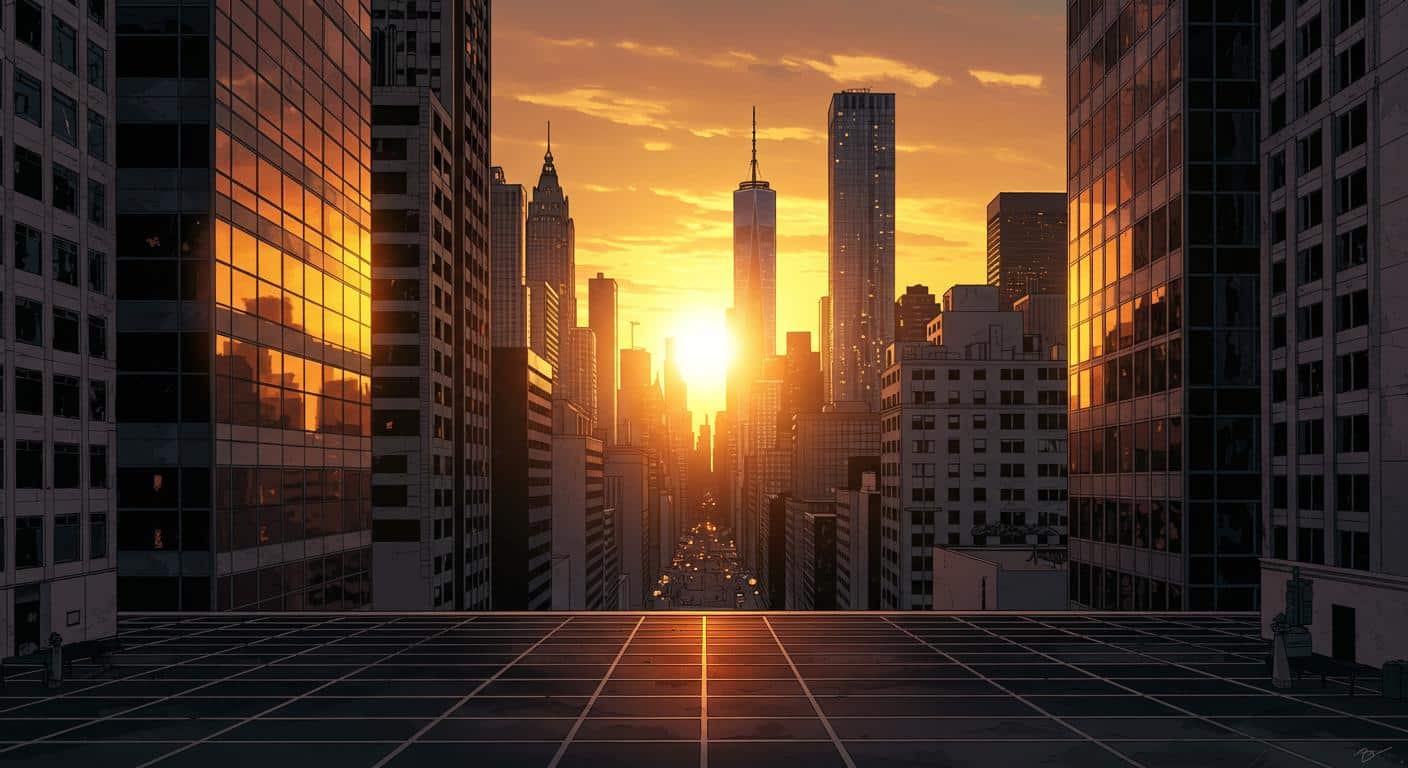
Twice a year, the laws of physics and the laws of urban planning conspire to serve up something that looks suspiciously intentional but is nothing of the sort: Manhattanhenge, the moment when the setting sun aligns perfectly with Manhattan’s street grid, producing an effect that’s as dramatic as it is unplanned. According to a recent report by the Associated Press, New Yorkers (and, let’s be honest, a healthy contingent of giddy tourists) are devoted to this fleeting intersection of cosmology and civil engineering.
A Sun for the City That Never Sleeps
This curious architectural solstice makes its first appearance this year at 8:13 p.m. on May 28, with an encore the next day—though viewers in 2025, as the AP warns, might face a letdown since clouds and rain are in the forecast. That’s characteristic of Manhattanhenge: an already brief phenomenon, rendered even briefer when the sky refuses to cooperate. Eager crowds, as the outlet points out, often gather with smartphones at the ready on sidewalks like those along 42nd Street, only to have everything turn a nondescript shade of wet pavement if weather isn’t on their side.
The origin of the event’s name is as delightfully nerdy as the event itself. Astrophysicist Neil deGrasse Tyson, a native New Yorker, coined “Manhattanhenge” in a 1997 article after comparing the sunset spectacle to the effect at Stonehenge, where ancient megaliths frame the sun on the solstice. Unlike those Neolithic monument-makers, the architects behind Manhattan’s grid, according to AP, were more focused on maximizing real estate and perfecting right angles—the celestial alignment was an accidental bonus.
Subtle Variations, Same Cosmic Party
Manhattanhenge offers several variations, as detailed by AP with information from the Hayden Planetarium. On May 28 and July 12, viewers are treated to a “half-and-half” version, with the sun sliced by the horizon at the moment of peak alignment. On May 29 and July 11, the full disc of the sun is visible, seemingly suspended between Manhattan’s buildings before making its exit across the Hudson River. Interestingly, this show doesn’t occur right on the summer solstice (set for June 20 this year), but about three weeks before and after, when the sun aligns flush with the city’s east-west arteries.
AP also highlights that favorite vantage points include 14th, 23rd, 34th, 42nd, and 57th Streets, with the spectacle growing ever-wider the farther east you stake out a spot. The article notes that it’s also visible across the East River in Queens’ Long Island City. Still, for every iconic photo of a blazing solar orb framed by skyscrapers, there’s a cluster of determined city-dwellers playing impromptu traffic cop or apologizing to someone whose evening commute has collided with a sidewalk-obstructing photo op.
Is it an organized event? Not really, AP explains. While informal viewing parties do occasionally happen, most Manhattanhenge-watching is a do-it-yourself affair—crowds descend roughly half an hour before sunset, hoping for clear skies and that “just right” moment. As the outlet documents, a cloudy or rainy evening means the sun stays stubbornly hidden, no matter how enthusiastic the crowd.
A Worldwide Department of Henges
The AP also notes that other cities get their own “henges,” thanks to uniform street grids and celestial coincidences. Chicagohenge and Baltimorehenge take place around the spring and fall equinoxes (March and September), while Toronto enjoys Torontohenge in February and October. Still, Manhattan’s version is considered especially striking—not just because of its grid, but thanks to its high-rise canyons and a perfectly fortuitous western view across the Hudson River.
Accidents, Intentions, and the Weird Beauty of Alignment
For all the technological wizardry and urban planning minutiae of today, one of New York’s most photogenic annual events is pure accident. No league of astronomers mapped out street angles for a midtown solstice; it’s simply the happy overlap of geometry, history, and chance. When crowds fill the boulevards, cellphones raised in collective anticipation, what results is less a meticulously planned celebration and more a spontaneous festival of happy alignment.
Reflecting on the AP’s coverage, one wonders if other chance alignments are lurking in urban landscapes everywhere, waiting for a keen observer to announce the next minor civic holiday. Would New York feel different if its grid was rotated a few degrees? Do we, as city-dwellers or visitors, instinctively seek meaning in these moments where built environment and the natural world neatly snap into place? Or is this just another example of the delightful surprises that arise when pattern-seeking meets random chance?
Either way, the fleeting glory of Manhattanhenge reminds us that some of life’s best spectacles aren’t engineered or orchestrated—they just happen. All it takes is a city grid, a setting sun, and the willingness to look up.
Source: Associated Press reports on the cosmic commotion of Manhattanhenge.