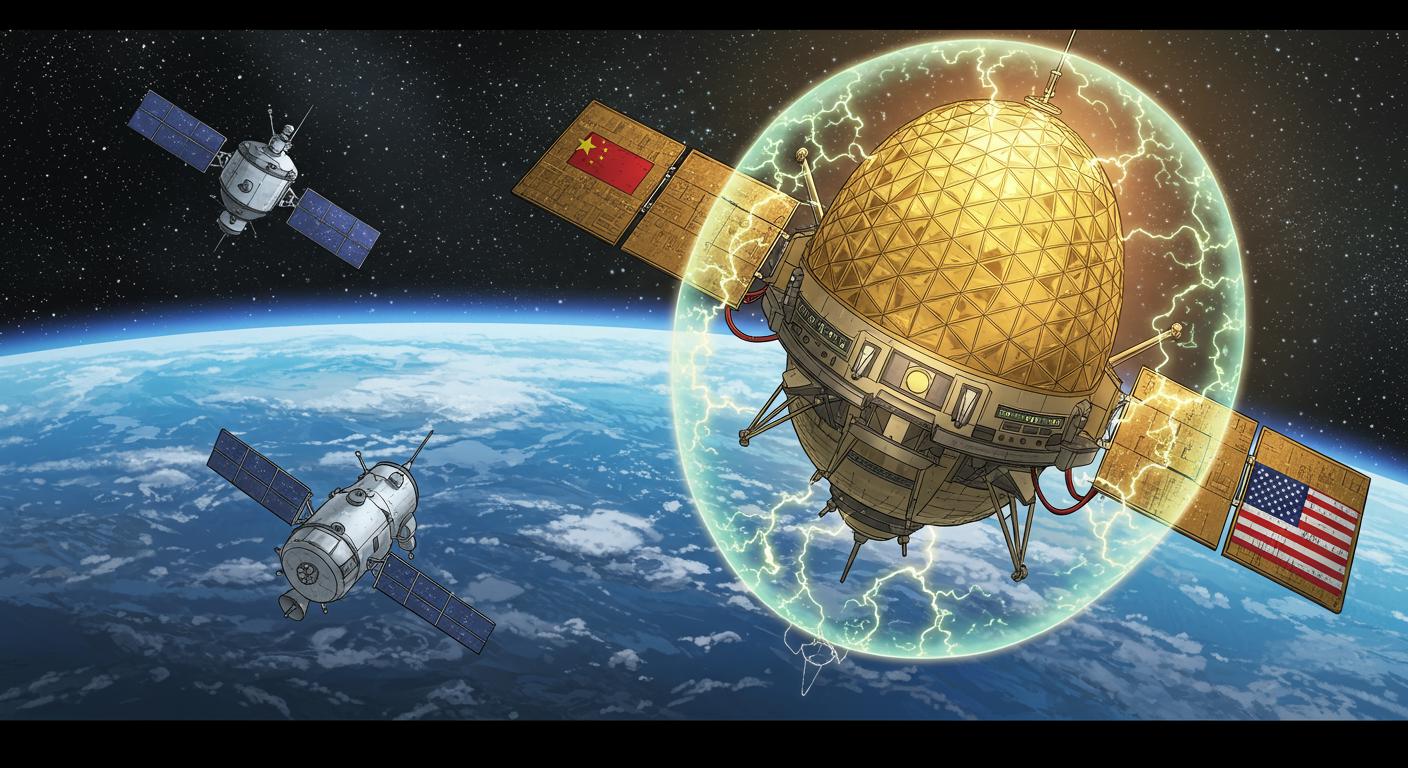
If missile defense had a couture line, the “Golden Dome” would be its sequined showpiece—shiny, ambitious, and apparently anxiety-inducing in Beijing. In the latest episode of the earth-versus-orbit drama, President Trump’s vision of a star-spangled, multi-layered, possibly space-based missile shield has prompted China to issue warnings about its disruptive potential for both Earthly stability and the calm of the cosmos.
From Iron Dome to ‘Golden Dome’: When Shields Spark Shivers
The “Golden Dome,” a concept revived with characteristic flair by Trump and placed front and center in his new term, aims for nothing less than a dome of technological superiority. The multi-layered system as profiled in Newslooks features interceptors positioned to knock down enemy missiles at every possible phase—pre-launch, boost, midcourse in space, and even as the warhead nears its target. The idea: an umbrella able to swat hypersonic threats, FOBS, and conventional launches alike, even if they take the scenic route over the South Pole.
But as Newslooks details, the program’s specifics remain notably fuzzy. Gen. Michael Guetlein has reportedly been tapped to oversee the project’s development, while Trump’s administration requested $25 billion as a starter for the colossal undertaking—though the actual technical requirements are still being drafted, a reversal of the Pentagon’s usual cart-before-horse procurement dance. The Congressional Budget Office pegs the long-term cost for the space-based portion alone at $542 billion over twenty years, with initial system estimates ranging between $30 and $100 billion. These aren’t so much “ballpark” figures as “entire stadium” figures.
And if that all sounds a bit like “Star Wars: The Budget Awakens,” well, you’re not alone. The echoes of Ronald Reagan’s strategic missile defense pop up throughout Newslooks’ analysis, with everyone from generals to budget hawks noting the leap from concept art to working hardware remains, generously, a work-in-progress.
China Watches the Skies—and Raises the Volume
China, for its part, feels decidedly not invited to the dome-warming party. According to Global News, Chinese foreign ministry spokesperson Mao Ning spelled out the government’s concerns: The Golden Dome, in her words, carries “strong offensive implications,” inching the world closer to an orbiting arms race and increasing the militarization of outer space. Mao argued that seeking “absolute security” at others’ expense threatened balance and violated established principles of international security, before calling on the U.S. to ditch the project in favor of some old-fashioned diplomatic trust-building.
Grounding these worries in more detail, Tribune.com.pk notes Beijing’s specific objections: The plan’s focus on space-based interceptors, which could put actual weapons in orbit, risks violating the Outer Space Treaty—yes, that’s a real thing prohibiting weapons of mass destruction in the skies above our heads. Chinese officials warn of destabilization, both from the hard advantage the U.S. might gain and from the way these cosmic upgrades nudge other military powers (hi, Russia) toward their own orbital arsenals. For anyone hoping for a peaceful future in low Earth orbit, these are not reassuring noises.
It’s not just rhetorical. As outlined by Sustainability Times, China has been busy upgrading its own playbook with fractional orbital bombardment systems (FOBS) and hypersonic glide vehicles (HGVs). The Defense Intelligence Agency estimates China could field up to 60 FOBS-based nukes and a staggering 4,000 HGVs by 2035—numbers that leave even military planners blinking. The point: No one wants to be the last nation without a four-stage, possibly orbiting, platinum-tier missile shield.
Sticker Shock and Strategic Puzzles
The logic, at least from the American strategic perspective, is straightforward. Sustainability Times points out that U.S. missile defense faces new and slippery threats: China’s FOBS and HGVs are designed specifically to sneak past or blitz through traditional radar and interception systems. The Pentagon believes that only by jumping into the orbital sandbox with its own hardware can the U.S. maintain deterrence.
But as various voices in and around Congress pointedly observe (Rep. Ken Calvert’s musings come to mind), the actual definition of the Golden Dome remains so vague that even supporters might struggle to explain what’s being built, when it’s arriving, or whether it’s more than a high-concept PowerPoint and a very shiny sticker price. As Sustainability Times highlights, many allies and critics alike are wary of pouring hundreds of billions into a system whose real-world effectiveness—and legal standing—isn’t clear, especially given the risk of weaponizing a domain that, until recently, was reserved for GPS, weather forecasting, and dubious satellite radio.
Perhaps most strikingly, even as the administration trumpets the Golden Dome as a “next-generation shield for peace,” there’s a certain absurdity to the idea of absolute security via gadgets in orbit. After decades of treaties, aspirations of space as a shared province, and the perennial hope that “space” might mean “above it all,” we’re now debating whether one nation’s floating defense grid could tip the scales back toward arms buildup and suspicion.
Space, Shielded: Reflections from the Cheap Seats
It’s a little poetic, and just a tad ridiculous, that so much of the world’s hope and paranoia now looks skyward—worrying less about what’s crashing down from above than about who’s cramming what up there in the first place. History has rarely lacked for escalation, but cosmic missile tag does feel like escalation with a glitter bomb.
So here we are: global powers outbidding each other for orbital insurance policies, even as the rules and the hardware remain not just up in the air, but literally in another layer of the atmosphere. How long before today’s rhetorical warnings solidify into a hardware-and-hair-trigger standoff above our heads? Or will the “Golden Dome” remain mostly a budget line and a diplomatic talking point, its most tangible impact for now being a nice new acronym for military PowerPoints?
It makes you wonder—if space is the new high ground, how much room is there for everyone’s dreams and fears? And how long until we look up at the night sky, wondering what’s lurking up there amid the stars: hope, paranoia, or just the echo of human ambitions in a zero-gravity game of one-upmanship?