
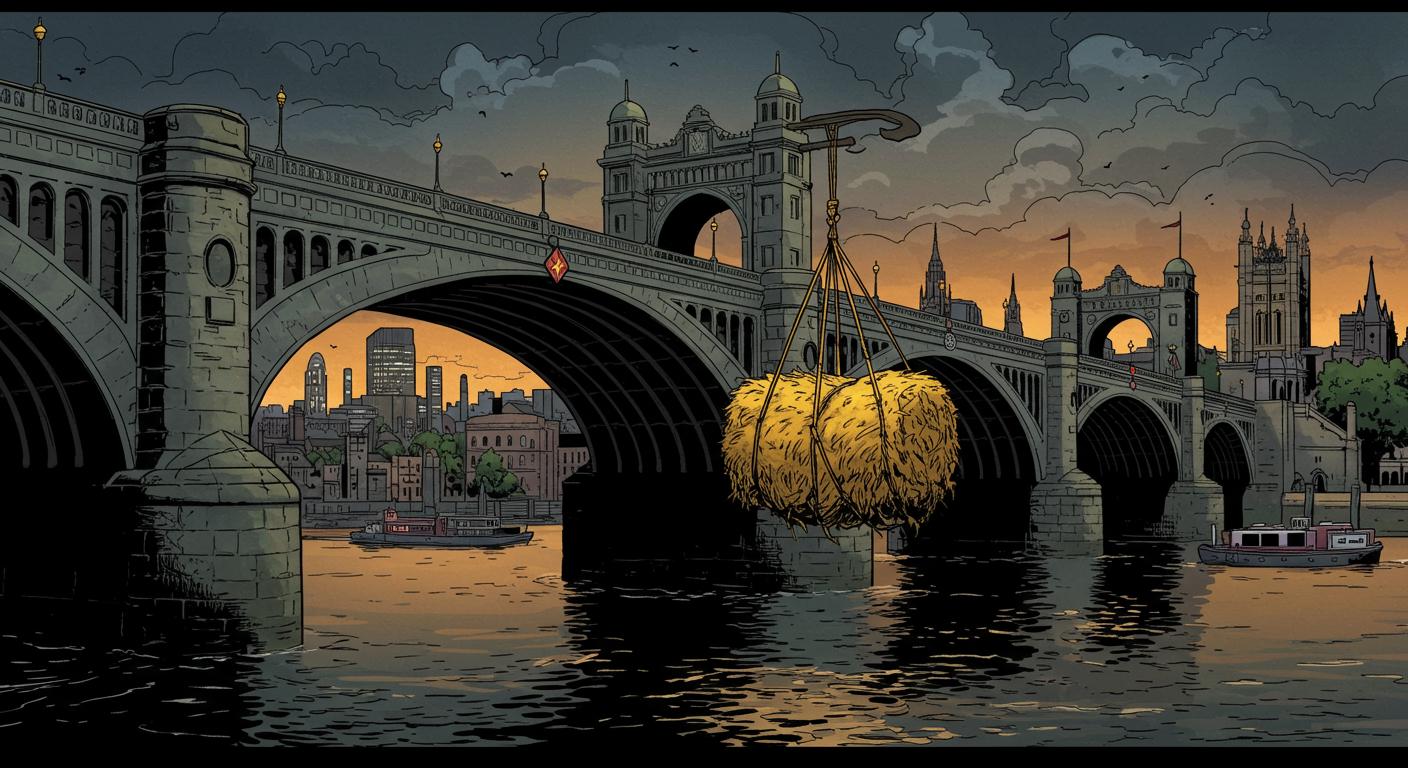
Anyone passing by London’s Charing Cross railway bridge lately might have noticed a somewhat rustic accessory dangling from its flanks—a pair of hay bales, incongruously upstaging the usual steel-and-scaffold chic of 21st-century maintenance work. While it could pass for a nod to the city’s agricultural past (or a leftover Banksy installation with severe hay fever), this is, in fact, bureaucracy at its most delightfully peculiar. According to a report by ianVisits, these straw bundles aren’t the result of a whimsical maintenance crew; they’re the visible legacy of a genuinely ancient river law.
Straw, Scaffolding, and Statutes
As detailed in ianVisits’ coverage, the Port of London Thames Byelaws, specifically Clause 36.2, require a bale of straw to be hung from any London bridge whose headroom is reduced from its usual limits. The logic behind the hay, the article notes, has been thoroughly lost to history—no one now recalls why straw, in particular, was considered the best choice to warn mariners. Still, the regulation rolls on through every update of the river bylaws, leaving the medieval requirement standing amid streams of more modern rules.
The current repair work on what’s officially called the Hungerford Bridge, as explained in the outlet’s report, has led to scaffolding dropping down into the territory of the river arches and thus lowering the clearance for passing vessels. That’s all it takes to activate the straw clause, sending contractors out to acquire hay—origin and organic status apparently not legislated. For practical reasons, ianVisits specifies, the hay bales are hung from the adjacent Jubilee footbridges, flanking the tracks like sheepdogs anxious about river traffic.
At the moment, only the arch with restricted clearance displays its hay warning, but the outlet points out the arch is still open to boats. Night river travelers aren’t left entirely at the mercy of medieval agricultural signage either—warning lights supplement the bales after dark, a practical adaptation highlighted by ianVisits.
Why Not Just… Update the Law?
In a detail spotlighted by the outlet, the precise origins of the straw warning have faded into obscurity. Mariners in centuries past may have been more attuned to a swinging bale than a placard, or perhaps straw was simply handy. Nevertheless, when the river bylaws are revised, the straw requirement persists—carefully preserved in the legislative undergrowth while contemporary warning systems blink stoically nearby.
So, for the duration of the bridge’s phased face-lift, the hay bale will function as both legal safeguard and unexpected public art installation. As mentioned earlier in the ianVisits report, whenever scaffolding shifts to a new arch, the hay must tag along, making its slow migration northwards. This situation begs the question: Will any passing boat captain actually rely on the bale for guidance, or would even one flaming skeptically at the anachronism? It’s easy to imagine a compliance officer quietly ticking a box, satisfied—law observed, tradition maintained.
The Strange Comfort of Ritual Law
Not every relic of medieval regulation is as benign (or as biodegradable), but as ianVisits notes through its bemused tone, there’s something comforting about the persistence of such a tradition. Charing Cross—one of London’s most recognizable crossings—finds itself temporarily adorned with this ancient fixture, visible only to those who notice the curious silhouette mid-span.
Every time the scaffolding creeps ahead, the bale follows, forming a quiet procession led by the ghostly hands of history-minded bureaucrats. It’s a small, wonderfully odd tradition in a city largely defined by constant change—a reminder, perhaps, of the charmingly oblique ways the past survives in plain sight.
So, if you find yourself on the Thames over the coming years, spare a glance for the humble bale. As ianVisits has so carefully documented, it hangs by ancient authority and, accidentally, as a living exhibit in London’s gallery of civic quirks. Isn’t it fascinating what we keep—and, hay or not, what manages to endure?