
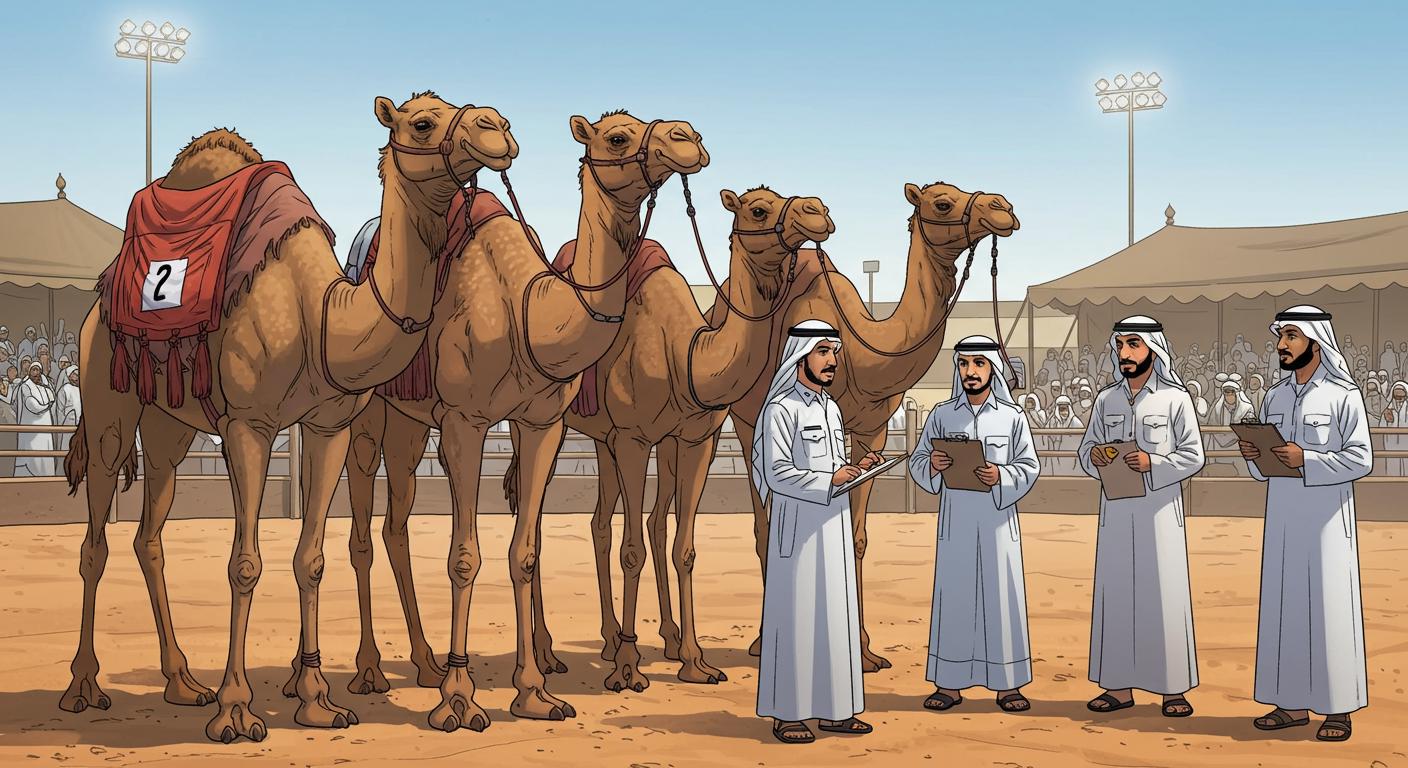
Every now and then, a story emerges from the deluge of international headlines that feels tailor-made for those of us with a deep curiosity for the truly peculiar. This year, at Saudi Arabia’s renowned King Abdulaziz Camel Festival, scandal reared its—depending on your preferred breed—delicate or robust head once more. More than 40 camels were ejected from the festivities after authorities uncovered a veritable gift basket of cosmetic enhancements: Botox, hormone injections, collagen fillers, and strategic rubber bands inflating various unmentionables, as detailed in reporting from ABC News Australia.
The Quest for the Perfect Pout (on a Camel)
It’s a sentence one doesn’t expect to write often, but yes—Botox is officially banned at the world’s most lucrative camel beauty pageant. The festival, a sprawling celebration of Saudi heritage, has become ground-zero in a sort of arms—or perhaps lips—race among ambitious breeders. The goals are simple: longer lips, shinier coats, and the elusive “pouty and pendulous” look so prized by the judges.
In recent years, authorities have ramped up their efforts to address cheating, employing veterinarians equipped with “specialised and advanced technology” to identify cosmetic interventions. As ABC reports, these enhancements cover quite a range: stretching lips and noses by hand, plumping muscles with hormones, inflating body parts with rubber bands, and of course, good old-fashioned Botox. This high-tech scrutiny reveals a curious parallel to competitive human beauty circuits—though, in this case, cattle prods are traded for cosmetic syringes.
Notably, these efforts aren’t unprecedented. ABC’s retrospective on past festivals describes how in 2018, twelve camels were caught out for Botox use, and a veterinarian in the United Arab Emirates was found performing cosmetic surgery on camels, including ear reductions for breeds that prize a “delicate” look.
Beauty and the Big Bucks
Why all this fuss? Boiled down, it’s a potent brew of enormous financial incentives and social prestige. According to ABC, the festival offers a prize pool in the neighborhood of $90 million—a number that rivals the purse at some premier global sporting events. For breeders, a win isn’t just about bragging rights: top camels fetch millions at auction, while a good showing enhances a breeder’s reputation and business prospects in this multimillion-dollar industry.
Success at the King Abdulaziz Camel Festival isn’t just a local accomplishment, either. The festival’s heritage roots run deep, commemorating Saudi Arabia’s founder and underscoring the cultural significance of camels in the region. For many breeders, the festival is where personal ambition, tradition, and enterprise all converge—so it’s no surprise some push the boundaries of the rulebook in pursuit of the perfect beast.
Standards to Make a Supermodel Blush
Beauty, as it turns out, obeys a strict rubric in the camel world. ABC references animal genetics academics Jaime Gongora and Mahmood Alamri, who describe a checklist of desirable traits: the coat should be shiny and vividly colored; the neck is expected to be long, lean, and wide; the body between neck and hump must appear “long and strong”; and, of course, hump placement and proportion deserve scrutiny. The head should seem upright and large (but not disproportionately so), and the facial ideals verge on the poetic: “pouty and pendulous” lips, a clefted upper lip, long dark eyelashes, and a chin visible from multiple angles.
With such detailed standards, it’s little wonder that human intervention tempts some. What owner wouldn’t want that extra gleam or sag if it means not just a trophy, but potentially life-changing winnings?
In addition to beauty competitions, the festival also includes awards for the fastest and best-behaved camels—but as ABC highlights, it’s the beauty contest that commands the spotlight and draws the fiercest competition.
What’s in a (Camel’s) Face?
These pageants, with their stringent criteria and high-tech enforcement, echo larger questions about authenticity and artificial enhancement. Is the scramble to perfect a camel’s looks just a reflection of broader human obsessions, or are there particular forces at play in the world of livestock breeding? The camels themselves are silent on the matter—judged not only for their lineage, but for the very shape and movement of their lips.
There’s also an ongoing dance between innovation and enforcement. When the stakes hover in the millions and reputations are on the line, it seems inevitable that breeders would seek secret advantages. Festival officials, for their part, appear equally determined to preserve what they see as the integrity of the tradition, armed with advanced scanners and a clear sense of mission.
Reflection: Beauty Is in the Eye of the Beholder, but Not the Botox
For all its oddity, the annual saga of camel pageant scandals situates itself at a surprisingly familiar intersection: money, prestige, tradition, and the malleability of beauty standards. The only real twist is the species involved—though perhaps that just highlights how universal this story is.
After all, whether it’s on a catwalk, a televised dog show, or in the heart of Riyadh’s desert, is anyone truly shocked that, when glory and a financial windfall are in the offing, someone, somewhere, will try to give their contestant a little extra help? It’s just that, this time, the help comes with a drooping lip, a perfect hump, and the wary gaze of a competition judge wielding a scanner.
One can’t help but wonder what the camels themselves make of all this. Or, for that matter, what surreal twists await next year’s pageant. Will the contest ever see an all-natural winner, celebrated for their untouched beauty—or will the arms race for the finest facial dangle continue?