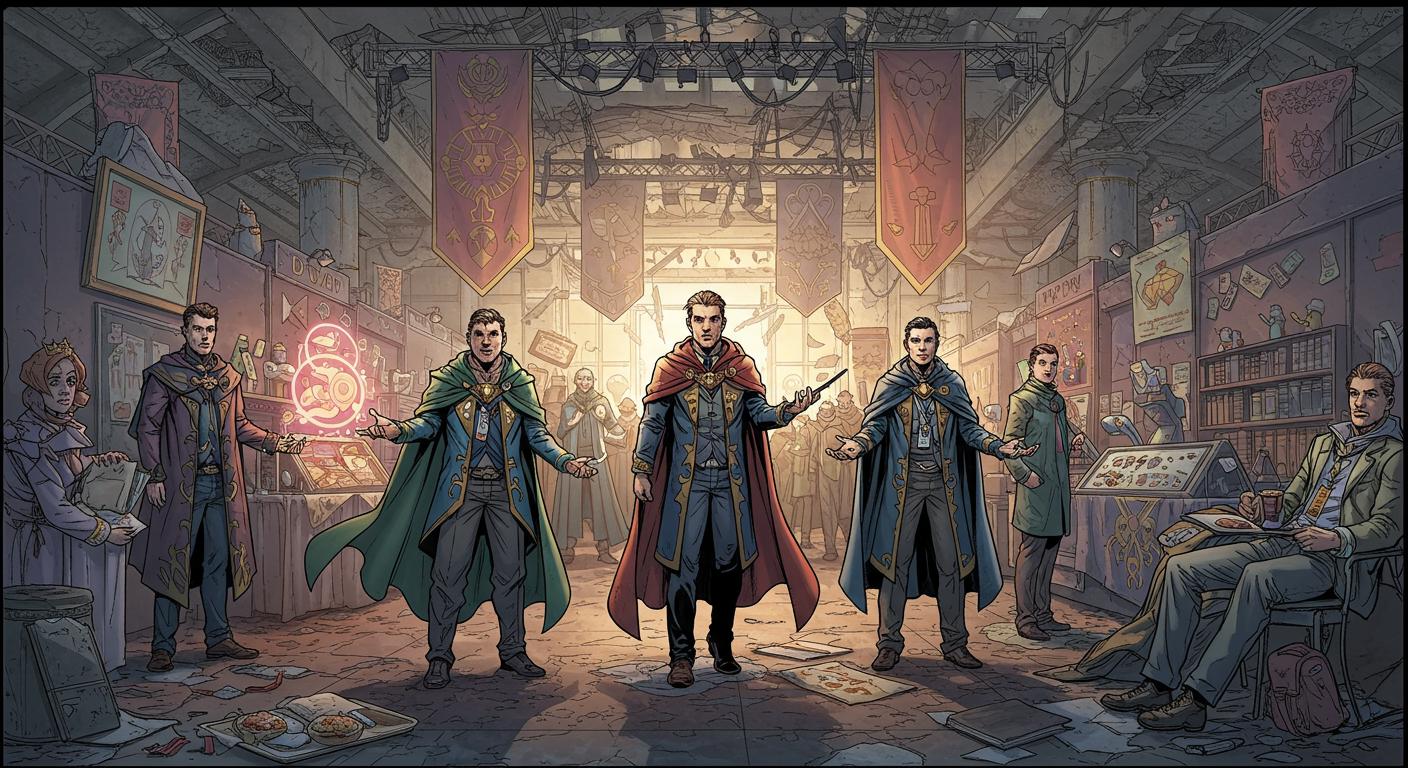
It’s one thing to buy a ticket to a fantasy-themed ball and arrive to find, say, a little too much glitter and one too many replica swords. It’s quite another to spend thousands traveling across the country (or the Atlantic, in some cases), only to discover that your “Ball” is a giant grey concrete room, sparsely adorned with fake rose petals, a single Bluetooth speaker propped on a chair, and—if you’re lucky—a place at the cash bar where you can drown your sorrows in a cup of tepid Chardonnay. Even in the land of literary convention mishaps, what unfolded in Baltimore over the weekend set a new bar for surreal disappointment.
A Million Lives, Zero Decorations
According to reporting by CBC, the so-called “A Million Lives Book Festival” delivered more of a metaphysical void than an epic tale. Billed as the perfect gathering for indie romantasy authors and their fans—a “fantasy ball” capping off the weekend—it managed only to conjure up memories of the ill-fated Fyre Festival, or, for those who prefer their memes with a side of existential dread, the unforgettable DashCon (one word: ball pit).
Footage reviewed by CBC and widely shared by authors and attendees across BookTok reveals the scale of the misfire. According to attendees, panels reportedly began late, if at all; swag bags and basic supplies like chairs were more myth than reality. CBC cites narrator Carmen Seantel’s TikTok post, in which she recalls both panelists and audience sitting on the carpet for an audiobooks panel, as there were no chairs provided. VIP ticket holders, who had paid $250 for the main event—a fantasy ball—found themselves standing in a cavernous, mostly empty convention hall, described by Stephanie Combs in her TikTok (and as highlighted by CBC) as “dressed to impress, tried to make the best of it,” amidst a few token fake rose petals, a cash bar, a folding table with desserts, and that now-notorious Bluetooth speaker on a chair.
Perci Jay, a Texas-based author interviewed via her TikTok commentary and quoted by CBC, likened the experience to “the Willy Wonka experience but with books”—not as a golden ticket fantasy, but in the sense of expecting a magical chocolate river and getting an unheated warehouse. Jay, as relayed by CBC, admitted she had even planned her pregnancy around being at the event: the kind of detail that would sting even in a less disastrous scenario.
The Promise: Community and Glamour; The Reality: A Networking Group Therapy Session
CBC details that Archer Management—the organizing company—hyped the event as something straight from a BookTok devotee’s dreams: panel discussions, cosplay meetups, a bustling vendor hall, and a special “content creation room.” Indie authors, according to CBC’s analysis, paid $150 for a booth with the hope of connecting directly with readers, while tickets for attendees ranged from $50 up to $250 for the VIP fantasy ball access.
As reported by CBC, Archer Management told authors that 500 tickets had been sold. Yet TikTok posts from authors and guests, cited throughout the CBC report, reveal that only around 80 attendees ever materialized—sometimes as few as 30 on opening day—with several guests noting the number of authors and vendors may have outnumbered visitors. CBC also points to the fact that the heavily-promoted “content creation room” was simply an unused conference room, closed altogether on Saturday.
For author Kalista Neith, cited by CBC and in a series of her own TikTok videos, cracks appeared before the weekend even began. Neith reported that after being invited as a featured guest 18 months previously, organizers assured her of a room in a nearby Hilton, only to abruptly downgrade accommodations to the Days Inn mere days before the event—another broken promise, recounted in CBC’s coverage. After walking into the much-anticipated ball and seeing the barren reality, Neith decided to publicly apologize to her own readers who had spent money on what she described, both to CBC and online, as “unacceptable.” “As an author, all we have is the readers’ trust,” she told her followers, words echoed by CBC’s reporting.
CBC recounts that indie authors expect a bit of business risk when attending these conventions, fronting costs for printing, travel, and logistics in the hope of decent book sales and vital networking. However, this time, the usual gamble ended in a collective loss. According to Jay, reported by CBC, “People are thousands of dollars in debt because of the lies and the false promises and the mismanagement.”
We Did Not Sell Much of Anything
CBC highlights the disappointingly meager sales figures for authors like Caitlin Burkhart (who publishes as C.A. Burkhart), who said in her TikTok (as cited by CBC) that despite bringing plenty of physical copies of her books, “we did not sell much of anything, really.” The report notes that in the days leading up to the festival, Burkhart had posted optimistically about signing times and reader meetups, only to be met with a vendor hall echoing with disappointment.
Bringing the aftermath into focus, CBC notes that, while most of the event’s promises dissolved, a small silver lining appeared: authors and creators began boosting each other’s work online, making connections and forging what Burkhart dryly suggested might have been better as a free meet-up. “I just wish it was a meet-up and not a paid thing that we all lost money on,” she told her audience in a sentiment CBC found echoed by others.
Organizers Respond, For What It’s Worth
Acknowledging the mess, CBC reports that Grace Willows, the lead organizer behind Archer Management, posted a video apology on TikTok, admitting the ball was “not set up to standards” and inviting refund requests. Soon thereafter, Archer Fantasy Events announced full refunds for all attendees, authors, and vendors, according to CBC, and later posted a TikTok statement—complete with a remix of Nirvana’s “Smells Like Teen Spirit”—declaring not only the demise of this event, but the cancellation and refund of all future gatherings as well. CBC further notes that after sharing these TikTok statements with the outlet, Archer Management did not respond to additional follow-up.
Whether it was a case of sincere but misguided mismanagement or simply a spectacular example of overpromising and underdelivering in the age of viral fandom, remains to be debated. CBC’s account paints a picture of organizers scrambling to staunch the fallout while indie creators tally their very real losses.
Lessons From a Literary Lemon
CBC presents “A Million Lives” as a case study in the sometimes perilous intersection of internet-driven hype and the realities of event planning—one that indie authors, in particular, cannot easily shrug off. Attendees, left with empty tables and emptier wallets, blend disillusionment with surprising camaraderie. If there’s a lasting takeaway, perhaps it lies in what CBC observed: amid absent readers, undelivered swag, and a ballroom that was neither, authors found one another, forging new links in a genre community that remains passionate and, perhaps, a little more wary.
Is there something inherently irresistible about bringing online communities into physical spaces, despite all the risks and previous cautionary tales? Or will this latest disappointment temper the flood of romantasy conventions sprouting across the calendar? In the meantime, next time someone promises an enchanted ballroom at a book convention—well, it might be wise to pack your own chair, and perhaps a snack or two, just in case the only fantasy on offer is a plot twist no one saw coming.