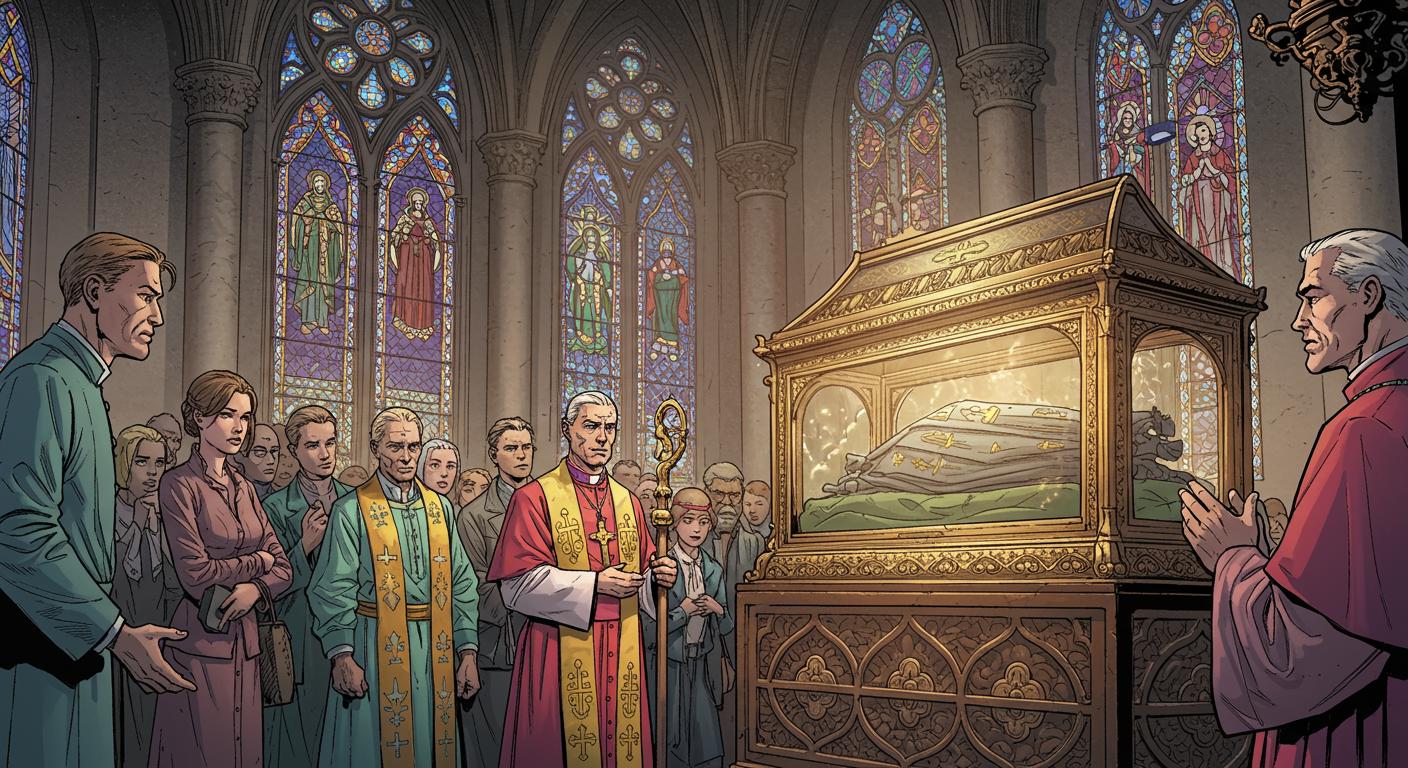
A silver casket, a revered skeleton, and a bishop on the fence—sometimes the line between spiritual devotion and public spectacle is as thin as the glass separating viewers from the remains. The display of Saint Teresa’s remains in Alba de Tormes saw tens of thousands of people descend upon a Spanish town for a once-in-a-century opportunity: witnessing the preserved body of a 16th-century mystic who—according to both lore and historical reports—has inspired awe, devotion, and, perhaps inadvertently, a touch of ghoulish fascination.
Sifting through the reports, one gets the sense of a medieval pageant meeting a modern pilgrimage. Yet, as church bells tolled and crowds processed, it wasn’t just adoration in the air—there was also controversy.
Devotion, Drama, and a Dash of Skepticism
Crowds queued up in silence, many visibly moved, to see Saint Teresa laid out with all the dignity a silver casket and centuries of reverence can confer. One attendee, Guiomar Sanchez, shared with Sky News that the experience brought “a feeling of fulfilment, of joy, and of sadness,” emphasizing the emotional charge often at play with relic veneration. On the final exhibition day, nuns from India reportedly wept as they looked upon the saint through her glass enclosure, the outlet relates.
Still, not all were swept up in the fervor. Bishop Jose Luis Retana of Salamanca, whose diocese neighbors the event, remarked to Sky News, “It is not a good idea to display the body of Saint Teresa in this way. It only serves to encourage people’s morbid curiosity.” That critique, lodged in the middle of what otherwise reads like religious fanfare, stands out like a footnote from a skeptical archivist—one who’s spent enough time among dusty ossuaries to know that the lines between reverence, ritual, and the weird can get distinctly blurry.
Of course, keeping bits and pieces of saints on public view for the faithful isn’t exactly a new phenomenon. Church officials and scholars downplayed the bishop’s reservations, reminding Sky News that displaying relics fits squarely into longstanding Catholic tradition. Cathleen Medwick, who authored a book on Teresa, explained, “It was just something people always did when they thought somebody might be a saint,” adding that the relative lack of decay in Teresa’s remains was historically considered proof of sanctity.
Professor Jose Calvo, a specialist in Medieval history at the Pontifical University of Salamanca, said the saint’s writings on inner life have endured as “a profound treatise on spirituality.” Sometimes, history really does double as a talismanic highlight reel—Franco, Spain’s 20th-century dictator, famously kept a relic of Saint Teresa’s hand next to his bed. The story is surreal, but hardly unusual by the standards of saintly afterlives.
When the Sacred Gets a Red Carpet
There’s always been an undeniable pull to the physical remnants of extraordinary people—artifact or ossuary, memento or memorial. Sky News reports that the body was displayed for the first time in over a hundred years, then paraded through town, silver casket glinting and pilgrims in tow. The result? A spectacle both familiar and uncanny, depending on where your comfort with medieval practices (and preserved relics) begins to wane.
Why do crowds line up, moved to tears or restlessness, to glimpse centuries-old bones? Is it an echo of pure devotion—or is there an element of curiosity that’s less sublime, more morbid? One can’t help but note the similarities to modern celebrity culture: the hush, the awe, the stories passed along of having been there.
The oddity isn’t just in the event itself, but in how unchanged the impulse seems. We still gather at displays of the unusual—call it a pilgrimage, a fascination with history, or simply human nature. As someone who’s logged more hours in archival stacks and curiosity cabinets than most, my sense is that reverence and curiosity are rarely mutually exclusive.
Reflections from the Archive
The casket is now resealed, the crowds have drifted home, and Bishop Retana’s point lingers: at what point does a religious relic become more sideshow than spiritual inspiration? Or, perhaps, has mystery—and even a little morbidity—always been part of the appeal for believers and skeptics alike?
If nothing else, Saint Teresa’s journey from the reforming heart of Spain’s Golden Age to present-day crowds testifies to the power of relics, rituals, and a public that’s never quite lost its appetite for the marvelous and macabre. Maybe that’s the ultimate oddity: that a skeleton, centuries quiet, can still command a procession and spark both wonder and wariness, all in the span of a single afternoon. History, as usual, keeps its best punchlines just this side of the uncanny.