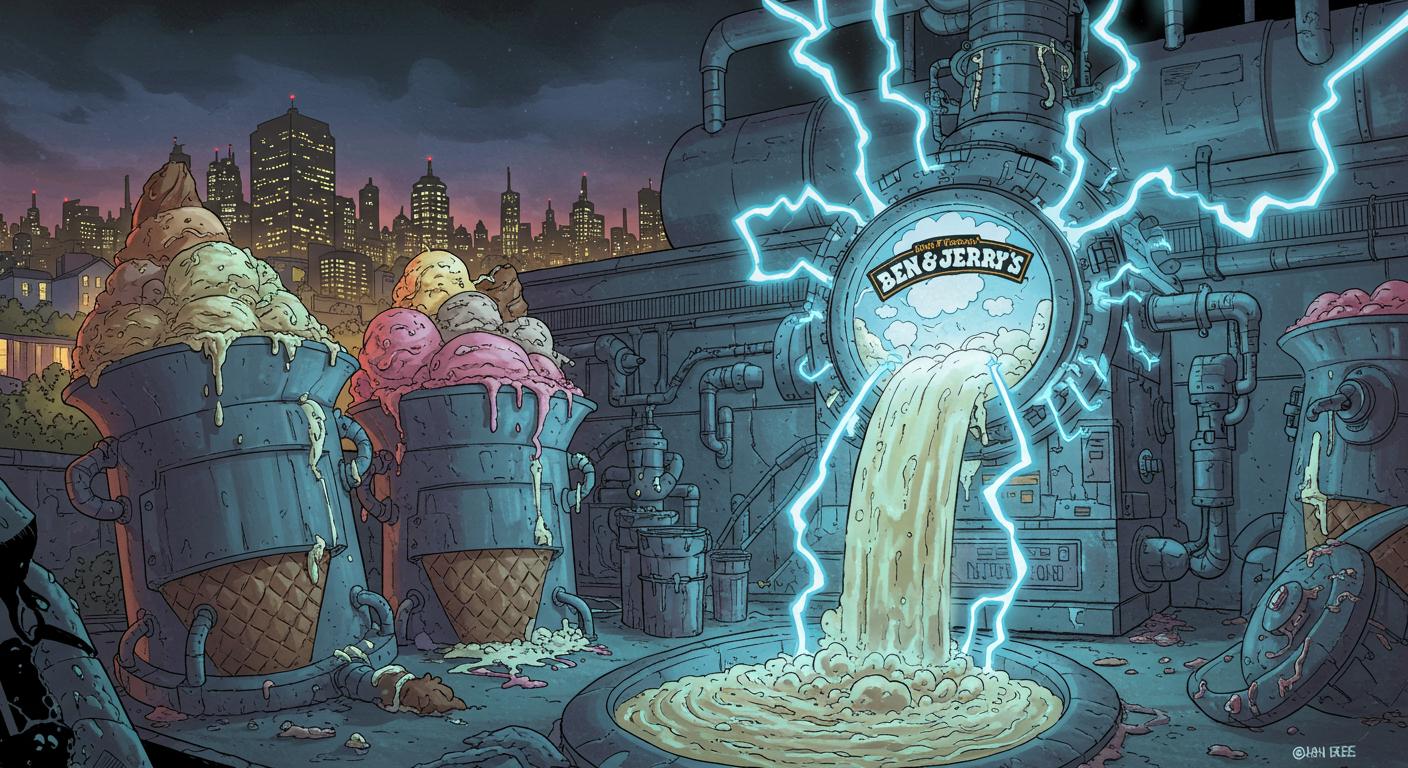
If you were hoping your late-night pint of Cherry Garcia came with a side of environmental activism, Ben & Jerry’s may have just upped the ante—though perhaps not in the way most of us expected. In a detail spotlighted by Interesting Engineering, the Vermont ice cream icon is now sending factory waste, including off-spec batches and the sticky remnants of production, through a dedicated pipeline to a high-tech facility. There, the leavings of our collective sweet tooth are transformed, Willy Wonka fashion, into enough clean electricity to power hundreds of local homes. Who knew a botched batch of Chunky Monkey could end up lighting someone’s living room?
Waste Not, Want Not (Especially If It’s Chunky Monkey)
This isn’t a backyard compost heap, but an industrial-scale enterprise run by PurposeEnergy, which employs anaerobic digestion—a process best described as oxygen-free waste breakdown, though considerably less flashy than its name suggests. As reported by Interesting Engineering, Ben & Jerry’s entered into a 2021 agreement to pipe all their “high-strength organic waste”—including those unfortunate ice cream batches that never quite made it to the freezer section—directly from their St. Albans factory to the neighboring digester. Instead of languishing in a landfill or clogging up wastewater treatment plants, the waste now embarks on a journey of scientific reinvention, breaking down in sealed tanks and producing methane-rich biogas.
This biogas, in turn, is harnessed to produce a notable 8.75 million kilowatt-hours of electricity annually—a figure the outlet notes is sufficient to power hundreds of households through Vermont’s Standard Offer Program for renewables. Quinbrook Infrastructure Partners provided the financial backing, and the facility officially flicked the switch in December 2024. One wonders: what other culinary misadventures from the conveyor belt are also finding new life as kilowatts?
Ice Cream: Now With Fewer Emissions Than Your Average Dessert
It’s hard to avoid some amusement at the symmetry here. Food waste, once a behind-the-scenes villain in the story of industrial food production, now plays the unexpected role of renewable hero. Grouping several related details highlighted by Interesting Engineering, the project is lauded by PurposeEnergy’s chief development officer Erik Lallum as “a model of industrial symbiosis—turning food production waste into clean energy, reducing emissions, and supporting local economies.” By piping waste directly from the production line to the digester, the set-up sidesteps both landfill and lengthy truck journeys, all while capturing the energetic value of Vermont’s least photogenic pints.
And it turns out electricity isn’t the only byproduct. PurposeEnergy’s global sustainability manager Jenna Evans, quoted by the outlet from comments to Electrek, explained that the plant also captures up to 45,000 million British thermal units of renewable thermal energy per year to heat the digester and support on-site operations. That means even the process of making power stays warm and cozy, a detail that feels oddly appropriate in chilly Vermont.
According to Evans, the initiative is designed to reduce local road traffic, lower greenhouse gas emissions, and decrease phosphorus pollution—a neat bundle of benefits for a state with a fondness for both cows and clean rivers. Isn’t it curious that the logistics trail of an ice cream cone can ripple out to affect everything from tailpipe emissions to algae blooms?
Replicating the Recipe: Can Other Foodmakers Follow Suit?
Though Ben & Jerry’s takes center stage in the publicity swirl, the facility is far from exclusive. As noted in the article, several other area food producers—Casella, Wind River Environmental, Evergreen Services, among others—are layering their own waste streams into the same digestion process. The advantage, per the outlet, is a centralized approach: one waste-to-energy site serving multiple producers, all feeding into the grid through Vermont’s Standard Offer Program (a detail that all but guarantees both a buyer for their electricity and a local solution for sticky surplus).
It begs the question: could this closed-loop model catch on in other regions, or is it uniquely suited to Vermont’s blizzard of dairy output and community-scale utility programs? Industrial attempts to monetize food waste energy aren’t new, but many such plants historically faltered for lack of scale, coordination, or simple buy-in. With local development support—interestingly, the facility sits on land from the Franklin County Industrial Development Corporation—the scheme hints at a larger recipe: a pinch of tech, a grant or two, and a steady supply of edible rejects.
Taking Stock: A Greener Future, By the Scoopful?
So, next time you dig into a pint of Phish Food, consider the understated alchemy happening just down the road: what fails the taste test at Ben & Jerry’s doesn’t quietly disappear, but spins the meter on the local grid. One could raise an eyebrow at the eco-spin or the mental image of entire tanks of melting ice cream dispatched via pipeline, but the results speak for themselves. Vermont’s electricity gets a little greener, waste finds new purpose, and we inch (sundae by sundae?) toward a more sustainable status quo.
Is this heralding a national movement or is it more of a uniquely Vermont curiosity? The answer, much like the consistency of a pint midway through an August picnic, remains up in the air. Still, there’s something quietly satisfying in knowing that even when dessert goes wrong, it might just give someone else a brighter day—or at least a brighter lightbulb.