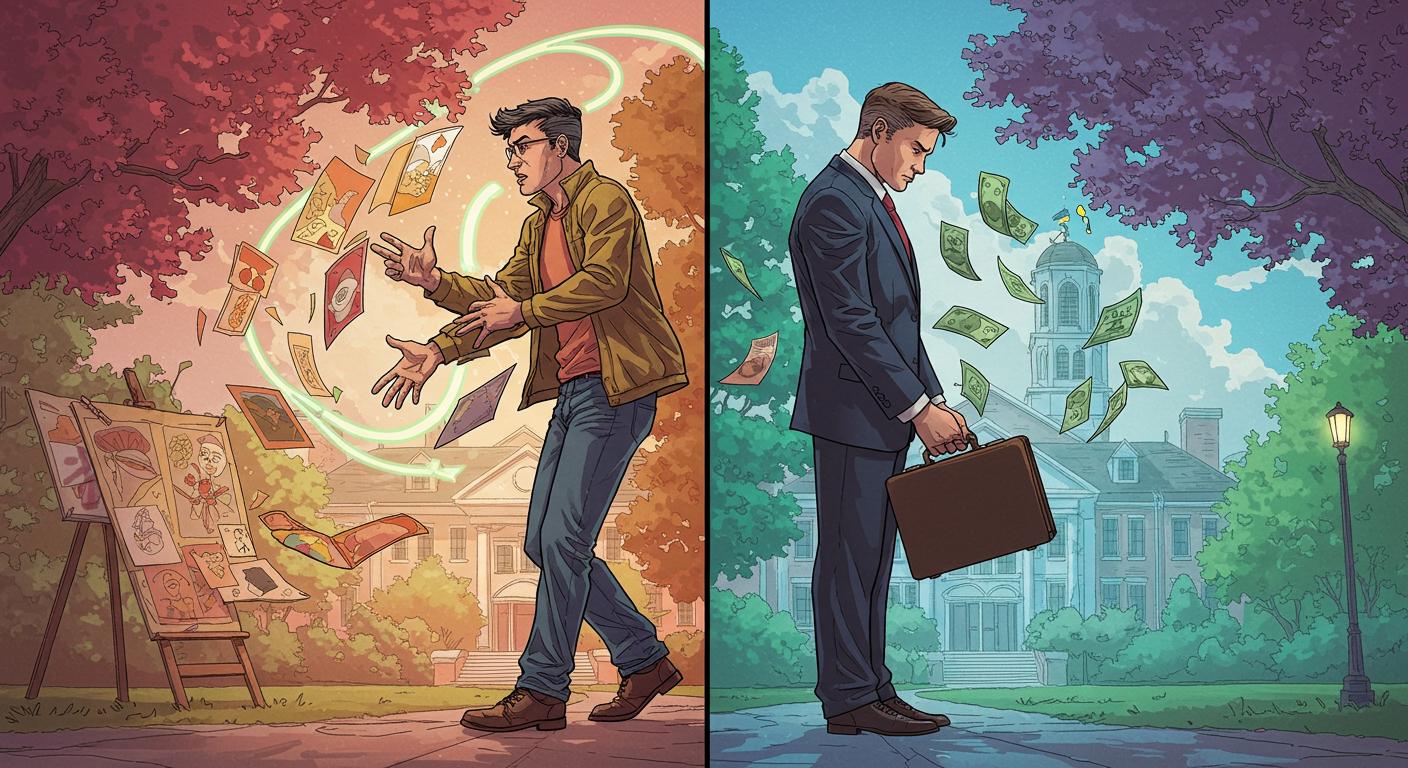
If your family dinners feature perennial debates about whether to “follow your passion” or “choose something practical,” this might be the plot twist no one saw coming. An analysis highlighted by CNBC, drawn from the Federal Reserve Bank of New York’s labor market deep-dive, shows that art history, philosophy, and nutrition majors are pulling ahead of finance and some computer science grads in the post-diploma job stakes.
The Numbers: Employment Prospects by Major (Wait, Really?)
For years, the scripting went like this: study finance or computer science for job security, and maybe paint in the garage for existential fulfillment. Yet, as CNBC details using 2023 Census numbers, the unemployment rate for recent art history majors is just 3%. Philosophy isn’t far behind at 3.2%. By comparison, computer science graduates are clocking in at a 6.1% unemployment rate—computer engineering even higher, at 7.5%. Even economics and finance majors—fields typically stamped “safe”—face unemployment at a 3.7% clip. The outlet notes these figures are notably outpacing the rate of joblessness among graduates from the oft-maligned humanities.
Digging a bit deeper into the broader landscape, the New York Fed’s research—referenced throughout the CNBC piece—reveals recent college grads are navigating a tight market, with unemployment among Gen Z households up 32% over the prior year. The overall unemployment rate for this cohort rose from 4.6% to 5.8% between March 2024 and March 2025. Yet it’s the humanities, not the STEM fields, that have edged out more reliable employment for the first time in recent memory. Did anyone have “art history major” on their workforce resilience bingo card?
Rethinking the Soft Skills Story
So, what cosmic lever shifted in favor of those cataloguing Impressionist landscapes and debating Kant? As documented by CNBC, a rising chorus of employers—including titans like BlackRock—are explicitly scouting for humanities grads. Robert Goldstein, BlackRock’s COO, is quoted in the report sharing the company’s “conviction” that they need more people “who majored in history, in English, and things that have nothing to do with finance or technology.” It appears that in a world suddenly wrestling with generative AI and automation, critical thinking, adaptability, and creativity—those elusive “soft skills”—have leapt from HR’s wish-list to the A-list. One almost wonders what Socrates would make of that particular job posting.
The interplay is almost poetic: as the market’s faith in hard skills gets scrambled by new tech forces, those who spent college reading dead languages or deciphering symbolism in Botticelli might be in the right place at the right time. The tide of “learn to code or face ruin” appears, at least momentarily, to have receded.
Stable Bets Remain: The Health Care Outlier
Not to be outdone, fields tied directly to health care remain nearly recession-proof, as the New York Fed’s findings also convey. CNBC reports the unemployment rate for nutritional science graduates is a head-turning 0.4%, and nursing majors weigh in at a low 1.4%. The Bureau of Labor Statistics, cited in the outlet, predicts healthcare and social assistance jobs will outpace nearly every other sector between now and 2033. Travis Moore, a strategist at Indeed and practicing nurse, told CNBC that persistent nursing shortages translate to admirable job security, even if initial wages aren’t as lofty as those for economists or finance grads. Sometimes, predictability is its own kind of luxury.
Some Artful Irony—and A Few Open Questions
There’s something inherently satisfying about seeing the table turn—if only for a news cycle or two. The image of the “unemployable” art historian now quietly faring better than the spreadsheet-wielding finance grad may prompt a few raised eyebrows at the next alumni event. The shifting fortunes, described throughout CNBC’s coverage, invite reflection: are we witnessing a fundamental, tech-driven revaluation of what the workplace actually needs, or is this just a brief statistical hiccup?
After all, those art history majors who spent countless hours dissecting the hidden themes in Renaissance paintings might tell you that reversals of fortune are part of the human condition. Is this a lasting realignment, or simply the artful chaos of the job market doing what it does best? One thing seems certain: the next time a college student announces a “risky” major, it wouldn’t hurt to pause before replying, “But how will you find a job?” Sometimes the answer is a bit more surprising—and, dare we say, a little surreal.