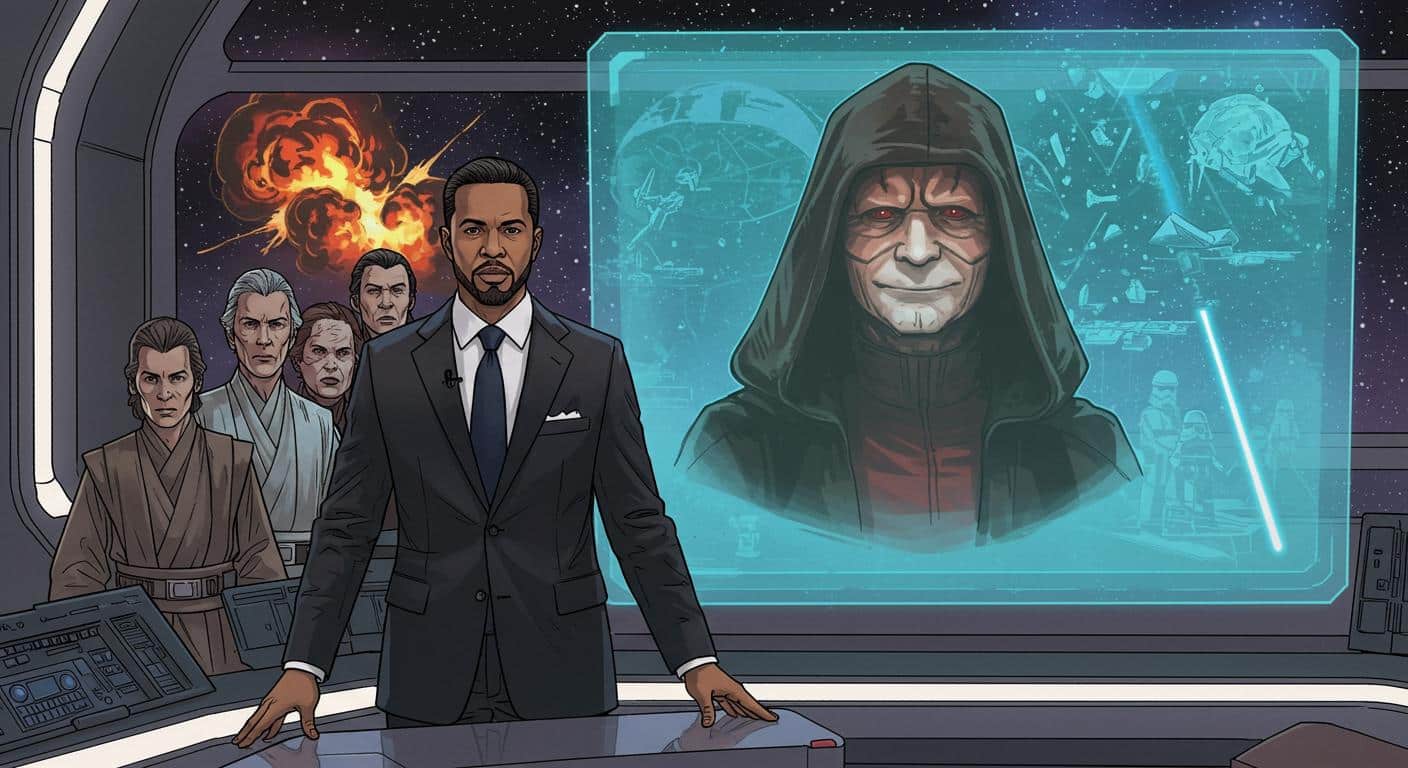
If you’ve ever wondered what happens when pop culture villains get reappraised through today’s political filter, look no further than a recent eruption on Bluesky. Scott Jennings—a commentator known for his pro-Trump leanings—has apparently decided that Emperor Palpatine, of all people, isn’t getting a fair shake. Yes, that Emperor Palpatine: the robed, lightning-slinging autocrat from Star Wars who ordered the obliteration of Alderaan and is generally considered the gold standard of galactic evil. Jennings came out swinging with a defense of Palpatine’s legacy, lobbing criticism at the Jedi, and even offering a rationale for the planetary-scale demolition that vaporized a few billion technicolor citizens.
Jedi, Hippies, or Deep State Cabal?
As detailed in the original Bluesky post, Jennings painted the Jedi in a rather unflattering light, tagging them as “unelected hippies and violent protesters.” Rather than the noble guardians portrayed in the films, his take frames the Jedi Council as a sort of galactic “deep state,” meddling behind the scenes and subverting true democracy with their own spiritual agenda. The post points out that this analogy almost feels tailored for current times, where “unelected” and “establishment” are hurled at anyone perceived to be standing in the way of political ambition.
It’s an entertainingly absurd comparison—seeing the Jedi reimagined less as samurai-philosophers and more as the galaxy’s answer to bureaucratic gatekeepers. But even with Jennings’ imaginative reframing, it’s difficult to find archival support for the notion that secretive boardroom meetings and cryptic prophecies truly put the universe at risk of malaise. If the Jedi Council really was a cabal, one wonders what Jennings makes of the Ewoks.
Alderaan: Collateral Damage or… Necessary Tough Love?
In perhaps the most forehead-raising twist, Jennings even defends the destruction of Alderaan. The post highlights his argument that Palpatine’s decision to annihilate an entire, mostly peaceful planet wasn’t evidence of sociopathic cruelty, but a decisive move against what he calls the “deep state.” While this logic may stretch credulity for most viewers (and Alderaan’s non-existent survivors), the suggestion is that planetary vaporization was more crackdown than cataclysm.
The justification almost feels like a cosmic exercise in “devil’s advocate,” echoing rhetoric sometimes seen in cable news panel debates. In a universe teeming with diplomatic options, framing the Death Star as a blunt negotiation tool is certainly playing the long game in punditry. The post captures this spectacle neatly, as Jennings’s take manages to recast an act of cinematic atrocity into a kind of administrative necessity.
When the Hot Take Goes Thermonuclear
While it’s tempting to dismiss all this as a performance in political theater, there’s an odd resonance between these galaxy-brained hot takes and the broader culture of constant re-framing. Are we truly so deep into us-versus-them mindsets that even Star Wars villains are up for political rehabilitation? The post’s rundown reads partly like a dare—a challenge to see who can come up with the wildest analogy and still keep a straight face.
But in a media landscape where virtually everything, from snack foods to sentient robots, gets filtered through a culture war lens, perhaps Palpatine’s cable news moment was inevitable. Do galactic tyrants simply need a good PR agent, or is this just a case of punditry running low on material?
It raises a few questions worth pondering: If the Empire is due for reevaluation, how long until some talking head frames Darth Vader’s HR tactics as “firm but fair,” or the Ewoks as insurgents in a treehouse uprising? The terrain of pop culture commentary is vast and strange, with room for revisionism that might surprise even Emperor Palpatine himself.
In the end, history—galactic or otherwise—seems to have a stubborn resistance to slick reframing. Still, as the Jedi caution, “Always in motion is the future.” Lately, so is the punditry.