
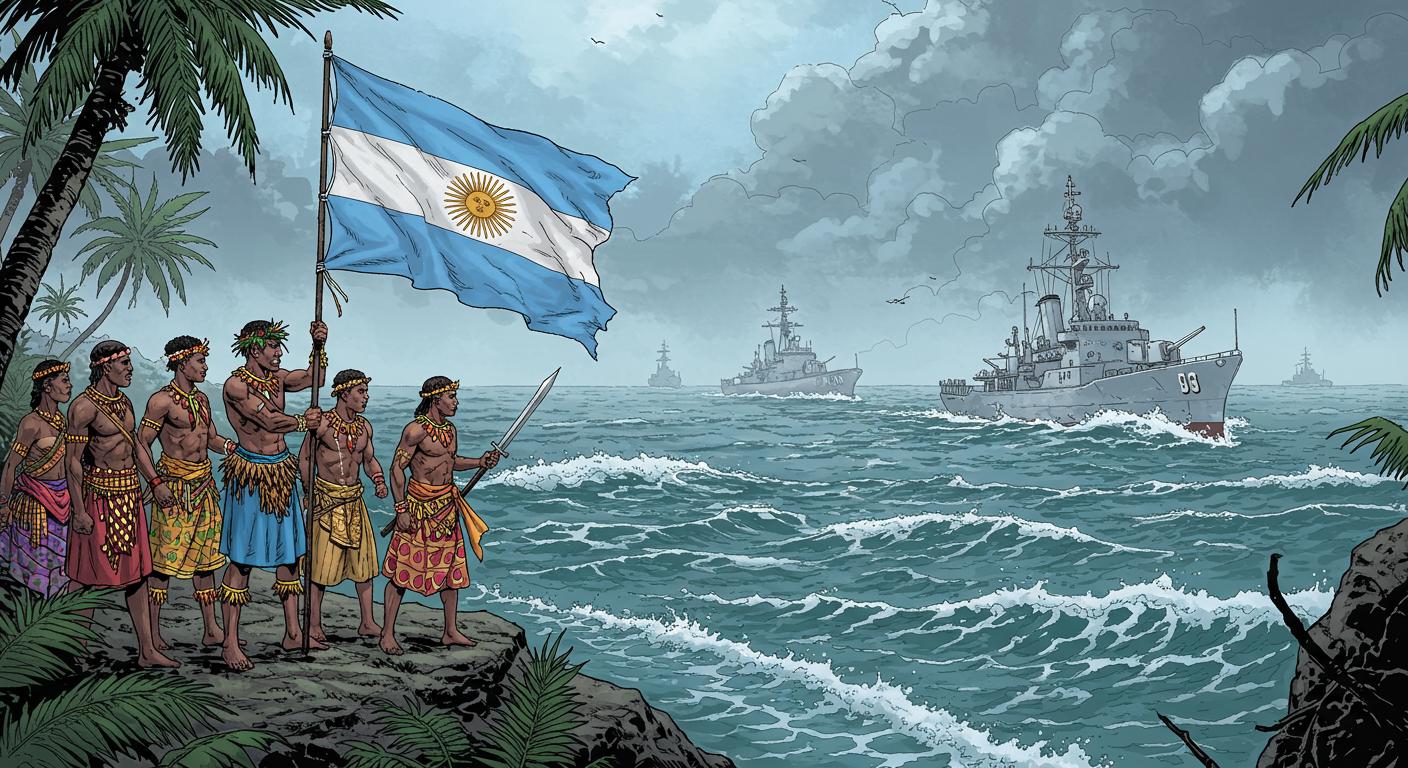
Occasionally, a geopolitical headline surfaces that feels strangely borrowed from the margins of a historical trivia manual or an especially creative diplomatic simulator. The latest case in point: Annobón, a small island off the coast of Central Africa, has asked to be annexed by Argentina. As reported by La Derecha Diario, this unlikely appeal landed in Buenos Aires courtesy of Annobonese Prime Minister Orlando Cartagena Lagar, who delivered what can only be described as a blend of plea and proposal.
A Gulf of Guinea Island Rings Argentina’s Bell
Annobón, a volcanic outcrop drifting in the Gulf of Guinea, finds itself at a desperate crossroads. The prime minister’s journey to Argentina wasn’t just symbolic—he forcefully drew attention to a serious humanitarian crisis, alleging a chronic lack of essentials such as clean water, electricity, and medical care. The island, he argued, is suffering under Equatorial Guinea’s dictatorial regime, with “systematic violence” contributing to a sense of being, in Cartagena Lagar’s blunt words, “killed slowly.” These details, outlined by the outlet, paint a bleak portrait of daily life on Annobón.
But humanitarian urgency was only one strand of the appeal. Cartagena Lagar also invoked what he described as a shared historical narrative, claiming Annobón once belonged to the Viceroyalty of the Río de la Plata before an 18th-century transfer placed it under direct Spanish control. Although historians might find this regional tie rather tenuous, the prime minister pressed Argentina to “renew” old connections in the supposed spirit of solidarity—an interpretation the publication notes is, generously, “historically controversial.”
Unusual Alliances and Hidden Motives
Beyond appeals to shared history and basic survival, Annobón’s proposition included hints at strategic partnership. The island sits on a key Atlantic maritime route and boasts natural riches in fishing and minerals—a detail highlighted in the report. Viewed from this angle, Annobón’s offer morphs into something more than a humanitarian request; it’s an invitation for Argentina to expand its global presence, potentially granting it an outpost on a third continent. For a country with longstanding interests in South America and Antarctica, the thought of suddenly becoming a player in Africa as well is, if nothing else, novel.
The question arises: are we witnessing a daring attempt at self-determination or simply a unique twist in the litany of strange diplomatic ideas floated out of necessity? The idea of Argentina acquiring a foothold in West Africa feels less like traditional foreign policy and more like the plot of an alternate timeline.
Diplomatic Tightrope
The proposal, as detailed by La Derecha Diario, hasn’t exactly set off a stampede in the halls of power. Argentina’s executive branch gave the request a polite decline, choosing instead to pass it along to Congress, where committee discussions are reportedly underway. Notably, previous declarations of Annobonese independence—in 2022, by their own initiative—have gone unrecognized by the international community, and as La Derecha Diario notes, Argentine diplomats have chosen to keep an exceptionally low profile, publicly denying any formal dialogue.
What’s at stake, from a broader perspective? Analysts caution in the original report that opening the door to Annobón could strain Argentina’s relations with Equatorial Guinea and cool regional support among African states. The situation is further complicated by ongoing disputes over the Malvinas/Falkland Islands—a longstanding international sore spot where Argentine claims have historically found some African backing. A move to accept Annobón’s plea might risk eroding precisely that support.
Footnotes from the Twilight Zone
The notion of an obscure African island seeking salvation 5,000 miles away raises more than one eyebrow. Would a diplomatic rescue mission of this kind set a precedent, or merely remain another curious episode for the record books? The precedent for such annexations is thin, to say the least, and usually hinges on somewhat firmer geographic or cultural ties.
Still, it’s hard not to feel empathy for Annobón’s population as described in these reports, caught between an unyielding regime and a distant hope for intervention. Is this bold outreach a last-ditch effort or simply what happens when all other options run dry?
In any event, the case poses knotty questions about national sovereignty, humanitarian responsibility, and the elasticity of historical bonds. Will Argentina ultimately decide to play an unexpected role on the African stage—or will this proposal fade into the archives of almost-history, another “what if” for international relations scholars to puzzle over?
Sometimes, the world delivers stories so odd they require little embellishment. Annobón’s request for Argentine annexation is one such headline: unlikely, undeniably real, and—like much of life’s true weirdness—awkwardly awaiting an answer.