
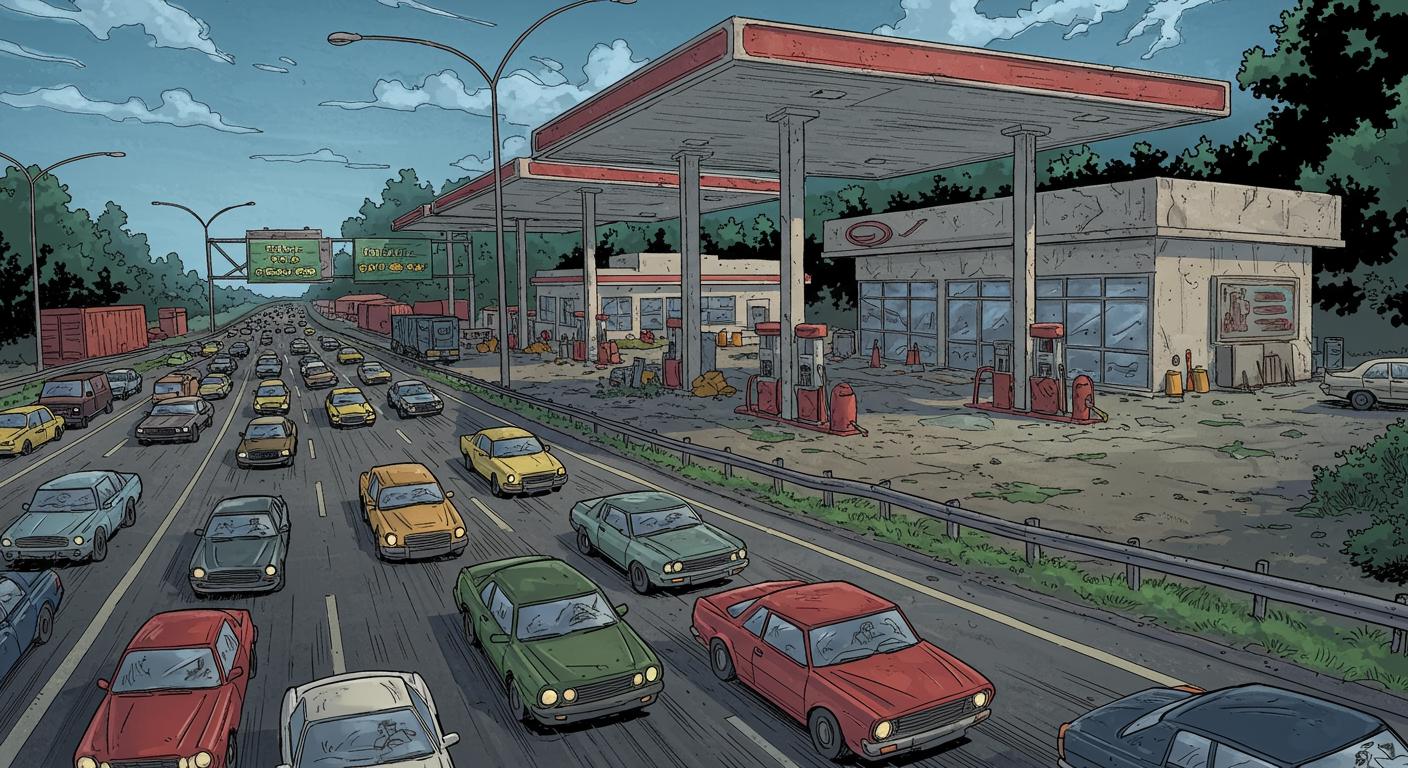
Some mornings, the news reads less like a forecast and more like a gentle suggestion to consider the merits of the bicycle. The latest episode comes courtesy of the Midwest, where more than a million drivers across Indiana and Michigan have been handed a very specific assignment: Don’t fill up your gas tank today. A surprisingly modern twist on vehicular abstinence, all thanks to plume after plume of Canadian wildfire smoke making itself at home in the Lower 48.
Gas Stations: Now a Protagonist in the Air Quality Drama
Described in Newsweek’s report, the Indiana Department of Environmental Management (IDEM) has issued an Air Quality Action Day and is urging residents, especially in the northern, northeastern, and northwestern parts of the state, to avoid gas stations as smoke from over 200 Canadian wildfires pushes particulate levels into the “unhealthy” zone. WNDU’s coverage, relayed by Newsweek, indicates that at least a million people are affected in cities such as Elkhart, Goshen, Fort Wayne, South Bend, Gary, and Valparaiso, with air-quality indexes slipping into “very unhealthy” territory.
It’s not just about gasoline itself. Newsweek cites EPA findings that even with vapor recovery systems, gas stations emit Volatile Organic Compounds (VOCs) during refueling. These VOCs rapidly evaporate, hitching a ride in the sunlight to mingle with nitrogen oxides and form ground-level ozone. Unlike the ozone that politely shields us from the sun’s rays, this variety is more likely to aggravate your lungs than offer cosmic protection. The EPA warns that ground-level ozone can kick up asthma symptoms and cause particular problems for people with heart or lung conditions—essentially, the kind of high-stakes chemistry experiment you’d rather not participate in.
Newsweek also notes that recommendations from IDEM include carpooling, biking, walking, combining errands, and avoiding drive-throughs. They even go as granular as suggesting refueling and use of gasoline-powered equipment be postponed until after 7 p.m. As if to really lean in, residents are encouraged to conserve energy by adjusting thermostats or simply turning off lights. According to details highlighted by the American Lung Association and shared by Newsweek, wildfire smoke amplifies risks for children, older adults, and anyone with respiratory issues—so the guidance to stay indoors, keep windows shut, and deploy air purifiers isn’t just a suggestion; it’s an earnest plea.
Michigan: Six Counties Under the Microscope
A separate yet uncannily similar set of circumstances is playing out north of Indiana. According to The Economic Times, authorities have placed over 1.5 million Michigan residents under an air quality advisory, encompassing Allegan, Kent, Muskegon, Ottawa, Berrien, and Van Buren counties. The Michigan Department of Environment, Great Lakes, and Energy (EGLE) warns that ozone pollution is expected to reach the “Unhealthy for Sensitive Groups” level—a metric that almost sounds polite until you realize it means “please don’t breathe too deeply today.”
EGLE, cited by The Economic Times, attributes the spike to a cocktail of high temperatures, abundant sunlight, brisk winds, and yet more wildfire smoke on loan from Canada. Residents have been advised to avoid topping off their tanks—or refueling at all—since such activities release vapors primed to jump-start ozone formation in warm, sunlit air. The outlet also notes recommendations including working from home, combining trips, and avoiding the use of gas-powered lawn tools. There’s even a pointed suggestion to switch to water-based paints if your weekend plans involved a splash of renovation.
As previously reported by The Economic Times, vulnerable populations—children, the elderly, those with asthma or respiratory conditions—are being cautioned to remain mostly indoors and to put outdoor exercise on pause for the time being.
Summertime and the Air is… Not So Easy
Taking stock of these advisories, you get the sense of a landscape in minor upheaval. In both Indiana and Michigan, walking or biking suddenly goes from nostalgia-tinged lifestyle choice to public health move. Postponing errands or working from home isn’t just the preserve of the efficiency-obsessed; it’s basic inhalation strategy.
Is this short-term inconvenience or a snapshot of summers to come? When wildfires, wind, heat, and a touch of chemistry all conspire to make errand-running a health risk, the old rhythm of “fill ‘er up on the way home” seems just a bit quaint. IDEM and EGLE, cited in their respective reports, combine to paint a picture where daily routines must be recalibrated whenever the wind changes—sometimes quite literally.
And perhaps the strangeness is the point. When topping off the gas tank becomes notable not just for the price per gallon but for its environmental repercussions on a particular Tuesday, are we inching closer to a different relationship with the automobile—and the air around us? It’s a question that seems destined to hang in the haze, waiting for a clear day.