We all have our delivery horror stories: the pizza left on the neighbor’s porch, the pad thai that apparently took a world tour before arriving lukewarm and apologetic. Still, few of us have wondered, as we track our burrito in feverish anticipation, whether it might be subject to the whims of air traffic control. That day, it seems, has arrived—if you happened to order DoorDash from within range of Chicago O’Hare.
DoorDash Takes the Scenic Route—On the Taxiway
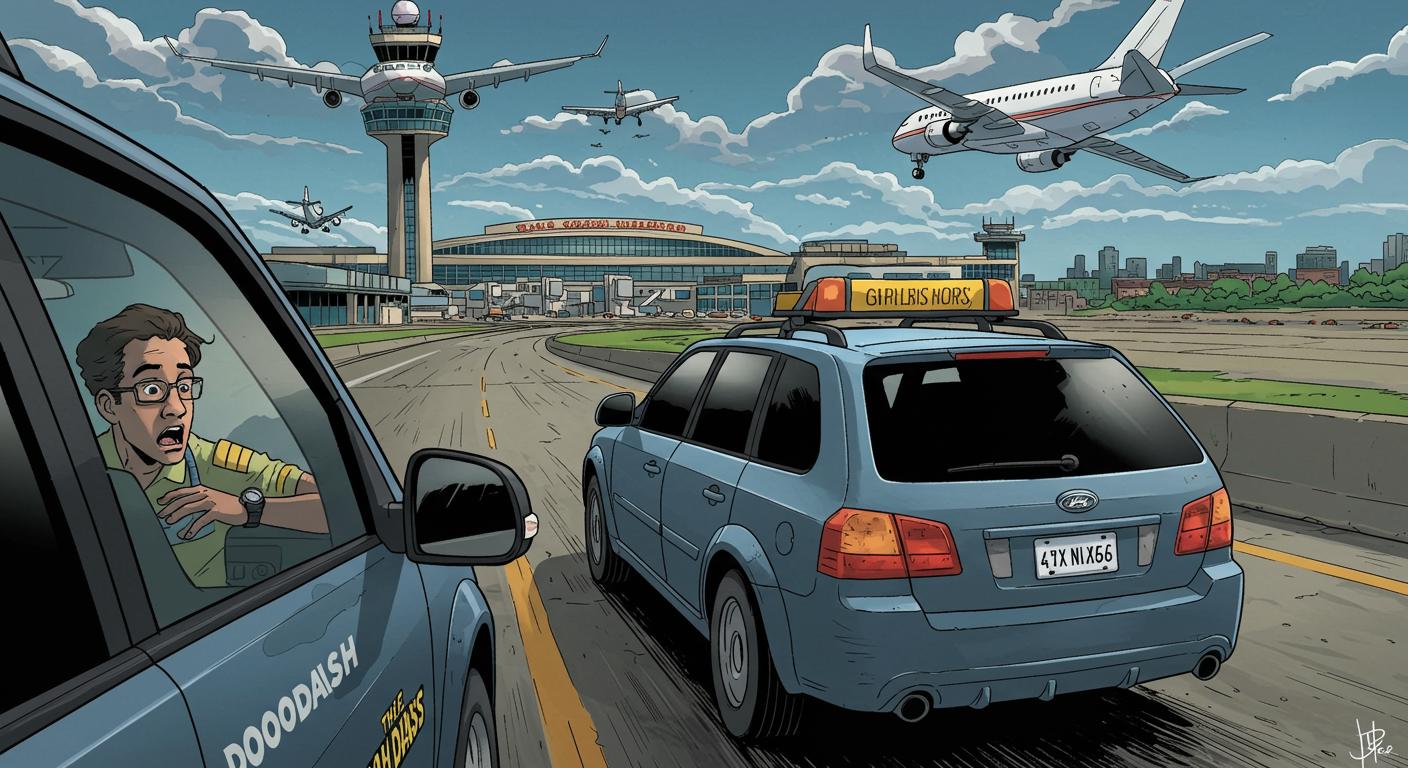
As detailed in One Mile at a Time, a DoorDash driver found himself spectacularly off-route on Saturday, May 17th, when, apparently by accident, he drove his car directly into the restricted taxiways of O’Hare International Airport. Not a high-speed chase or elaborate scheme—just a 36-year-old man, his questionable GPS, and, one imagines, a bag of food cooling with every unexpected checkpoint. According to CBS News Chicago and cited by AOL, the car traveled for miles across these off-limits corridors and possibly crossed runways before someone in the air traffic control tower finally noticed and authorities intervened.
Police told CBS News Chicago—referenced in the AOL report—that after a preliminary investigation, the driver appears to have made an honest mistake. There were no charges, no citations, and, as the Chicago Department of Aviation (CDA) confirmed to PEOPLE (as reported by AOL), “there were no operational disruptions or safety incidents reported, and the area was promptly swept by CPD and Aviation Security personnel out of an abundance of caution.” The incident, while undeniably unusual, ended with little more than a slightly surreal anecdote for all involved.
It’s hard not to appreciate the sheer everydayness of it all. Who among us hasn’t followed a GPS with mounting unease, hoping the payoff will not be, say, a tarmac filled with perplexed pilots?
Security, Human Error, and the Perils of Navigation
Both sources highlight how the incident raises larger questions about airport security—not through nefarious intent, but via the sort of thoroughly ordinary blunder that’s difficult to anticipate. The outlets document that the vehicle entered through an access point, rolled past multiple secured zones, and covered several miles of forbidden ground before being discovered. It’s the kind of sequence that prompts officials to dig out stage one procedures and ask, with a hint of disbelief, “Wait, how did this even happen?”
The CDA’s statement to PEOPLE, relayed by AOL, stressed that: “The CDA is taking this matter seriously and will use the findings of the investigation to inform any necessary follow-up or corrective measures.” It seems likely there will be some side-eye at the next security team meeting and perhaps a little less trust in “default closed” gates.
DoorDash, for its part, characterized its own role in the situation with understated alarm. In a statement to PEOPLE, also noted by AOL, DoorDash said, “We’re actively looking into what happened at Chicago’s O’Hare International Airport, which looks to simply be a case of a driver getting lost.” There is a certain humility in having to announce that your delivery network is, indeed, not certified for runway crossings.
In a detail highlighted by the AOL article, former air traffic controller Robert Mark told CBS News Chicago that while such mishaps are rare, he has seen them before at other airports, and the experience can be “frightening.” He pointed out that, under different circumstances—“if this had been at night… Headlights all look the same pretty much in the dark”—the story could have ended differently.
When Algorithms Collide With Reality
One Mile at a Time’s readers, in their typically lively manner, mentioned a very practical hazard: navigation tech itself. As described in a top comment, DoorDash’s built-in mapping functions can, apparently, guide drivers to some odd places, and attempts to override the app may lead to glitching or crashing. Perhaps the most quietly comic takeaway is that it may not be human confusion at fault, but the persistent misdirection of an overconfident smartphone.
So, was the driver genuinely under the impression he was making a delivery to Gate C23, or simply following step-by-step as his app ushered him deeper into the land of jet fuel and flashing lights? No one can say for certain, but it adds to the overall strangeness: in a world dependent on algorithmic guidance, losing the plot is just a wrong turn away.
Reflections From the Tarmac
As CDA authorities confirmed to PEOPLE, reported by AOL, the aftermath was more anti-climax than catastrophe: there was no operational disruption, no safety incident, and, unless we hear otherwise, only the state of the actual food delivery remains unresolved. The DoorDash driver, for better or worse, may now hold the record for most circuitous gig-economy route ever taken.
Events like this—drifting somewhere between airport procedural drama and slow-burn sitcom—reveal just how odd things can get, even in systems built around precision and control. If your next order seems stalled in a suspiciously aviation-related location, perhaps give it a few extra minutes. Sometimes your lunch really does have to taxi for a while.
And after all this, one has to wonder: Will navigation apps learn a lesson, or will O’Hare’s security planners begin treating spring rolls as potential runway incursions? Perhaps the true absurdity lies in just how normal the abnormal can become.