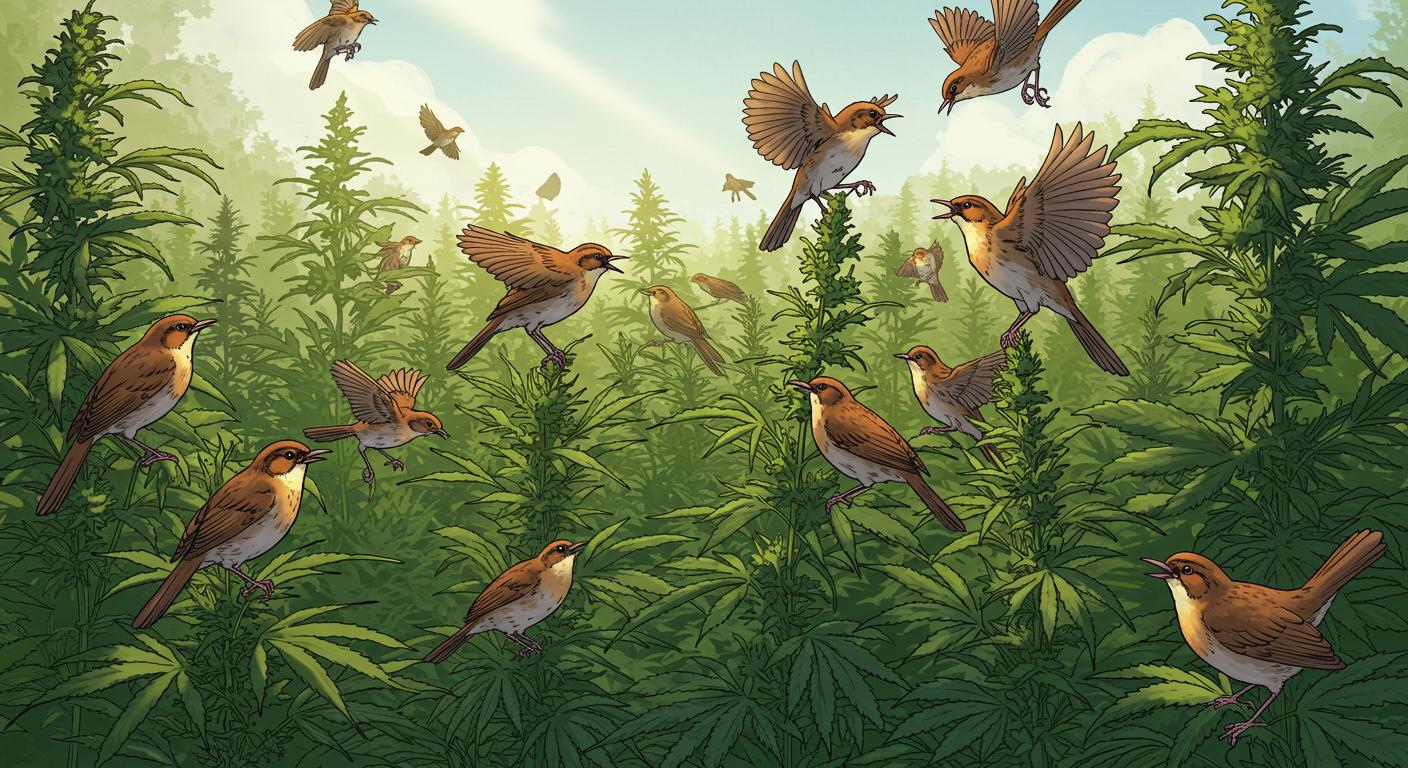
There’s always something oddly satisfying about nature giving a polite nod to human innovation—or, in this case, agriculture’s slightly rebellious cousin. As detailed in an article from BirdGuides, Germany’s Marsh Warblers have developed quite a fondness for hemp fields. This isn’t your cousin’s makeshift operation, but regulated, large-scale Cannabis sativa grown for industrial purposes in Lower Saxony. The real surprise: this crop appears to be the new hotspot for a certain migratory songbird.
Marsh Warblers Make Themselves at Home (Among the Hemp)
During a breeding bird survey in June 2024, researchers recorded 26 singing male Marsh Warblers in a 27.5-hectare hemp field at Neurhede. BirdGuides reports that, by contrast, only three males turned up across a much larger 669-hectare patchwork of the warbler’s usual habitats—nettle beds, meadowsweet, willowherb, and odds-and-ends by ditches, both wet and dry. It’s a striking disparity: not just a fluke of observation, but a meaningful pattern documented through systematic survey work.
Adding to the novelty, the outlet notes that males were observed perching atop hemp plants, singing for minutes at a time, and behaving in ways that suggested nesting in at least six instances. In a detail highlighted by BirdGuides, further visits in July 2024 found four additional males in three different hemp fields—fields sown later and still growing—mainly near field edges but as much as 74 meters inside. This behavior lines up with the recorded tendency in these birds to nest in dense, tall herbaceous cover.
If this all sounds unprecedented, it is worth noting that BirdGuides, citing Ornithomedia and earlier ornithological records, reveals a long-standing relationship: as far back as 1819, the naturalist H. R. Schinz remarked on Marsh Warblers frequenting hemp fields. More recently, the outlet documents a 1997 record of 12 singing males in two Saxony-Anhalt hemp fields (18 hectares total), followed in 1998 by confirmed nesting in 21 plots. So, while the scale of today’s findings is notable, history suggests this isn’t a brand-new warbler fad but rather a revival of a much older pattern.
A Conservation Win… or Just a Convenient Refuge?
While BirdGuides clarifies that the Marsh Warbler remains globally classified as “Least Concern” by the IUCN, the species has been experiencing steady regional declines. The outlet reports a 1–3% drop in Germany between 1980 and 2016, with populations in Lower Saxony and Bremen crashing by as much as 40% between 2003 and 2023. The article attributes these decreases primarily to intensified agriculture: think fewer fallow patches, more herbicides, and a general decline in the messy vegetation warblers once counted on.
In this context, the hemp field bonanza takes on a new significance. BirdGuides suggests that, should future fieldwork confirm successful nesting and chick-rearing among the hemp, these crops could form an important, if unconventional, conservation stronghold—especially in Western and Central Europe, where populations are in freefall. Of course, one has to wonder: is this a sign of remarkable adaptability, or evidence that warblers are being pushed to the ecological margins, settling for whatever cover remains? An accidental sanctuary is still a sanctuary, but it’s a reminder of how far the “natural” landscape has shifted.
Hemp Fields: Not Just for Hippies (and Now, Not Just for People)
The history of hemp cultivation in Europe is tangled and up-and-down. As BirdGuides describes, after dwindling almost to extinction in the mid-20th century, hemp has been making a quiet comeback, largely for industrial and nutritional uses—textiles, insulation, and health food, not just the recreational variety that raises eyebrows at customs. The outlet also notes hemp’s credentials: seeds rich in vitamins and protein, oil loaded with polyunsaturated fatty acids, and fibrous stalks fit for textile weaving.
What’s perhaps most curious is how readily Marsh Warblers have shifted their allegiance. Whether sitting atop hemp stalks or slipping between rows, these birds seem to be making the most of a crop few would have pegged as critical wildlife habitat. Would the late-18th century botanists who first chronicled hemp’s agricultural role be surprised to see songbirds making a similar calculation? Or perhaps just quietly amused.
Ultimately, BirdGuides raises the prospect—echoed by fieldworkers and ornithologists over two centuries—that artificial habitats may blend more seamlessly into the ecological quilt than we typically imagine. A modern industrial crop, once controversial for all the reasons you’d expect, may inadvertently offer what pesticide-laced margins and manicured fields cannot.
So, as policy debates swirl and hemp’s industrial value is reassessed, Marsh Warblers seem to have cast their own vote—one staked on tall, swaying stalks and the promise of decent nesting cover. It leaves a slightly whimsical thought in the air: what other wildlife experiments are underway right now, playing out in the quietly untidy corners of our agricultural world?