When Boats Leave the Harbor—Vertically
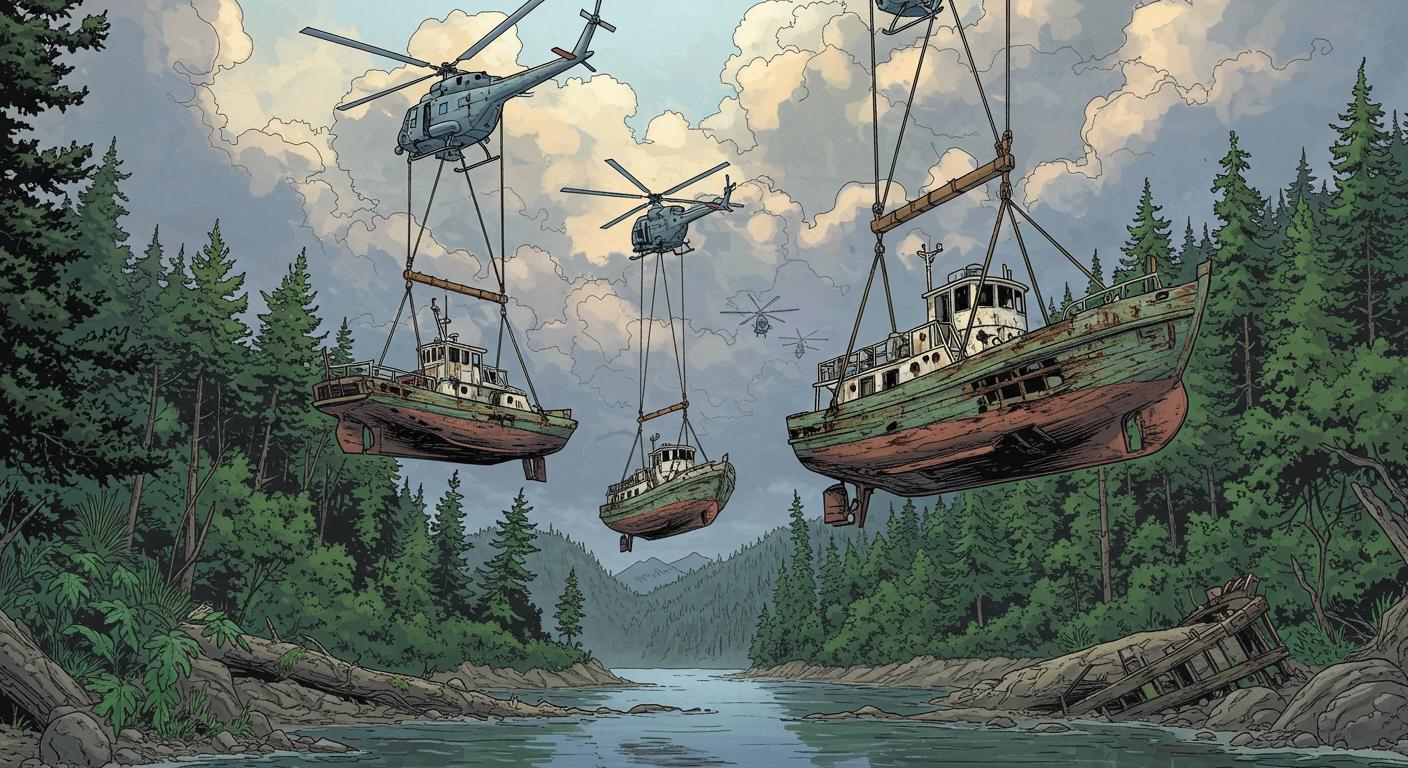
Every so often, reality coughs up a spectacle so peculiar that even the most seasoned internet trawler (guilty as charged) does a double-take. This week in Olympia, Washington, the sky itself played host to a rare twist on maritime salvage: as detailed in an Associated Press report, locals were treated to the unusual sight of derelict boats—some, masts and all—being hoisted off Squaxin Island and ferried through the air by firefighting helicopters. It’s hard not to feel a pinch of envy for the barnacles who just got the ride of a lifetime.
Kate Gervais, owner of the Boston Harbor Marina, has likely logged more eyeball hours on boats than most, but still described the airlifted fleet as “a very, very weird sight” to the AP. Apparently, the image of a sailboat soaring overhead has a way of resetting even a seasoned mariner’s sense of normal. Who says the Pacific Northwest doesn’t believe in airships?
Helicopters: Now Accepting Dead Boats
Why not just tow the boats out the old-fashioned way, you might wonder? According to officials cited by the AP, helicopters are called in to spare the fragile marine bed—especially kelp forests, which do more for local forage fish (and by extension, salmon) than most people realize. Dragging a sunken hulk through prime underwater real estate just isn’t sporting. Agency staff noted that these vessels often wedge themselves into coves, mud, or even hide at the treeline, further complicating traditional recovery methods.
The choice of aircraft wasn’t just for show, either. The report points out that while private pilots usually handle such removals, leveraging a state-owned firefighting helicopter allowed the Department of Natural Resources (DNR) to make the most of a $1 million NOAA grant. Commissioner of Public Lands Dave Upthegrove explained that the grant let the state stretch every dollar further, with helicopter retrievals proving both more cost-effective and more environmentally benign for this mission.
It’s not the department’s first foray into nautical spring cleaning. Since 2002, DNR has plucked over 1,200 derelict vessels from Washington’s waterways, AP records indicate. Yet an estimated 300 more boats lurk in the shallows and side channels, with new wrecks appearing on a depressingly regular basis. Upthegrove is blunt about the recurring cause, telling the outlet that many folks “dump their old boats into the water because they don’t want to deal with disposing of them”—a habit that foists the problem onto taxpayers and, occasionally, the nearest available helicopter.
A Mission with Deeper Roots
For this particular operation, the setting was far from arbitrary. The federal grant enabled the state to target vessels littering the shores of Squaxin Island, a place of significant cultural and historical value to the Squaxin Island Tribe. As detailed by the AP (drawing on the tribe’s own records), Squaxin Island was reserved for tribal use following the 1854 Treaty of Medicine Creek and still serves as a site for fishing, hunting, shellfish gathering, and camping.
Daniel Kuntz, policy and program manager for the tribe, described to the AP the enthusiasm for collaborating with the state: maintaining access to clean beaches and water remains essential for cultural continuity and future generations’ stewardship. There’s a tidy irony lurking here—modern technology swooping in to clear away the flotsam of modern neglect, all in service of very old traditions.
Oddities Aloft and Lessons Below
As someone whose job it is to sift through humanity’s stranger hallmarks, I admit the mental image of a slow-moving conga line of boats, barnacle-encrusted steering wheels and all, floating through misty skies is hard to top. There’s a wonderful absurdity in solving a problem created by collective apathy with the sort of resourcefulness usually reserved for wildfire season.
But what are we to make of a world where it’s logistically simpler (and, impressively, cheaper) to evacuate a boat by air than it is to motivate owners to handle things responsibly before their watercraft become historic artifacts? The AP’s reporting highlights the scale of the ongoing issue—a steady stream of unwanted vessels, and the reality that every unsolved problem eventually leaves someone else holding the tow cable. Or, apparently, the helicopter winch.
Will this become an annual airborne parade? Or will the spectacle—and expense—of flying stranded boats off sacred islands finally remind us that preventive care beats aerial intervention? I’m not holding my breath, but you have to appreciate the ingenuity, however awkwardly we land on it.
Somewhere between the ground and the clouds, amidst ropes, rotors, and the unlikeliest of cargo, the solution to maritime neglect floats tantalizingly out of reach—at least until the next grant, the next helicopter, and, inevitably, the next “flying boat” sighting. And if this isn’t an entry for the annals of very Pacific Northwest sorts of problems, I don’t know what is.