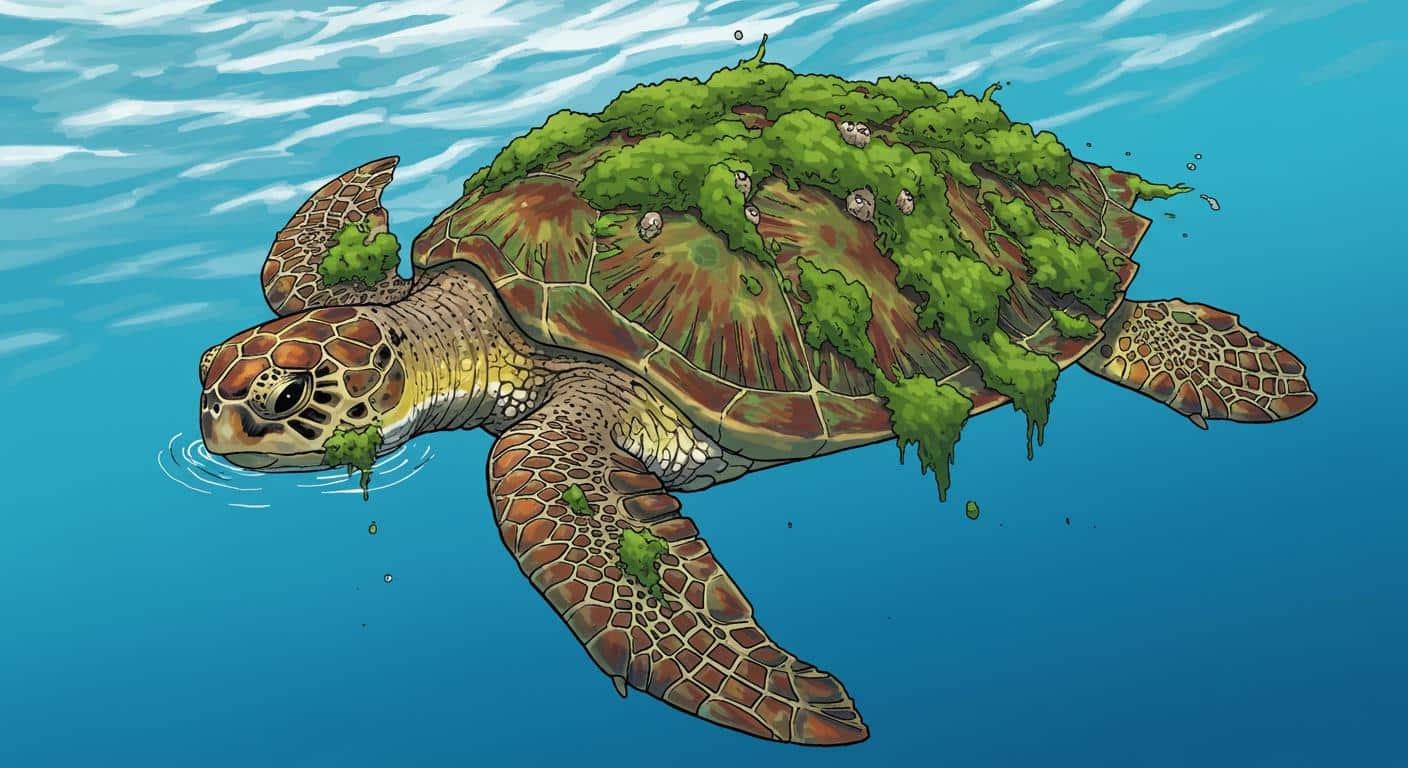
Every so often, a story paddles its way out of the surf and straight into the weird corner of marine biology, inevitably ending up in my inbox with the subject line: “You have to see this.” Case in point, the tale of one juvenile green sea turtle from North Carolina who, however inadvertently, managed to accessorize herself with what rescuers described as more than 1.5 pounds of clinging oceanic life—barnacles, algae, and an assortment of other hangers-on hoping for a free ride. There are makeovers, and then there’s being transformed into a floating reef.
From Turtle to Temporary Mobile Home
As detailed by UPI, the Cape Hatteras National Seashore’s resource management team responded to a call about a stranded juvenile turtle. Stranding is never a great sign for a turtle, so she was transported to the Sea Turtle Assistance and Rehabilitation Center at the North Carolina Aquarium for what could generously be called a spa day—less generously, a desperate cleanup operation.
According to UPI’s summary of a social media statement from the seashore’s staff, the turtle was “found with a heavy load of epibiota including barnacles, algae, and other sea creatures.” That term, “epibiota,” describes the opportunistic organisms (think: barnacle squatters) that call another animal’s surface home. In this particular case, the turtle was burdened by what amounted to a family-sized bag of sugar in barnacles and algae, all attached to her shell.
Few turtles aspire to nautical bling measured in pounds, and for an animal built for streamlined swimming, it’s a serious handicap. UPI relays that the rehabilitation team ultimately removed more than 1.5 pounds of this unwanted cargo. You have to wonder: Has anyone ever felt such immediate relief—animal or otherwise—than this turtle, dropped off at the center and divested of a small ecosystem?
Heavy Shell, Heavier Implications
Stories of marine oddities abound, but even within that crowded field, a turtle this thickly encrusted with freeloaders stands out. UPI points out that while the occasional barnacle or dab of algae is normal on a healthy turtle, such a dense collection of epibiota signals something’s not right. Typically, only a sluggish or ill turtle would accumulate this magnitude of hitchhikers—quick, healthy swimmers simply don’t provide the long-term lease these creatures require.
This creates a small biologist’s riddle: Was the turtle rendered immobile and stranded by the added weight and drag, or did her inactivity invite the squatters in the first place? UPI notes that after her dramatic cleanup, the green turtle was much more active, offering a hopeful reminder that sometimes rehabilitation does work—or at least, that removing a pound and a half of unsolicited roommates offers its own health benefits.
The Reluctant Trendsetter
If you’re tempted to view this turtle as a pioneer in oceanic accessorizing, perhaps it’s time to reconsider the look as a walking cautionary tale. There’s an understated irony here: a creature built for hydro-efficiency transformed, through misfortune and barnacle tenacity, into a slow-moving ecosystem. In a detail shared by UPI, staff at the turtle center observed that following her cleansing, the green turtle was “already looking much more active,” which seems to confirm that less is very much more when your design philosophy is “streamlined, not barnacled.”
Shells, Stories, and the Stuff That Sticks
What are we to make of a turtle turned temporary cruise ship for barnacles, algae, and friends? If nothing else, as UPI’s rundown of the saga reminds us, life in the ocean (like everywhere else) is about opportunity—sometimes for the resident, sometimes for the squatters. The turtle’s episode is a tidy intersection of odd luck, aggressive colonizers, and, thankfully, the timely intervention of humans who know a shell in distress when they see one.
A “heavy load of epibiota” might sound like the next frontier in spa treatments, but in the real world, it’s an invitation to rehab—occasionally, that’s the exact rescue tale you need. One can’t help but wonder what other sea creatures are right now hauling their own accidental sublets under the surface—if nothing else, the barnacles will keep looking for their next big score. The circle of marine life is nothing if not persistent… and slightly sticky.