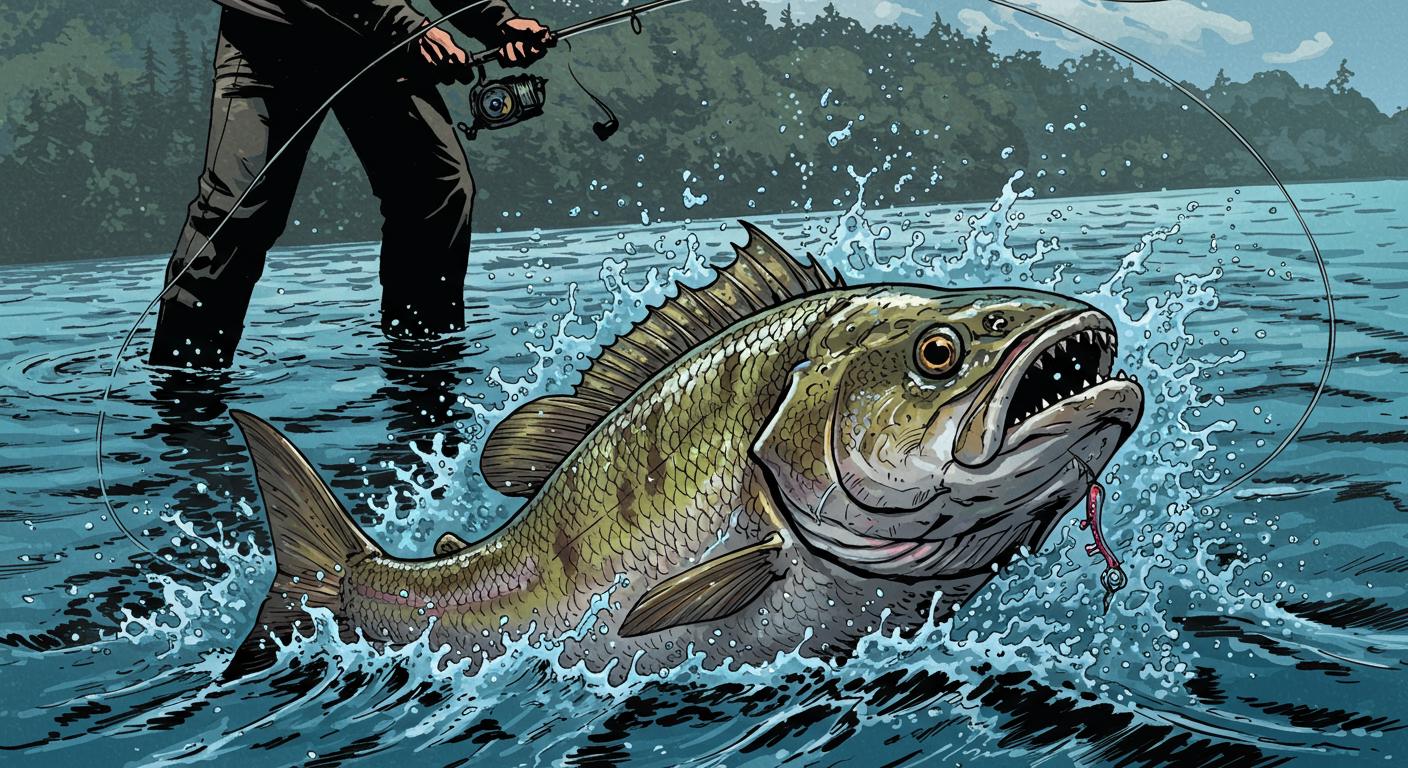
If you’ve ever wandered past a supermarket seafood counter and found yourself wondering how—exactly—a fish feels about its brief and turbulent journey from water to shrink wrap, well, science now has an answer. Spoiler: it’s grim. In a recent Earth.com article reviewing new research published in Scientific Reports, it’s made painfully clear (forgive the word choice) that fish, specifically the humble and much-consumed rainbow trout, do not go gently into that good night. Quite the opposite, in fact—they experience something shockingly similar to “intense pain,” sometimes stretching on for up to 25 minutes after being pulled from the water.
A (Slow) Gasping Truth
As detailed by Earth.com, the researchers broke down the trout’s suffering into four agonizing time segments, from the initial alarm of being removed from water to the slow depression of brain activity that marks the onset of unconsciousness. By combining behavioral and neurological evidence—such as EEG signals, reflex loss, and observations of gasping and distress—the team estimated that, on average, a trout endures a solid ten minutes of what they categorize as “hurtful, disabling, or excruciating” pain. In some scenarios, this duration can extend well beyond 20 minutes.
Perhaps the most eyebrow-raising metric is their invention of the Welfare Footprint Framework, described in Earth.com’s report as a sort of pain odometer that translates a fish’s suffering into minute-by-minute increments. For those keeping track, that’s about 24 minutes of severe pain per kilogram of fish. If you’ve ever tried to hold your breath underwater for even a fraction of that, you have the start of an idea.
The Method to the Miserable
Air asphyxiation—essentially leaving fish to suffocate after they’re pulled from water—is both legal and widespread, as Earth.com outlines. Chilling fish in ice or slurries might sound like an upgrade, but for cold-hardy fish like trout, it often simply prolongs the agony, inflicting additional injuries and dragging out consciousness. The researchers also note that suffering can begin well before slaughter, with crowding, transportation, and rough handling adding hours of stress and compounding the misery.
The Technology of (Slightly) Less Suffering
There are proposed solutions. According to the Earth.com report, electrical and percussive stunning can, in principle, spare significant suffering—electrical stunning has the potential to prevent between 60 and 1,200 minutes of pain for every dollar invested. But practical issues, like misplaced electrodes, inconsistent voltage, or malfunctioning equipment, often render these interventions unreliable. Percussive stunning, which involves a precise physical blow, is more consistent in a lab but tricky to scale for commercial use; different fish sizes and worker fatigue turn consistency into a moving target.
It raises an odd question: Are we technically advanced enough to send emails from refrigerators but stumped when it comes to swiftly and painlessly knocking a fish unconscious?
A New Lexicon for Aquatic Agony
One of the distinctive elements of the Welfare Footprint Framework, according to Dr. Wladimir Alonso as quoted by Earth.com, is its transparency and flexibility. Instead of offering neat labels, the framework uses probabilities—a 40% chance the pain is disabling, a 40% chance it is excruciating—resulting in a model that’s better attuned to real-world uncertainty. Not all fish experience the same thing, even under the same conditions. Pain, it seems, is as individual as taste in music.
So while the resulting conversation might not be ideal over dinner, this new language—measuring suffering in minutes saved—helps make the abstract more concrete. If we routinely count the carbon footprint of our coffee, is it really that strange to consider the pain footprint of whatever’s on our plate?
Implications: Beyond the Scales
While the focus here is on rainbow trout, the mechanisms of pain—oxygen deprivation, acidosis, metabolic failure—are broadly shared among other fish. As noted by Earth.com, the researchers indicate that salmon, catfish, tilapia, and seabass likely endure similar experiences when exposed to air, though differences among species mean there’s more data to gather. This points squarely toward the need for further research, but the central pattern is clear.
For those crafting policy or industry guidelines, this new evidence offers a foundation for reform. Modernized standards for effective stunning and truly humane slaughter methods seem not just possible, but overdue. Certification schemes, the article notes, can now move toward standards that reflect real pain data—not just the appearance of effort.
Reflection: The Cost of a Fish Dinner
It’s a reasonable question: Do fish really feel as we do? For decades, the prevailing wisdom—perhaps out of convenience—said “no.” Yet, as summarized in Earth.com’s analysis, mounting evidence keeps tipping the scales in the other direction. With trillions (yes, with a “t”) of fish slaughtered annually, even seemingly small improvements quickly multiply into significant change.
So, with the scientific community building a new metric for aquatic misery, one has to wonder: Is this enough to broaden our sense of empathy, or are we approaching a time when “humane fish slaughter” won’t sound quite so oxymoronic?
If nothing else, the takeaway is clear: Despite the old adage about fish feeling nothing, the latest science suggests they might just feel a lot more—and for a lot longer—than we’d like to admit.