You know a product is oddball when the reason for its recall is, quite literally, “it has too much space.” Welcome to 2025, where Volkswagen’s long-awaited, retro-futurist ID. Buzz has finally made its U.S. debut—only to have sales immediately grind to a halt. Why? The back bench seat, according to nothing less than the National Highway Traffic Safety Administration, is deemed too wide for its own good. This is not a plot twist I anticipated, but with the reincarnated VW Microbus, absolutely nothing has gone according to the usual script.
A Recall Rooted in Rear Seat Real Estate
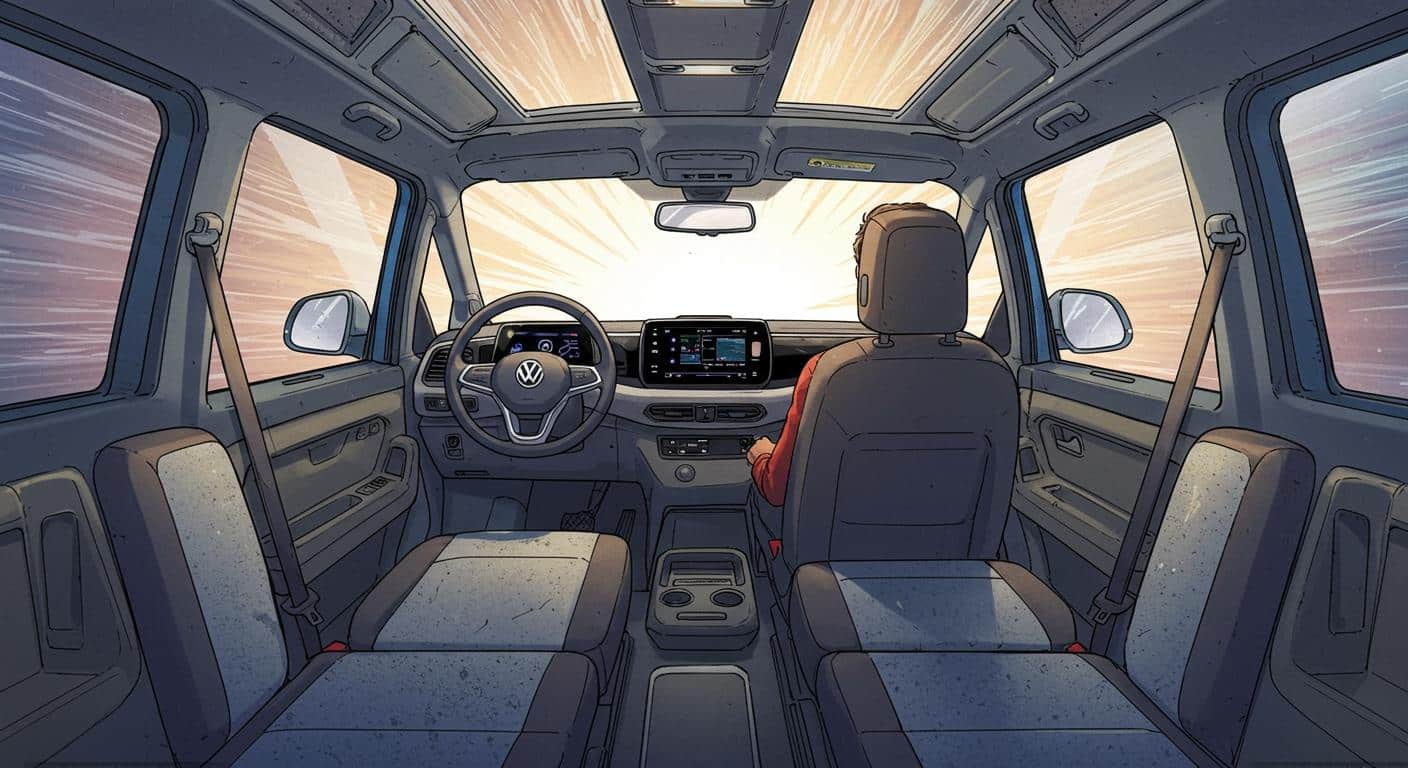
Let’s clear up the particulars before the punchlines write themselves. According to USA Today, the third-row bench seat in the U.S.-spec 2025 Volkswagen ID. Buzz is so wide, it could easily fit three passengers, yet Volkswagen only fitted it with two seat belts. The National Highway Traffic Safety Administration says this runs afoul of Federal Motor Vehicle Safety Standard 208: if there’s enough space for more people, there must be enough belts for them too. Volkswagen notified its dealers of the issue in late April and plans to alert owners by June 20, with 5,637 vehicles affected in the U.S. and another 771 in Canada, as compiled by The Drive. In the meantime, a stop-sale order has sidelined new and used ID. Buzzes on dealer lots across North America.
Not a Simple Fix—And No Third Belt in Sight
Given the cause, you’d think Volkswagen’s solution would be to add a third seat belt. Logical, right? Instead, The Drive details that Volkswagen’s official fix is to install a trim piece that physically narrows the seat area, rather than increase safety equipment. Essentially, the company is making it clearer that only two people are meant to squeeze into that generous bench—even if there’s room for a third. The specifics of this trim piece haven’t been released, and it’s unclear exactly what form this space-shrinker will take, but this is the approved compliance path. The adjustment will be performed free of charge at dealerships.
Did no one, at any point in the long process of bringing the ID. Buzz stateside, notice just how much real estate was on offer back there? Or is this a case study in how federal standards sometimes crash into optimism about human comfort? Even as The Drive wonders aloud about the rare recall for being “too wide,” the underlying logic is as bureaucratic as it is unyielding: if it looks like three can fit, you’d better make sure nobody tries without a buckle.
The Design Ironies Just Keep Buzzing
This is probably the most on-brand recall Volkswagen could have dreamed up for its 2025 World Car Design award winner. As detailed in USA Today, the van stands out for its witty blend of classic Microbus homage and audacious futuristic flair—a vehicle so insistent on pleasing the whimsical, nostalgia-loving driver that it scandalized a safety agency with its generosity. That same report relays the verdict of Top Gear, who observed, “we love it because it’s different, because it’s a new anti-SUV template, because it’s fun to be in and around.” Apparently, the abundance of fun even extended by the square inch to the back seat.
Instead of leaning into the altogether rare problem of seats that are “too inviting,” Volkswagen’s solution is to pare back, not add. There’s a certain Teutonic logic to this, if nothing else: meet the law, trim the dreams, and do it quickly.
A Van Out of Time, or Just a Victim of Its Own Success?
The ID. Buzz’s journey to U.S. dealers already felt improbable—a multi-year odyssey culminating in a vehicle so cheerily out of step with automotive trends that it arrives not just as a family hauler but as a rolling statement piece. Now, its very first American recall comes from making road trips too comfortable—proof, perhaps, that even the best intentions can spiral into a Kafkaesque loop of regulation and design.
USA Today also breaks down some details for curious shoppers: the Buzz starts at nearly $60,000 and doesn’t qualify for the federal EV tax credit, since it’s built in Germany. Even setting aside the spaciousness of its bench seat, it stands apart for specs, looks, and general approachability—never quite playing by the usual rules.
So, is it possible for a car to be “too comfortable” to be legal? Will other automakers start nervously measuring their own back seats, or is this just one of those quixotic moments that’ll be quietly fixed with a bolt-on hunk of new plastic? The whole saga feels like a strange collision between innovation, optimism, and regulation—a reminder that sometimes, too much of a good thing is only a problem on paper, but a problem nonetheless. Strange times, indeed.