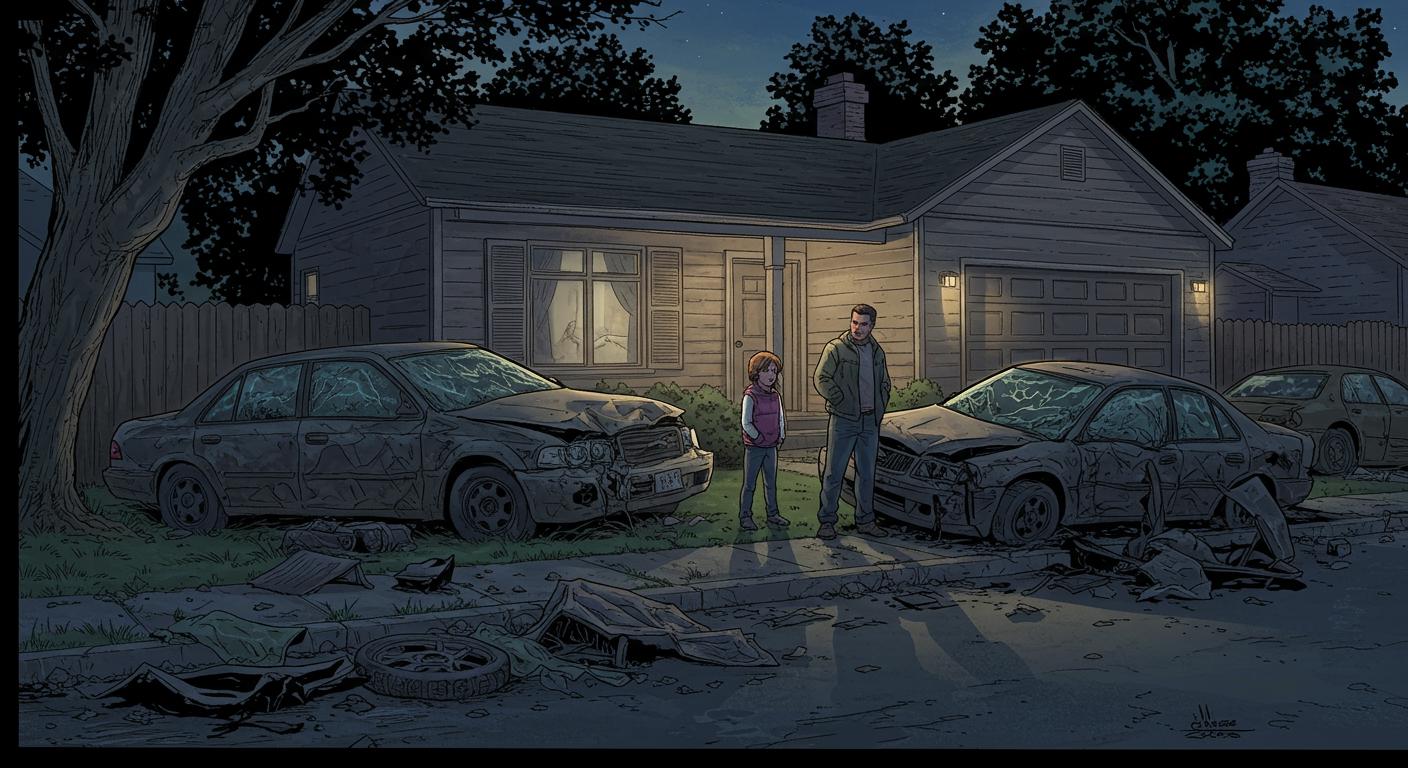
Some stories blur the line between local oddity and urban myth, but the saga of the Stoll family’s home in Denver is, regrettably, all too real. According to a report from 9NEWS, the Stolls are reluctantly considering selling their house—not for the usual reasons of life change or relocation, but because their address appears to be a kind of timeshare for runaway vehicles.
Where Street Design Meets Pinball
Let’s get our bearings: for 27 years, the Stolls lived at the intersection of Monaco Street Parkway and 17th Avenue. Over the past sixteen months, their house has been struck by cars not once or twice, but three times—part of a grand total of five crashes at that corner in under a year and a half, as chronicled by 9NEWS.
If this all sounds like the setup for a physical comedy routine, the reality is strikingly less funny. Dave Stoll, who could probably now minor in crash forensics, recounted the latest episode: late on a Saturday night, a car carrying three teenagers barreled down 17th Avenue at what Stoll estimates was well over 70 miles per hour. Details from the outlet reveal that the vehicle didn’t just wander off the road; it sailed straight across a median, hopped some so-called protective boulders, and then launched itself through the family’s yard and into their actual house. At this point, you almost wonder if the house has considered installing a scoreboard.
But Stoll is quick to point out this is hardly a recent phenomenon. Over the past two decades, he notes, drivers have repeatedly failed to notice that 17th veers left—especially at night, when a green light seems to lull motorists into a game of “follow the line,” with the front porch as the finish line. The result? Dozens of vehicle-versus-house run-ins, the worst of which tore through three floors and carried a repair bill of $440,000, according to the damage figures cited in the report. Contractors were still working on repairs from that December 2023 disaster when yet another crash cut things, quite literally, short.
A Home Reimagined as Obstacle Course
The neighborhood’s not exactly enchanted with its new reputation. The Stolls, along with neighbors, have repeatedly contacted city officials about safety upgrades—with relatively humble asks: reflective lights, clearer signs, perhaps even something that says “Please keep your sedan out of the living room.” These requests, described throughout the 9NEWS article, seem both modest and unusually urgent given the recurrence.
Yet, as relayed by a spokesperson from the Department of Transportation and Infrastructure, the city currently has no plans for improvements at that intersection. For anyone keeping score, that’s zero upcoming fixes, despite several cars quite literally keeping up with the Joneses (by moving in uninvited).
Here’s a question: We’ve all heard of “accident-prone” people, but can an address possess the same sort of gravitational pull? Or is this more a case of systematic urban roulette, with signage (or the lack thereof) doing the spinning?
Stress, Insurance, and the Ethics of Rebuilding
If there’s any whimsy left in multiple cars taking flight into one’s home, it’s quickly erased by the real-life stresses. After the December crash forced their family from the house for months, the Stolls faced a mountain of repairs and the looming dread that another impact could arrive before the paint’s even dry. Among the starker details covered in the 9NEWS account: the family now worries insurance might finally throw up its metaphorical hands and drop them altogether.
It takes a particular kind of patience—or, perhaps, endurance—to see the humor in repeated home invasions by Chevy, Ford, and friends. But eventually, even the most stoic homeowner gets worn down. “It’s extremely frustrating and heartbreaking,” Dave Stoll told the outlet, describing the cycle of anxiety and sleep disruption that’s upended their sense of safety.
Beyond their own front yard, the Stolls and their neighbors highlight a broader risk. With four lanes of traffic and regular pedestrian activity, Stoll argues, the intersection is essentially a ticking clock: it’s a matter of when, not if, a more serious tragedy strikes.
Magnetic Personalities (and Houses) Reconsidered
There’s a certain dry irony in a house drawing more traffic than a popular brunch spot—and not the kind that can be fixed with a fresh coat of paint. The repetition of these incidents almost defies probability, prompting a person to wonder if other homes across the country collect tales of runaway vehicles as unwanted souvenirs. Are there local legends elsewhere about homes just waiting to be “hit the right way,” so to speak?
In reality, it seems to all come down to a cocktail of design flaws and systemic inertia. At what point does “freak accident” give way to “predictable outcome,” especially in a city as traffic-prone as Denver? If you found yourself in the Stolls’ shoes—or hearing tires squeal perilously close, night after night—would you trust in fate, or just start looking up listings for a nice, safe bunker?
For now, the Stoll family’s patience appears to have finally run out, their sense of safety battered alongside their drywall. It’s not everyone who can say they’re on a first-name basis with local repair crews or own a home famous for unintended drive-through service. Perhaps, somewhere in the urban design universe, there’s still a lesson yet to be learned—one that doesn’t involve adding another tally to the collision count. Or is this just an oddity that everyone will marvel at, right until someone, somewhere, finally replaces that sign?