Life on Lord Howe Island has always been defined by the natural drama of wind, waves, and wingbeats. But now, a new, thoroughly modern—and thoroughly synthetic—sound has entered the chorus: the crunch of seabirds packed with plastic. Not the kind of soundtrack anyone wants to associate with a protected sanctuary 360 miles from the Australian mainland.
Researchers, as described by The Washington Post, have reported with almost clinical disbelief what they’ve discovered in the island’s iconic mutton birds, also known as sable shearwaters. “Gut-wrenching, crunching sound” is how ecologist Alex Bond puts it—a noise that can be heard by pressing beneath the bird’s sternum, both in dead birds and, rather hauntingly, in those still alive.
“Brick Birds” and Bottle Caps: The Grisly Roll Call
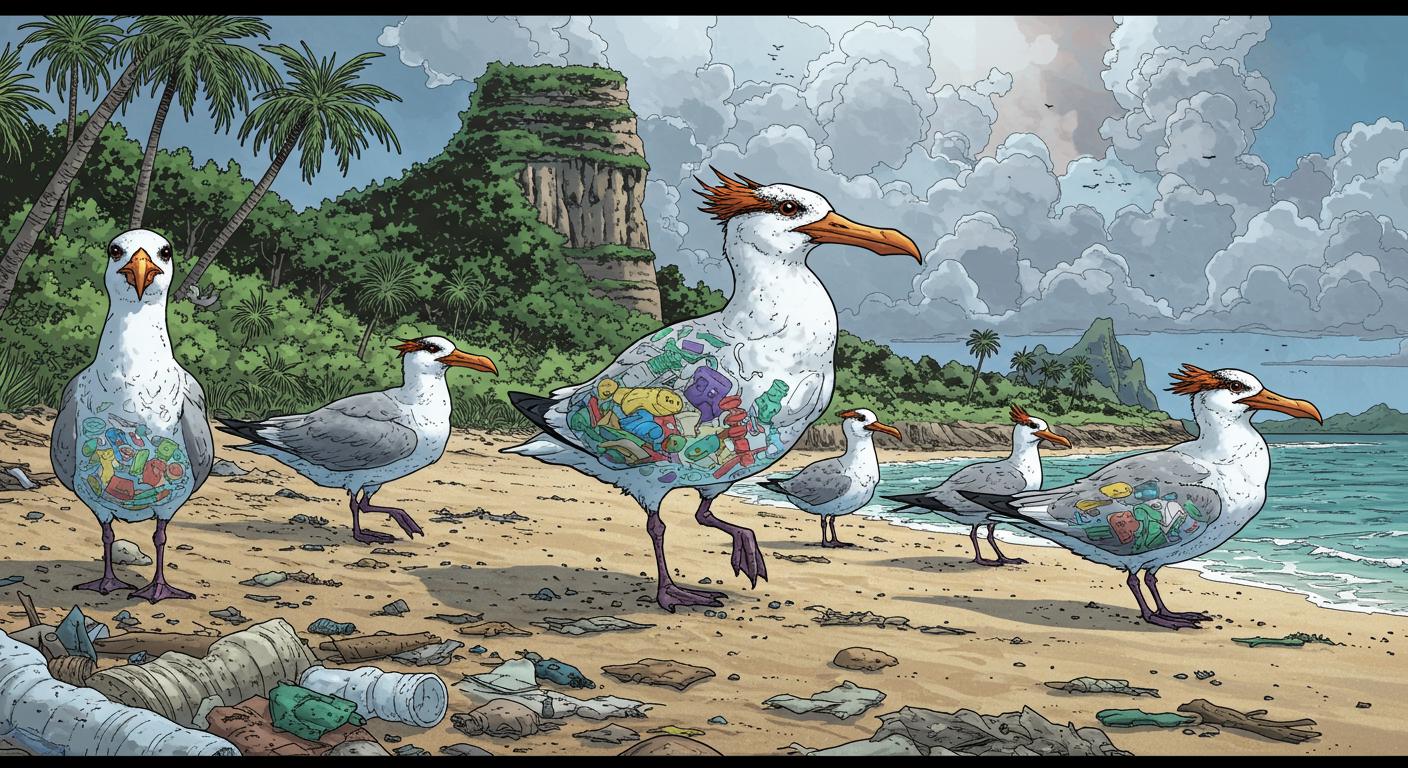
If you’ve ever wondered what it would take to become the unwitting world-record holder for something you really, really don’t want—here’s one for the books. In perhaps the most unsettling line in recent memory, researchers found a seabird chick crammed with 778 pieces of plastic, arranged “like a brick” inside its small body. As reported by The Washington Post, this isn’t the realm of invisible microplastics. Think bottle caps, soy sauce fish bottles, plastic cutlery, and the sort of debris you’d expect to see by a roadside rather than inside a chick not yet three months old.
It seems this isn’t even a rare find. Dr. Jennifer Lavers, a marine scientist working with Adrift Lab, told ABC News Australia that “there is now so much plastic inside of the birds you can feel it on the outside of the animal when it is still alive.” This unnerving observation was echoed during Lavers’ tour of the island with Tasmanian senator Peter Whish-Wilson, who observed to ABC that “we are poisoning this planet and killing nature by the way we are living and the decisions we are making.”
The scale of plastic ingestion is striking. Some chicks were found with plastic making up to 20% of their body weight—a detail documented in both ABC News Australia and a summary by PEOPLE. The research team dubbed certain individuals “brick birds,” their bellies so densely packed that the plastic had fused into solid masses, a grisly neologism that, as Jack Rivers-Auty explained to The Washington Post, turned from novelty to daily language during this season’s fieldwork.
As for how this happens, Bond explained that adult birds forage at sea and, deceived by chemical signals given off by some plastics, end up feeding their chicks a steady diet of forgery and refuse. The average mass of plastic found in these chicks has reached a level that’s alarming even to those who study environmental crises for a living.
Sounds Like Trouble
There’s something morbidly fascinating about the physicality of the problem. Pressing just below a bird’s sternum and hearing a crunch, not feathers or bone, but plastic. It’s the sort of uncanny detail that defies categorization—is it tragic, absurd, or both? For a library-leaning mind, it’s difficult not to mentally file it somewhere alongside “Victorian oddity” or “artifact from a lost civilization.” Only, of course, the lost civilization is our own—and these birds are apparently the first to show us the preview.
Bond told The Washington Post that sable shearwaters may be acting as “canaries in the coal mine,” serving up a grim warning of what’s coming for other species. An estimated 170 trillion pieces of plastic now float across Earth’s oceans, a figure cited in both the Post and ABC News, and that “plastic smog” is doubling roughly every six years. Lord Howe, with just 445 human residents but about 44,000 shearwaters (as The Washington Post notes), finds itself host to an ecological experiment of the most unintended sort.
Rivers-Auty underscored to The Washington Post that the impact is systemic: birds show signs of damage “in nearly every organ system.” Particularly troubling, the research team noticed markers of neurodegeneration—essentially, symptoms akin to dementia—in chicks not yet 100 days old. If as little as one or two grams of plastic is enough to kickstart these problems, what does that forecast for wildlife, or for us?
The Hardest Detail to Digest
So here we are, in 2025, marveling at a “Whale on the Wharf” sculpture in London made from reclaimed ocean plastic, as PEOPLE highlights, while across the world, real whales—and birds, and probably everything in between—are choking on the genuine article. There’s a sense of cosmic irony that would probably be funnier if it weren’t so, well, deadly.
The remoteness of Lord Howe Island is almost beside the point, given how efficiently ocean currents shuttle our cast-offs. As ABC News Australia documents, even this one-time paradise isn’t immune to the insidious reach of global plastic use and discard.
If mutton bird chicks, barely old enough to fly, are now classified not by plumage or song but by the density—and sound—of their stomachs, what’s next for other species? Will “crunchiness” become its own ecological indicator, right up there with “endangered”?
Crunch Time
There’s something uniquely unsettling about a warning sign that comes not as a whistle or a flashing light, but as a crunch under the sternum of a living, breathing animal. Is this the sort of detail that finally grabs our collective attention, or does it just slip quietly into the ever-growing reef of modern absurdities?
Maybe the oddest and most telling clues of environmental change turn out to be the ones we can literally hear—if only we listen closely enough, and are willing to ask: what other warnings, strange and small, have we already missed?