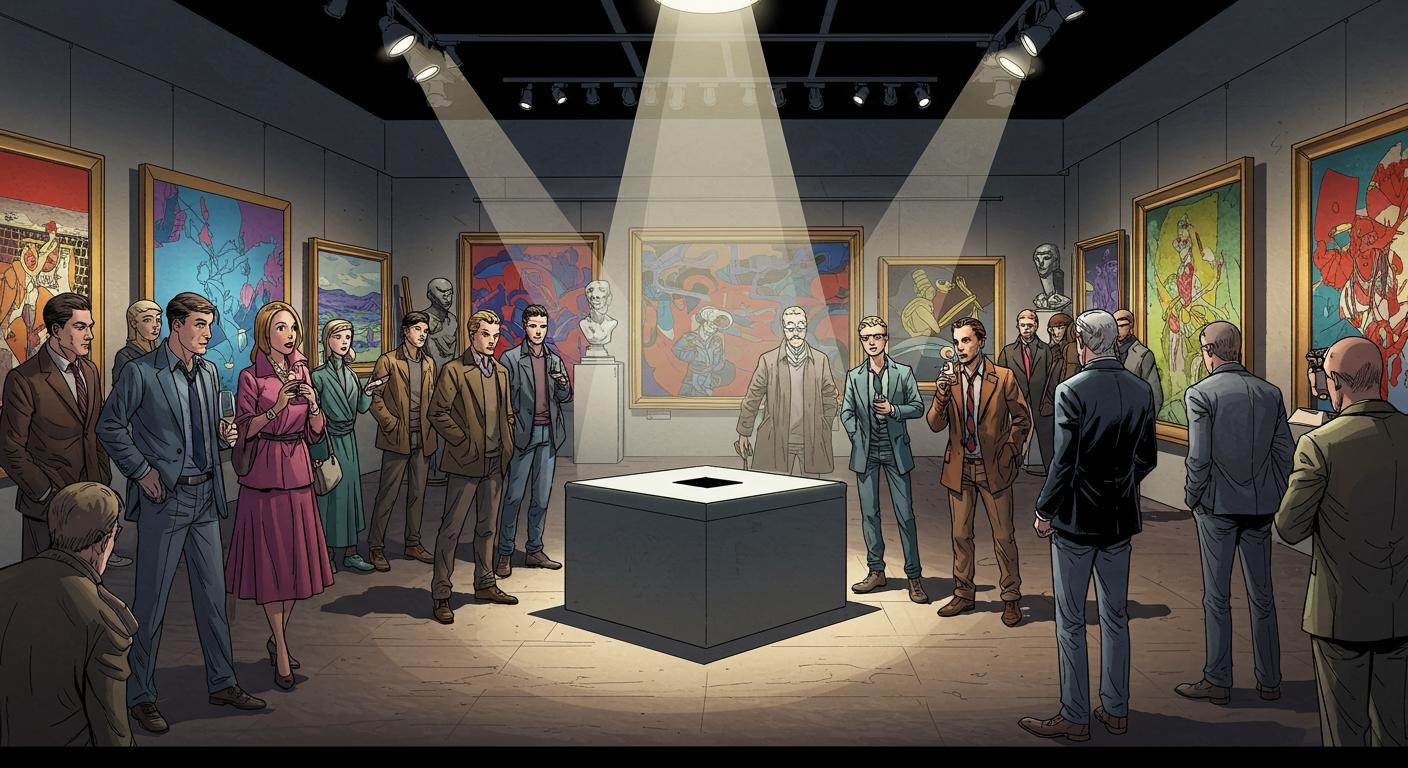
Sometimes, the universe tosses up a story so delightfully odd that you have to read it twice just to be sure someone isn’t pulling a fast one. As first published on Ecency and originally reported by the Times of India, an Italian artist named Salvatore Garau managed to sell… nothing. But not just any nothing—a special kind. Garau’s “invisible sculpture,” unironically titled Io Sono (“I Am”), fetched more than $18,000 at auction. That’s about the price of a used hatchback, but what the buyer drove away with can only be seen with the mind’s eye.
The Certificate of Belief
So, what, exactly, was the lucky patron left holding? According to the Times of India via Ecency, there’s no marble, no bronze—there isn’t even a wobbly plinth balancing an abstract shape. Instead, the buyer received a certificate, an official-looking document asserting their ownership of, well, an idea. There were also “instructions” about where and, presumably, how to properly imagine the artwork. Location is everything, even for thin air.
Garau himself, perhaps armed with a straight face or the best poker face in Europe, described the work as being made out of “air and spirit.” The sale, inevitably, sparked lively debate. Times of India documents that reactions ranged from impressed nods at the conceptual daring to skeptical head-shaking over the futility of purchasing literal absence.
Is Nothing Really Something?
It’s tempting, of course, to compare this with a certain emperor and his famously invisible wardrobe. But unlike fictional fashion disasters, Garau’s invisible masterpiece isn’t a case of groupthink nudity. In fact, it’s almost refreshingly upfront about its nothingness: no pretense, just pure, unadulterated conceptualism—art pared down until only the idea remains.
Times of India highlights that some see this as a “powerful and creative statement,” the ultimate distillation of art’s all-in-the-mind potential. Others view it as an elaborate prank—or at least a highbrow magic trick with a five-figure price tag. One person’s existential crisis is another’s avant-garde investment.
A Certificate for the Imagination
It’s worth noting that the legal paperwork appears to hold more substance than the artwork itself. The buyer didn’t blink at the invisible lot—perhaps confident that a certificate, unlike the sculpture, can’t be misplaced (unless lost in clutter). One can only imagine future family arguments: “Who took the sculpture? It was right here, next to my invisible bonsai!”
Jokes aside, this sale prompts a worthwhile question or two. If art is, at heart, an interaction between creator and observer—what does it mean when the “art” is just the act of believing it’s there? How far can collective faith in something abstract (and, in this case, absent) carry the value of an object—especially in a world that increasingly trades in memes, digital currencies, and NFT receipts for pixels? Did the buyer see value in the debate itself? The answer may be as ephemeral as the artwork.
Take a Breath—You’re Standing in It
There have been plenty of moments in art history where the boundaries of creativity have been stretched, sometimes to the point where observers need a deep breath to process it all. According to commentary collected on platforms like Reddit, where the story has drawn a mixture of disbelief and humor, Garau’s work has amused, baffled, and maybe even inspired others to ponder what’s next for non-medium media. Could this sale mark the dawn of an air-and-spirit renaissance?
Or is this simply a very expensive postmodern wink—an elaborate joke with a certificate, inviting us all to contemplate what, if anything, art must be? After all, it’s hard to argue that Garau’s invisible sculpture hasn’t accomplished its goal: people are talking, imagining, and perhaps secretly measuring out space in their living rooms for a sculpture no one can see.
In a world where the intangible grows more valuable each day, maybe the punchline is on those of us still looking for something to hang on the wall.