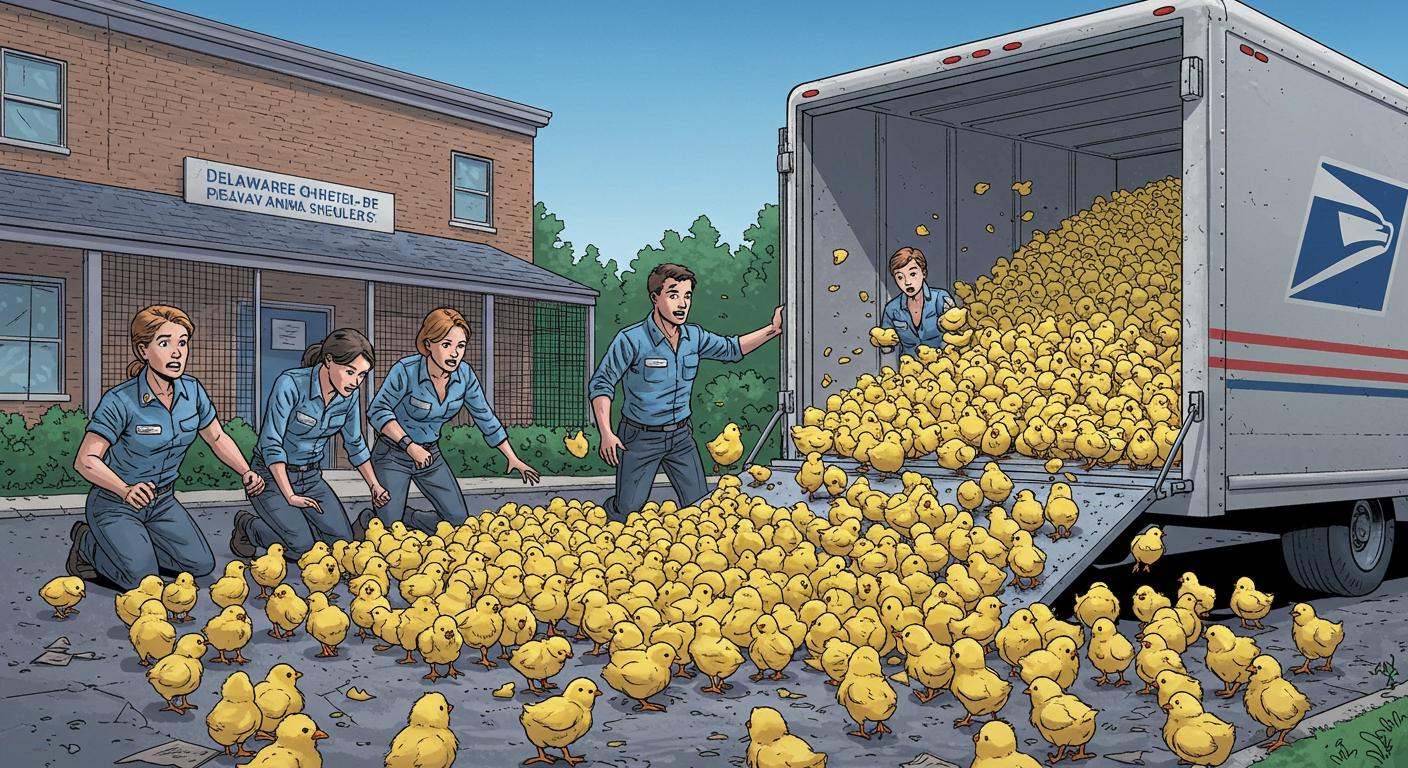
Live animals in the mail—already an odd sentence—took a turn for the even stranger in Delaware this month. An animal shelter in Camden is now scrambling to care for thousands of baby chicks discovered abandoned inside a USPS truck. The incident is something between a modern parable about supply chains and a how-did-this-happen scenario fit for the annals of improbable logistics.
When Parcel Becomes Poultry: The Great Chick Mishap
According to the Associated Press, more than 12,000 chicks were left inside a mail truck at a Delaware distribution center for over three days. Deprived of food and water in the stifling enclosure, thousands died before the discovery. The exact number of survivors remains uncertain, but shelter estimates place it at more than 2,000; meanwhile, Faharas News reports that officials initially found 4,000 dead chicks and around 10,000 still alive. The variation underscores the sheer chaos of counting so many panicked, peeping birds mid-crisis.
The shipment originated from Pennsylvania-based Freedom Ranger Hatchery, which confirmed it sends weekly consignments to customers around the country. As the hatchery’s spokesperson emphasized in the AP story, they couldn’t take the birds back due to biosecurity risks—a policy most folks, until now, probably never considered in the context of mass-mail poultry.
The Road to the Shelter, Paved with Good Intentions (and Feathers)
The question remains: how does a truckload of chicks vanish into bureaucracy for days? USPS acknowledged a “process breakdown” and is investigating, reports AP. After the birds were found, the Delaware Department of Agriculture directed them to the First State Animal Center and SPCA, which holds a state vendor agreement to handle such emergencies.
Still, help of the financial sort is a moving target. NewsNation, drawing on AP’s reporting, notes that the Department of Agriculture quoted $5 per chicken per day as a reimbursement rate, but both department officials and shelter director John Parana agreed the standard rate can’t scale to these numbers. Parana told AP that negotiations are ongoing but described communication indicating no immediate funds would be allocated. “They said that they’re gonna try to go after the post office to get recoupment,” he said, rightly noting this offers little help for current operations.
Not Your Average Shelter Intake
While shelters are no strangers to unusual arrivals, even the most seasoned staff rarely anticipate a sudden influx of thousands of farm birds. Among them were also turkeys, geese, and quail, but as AP details, the overwhelming majority were young Freedom Ranger chicks that, left unattended, face a long haul before reaching maturity—about ten weeks, according to Parana.
Rehoming progress has been slow: by mid-May, only a few hundred birds had been adopted, with multiples sources affirming this number. Some inquirers had intentions better suited for a butcher than a backyard, but the shelter—a no-kill SPCA—turned down any requests from those seeking meat birds. In the meantime, staff have patched together a 24/7 schedule to keep up with basic care, even dipping into their own pockets to buy necessities, as AP notes.
Brooding Questions About Logistics
The situation isn’t simply a fluke but a magnifying glass on larger logistical and ethical questions surrounding the shipment of live animals. Faharas News highlights that this story has sparked national debate about animal welfare and the reliability of protocols meant to prevent precisely this kind of disaster. How can a shipment of thousands of living creatures go overlooked for days? And what protections—or policies—need tightening to ensure that live cargo is never reduced to an afterthought?
At each step, communication breakdowns, unclear authority lines, and the oddities of using a public mail system for livestock distribution all converged in a way no amount of planning at your average animal shelter could anticipate.
Order from Chaos
For now, the surviving chicks are in the hands of overworked yet resilient shelter staff improvising relentlessly just to keep things running. The rows of yellow hatchlings, jostling under heat lamps, present an image that borders on the surreal—a daily reminder of how the improbable can arrive on your doorstep, postage due. As the days pass and more birds (hopefully) find new homes, a very practical question hangs in the air: When does a shipping mishap turn into a full-fledged community challenge?
It’s a strange chapter in the story of modern logistics—one that’s likely to provoke both chuckles and a raised eyebrow from anyone who’s ever gotten a surprise package. With a little luck, and a lot of feed, this flock will eventually disperse. But it’s safe to say Delaware’s animal shelter scene won’t be the same for a while.