
Some stories practically beg for a double-take, and the latest news out of California’s wildlife rehabilitation scene qualifies nicely. Apparently, at the San Diego Humane Society’s Ramona Wildlife Center, it’s not unusual these days to see staff lumbering around in full-body bear costumes—fur, mask, leather gloves, and even a healthy application of bear-scented hay—while caring for one very unusual charge. As first reported by The Guardian, a two-month-old black bear cub rescued from the Los Padres National Forest has become the recipient of an immersive, ursine-style education.
“Bear” With Us: The Odd Realities of Wild Cub Daycare
When the cub was found on April 12, campers in the forest described him as “crying alone,” weighing just three pounds and depleted after days without food or water. Campground staff alerted state biologists, who staked out the area in hopes his mother would return—a wait that, unfortunately, proved fruitless. Wildlife operations manager Autumn Welch told reporters the cub arrived at the center “extremely fragile,” needing a cocktail of specialized formula, careful monitoring, and a round-the-clock schedule. The outlet notes this is the youngest cub the organization has yet cared for.
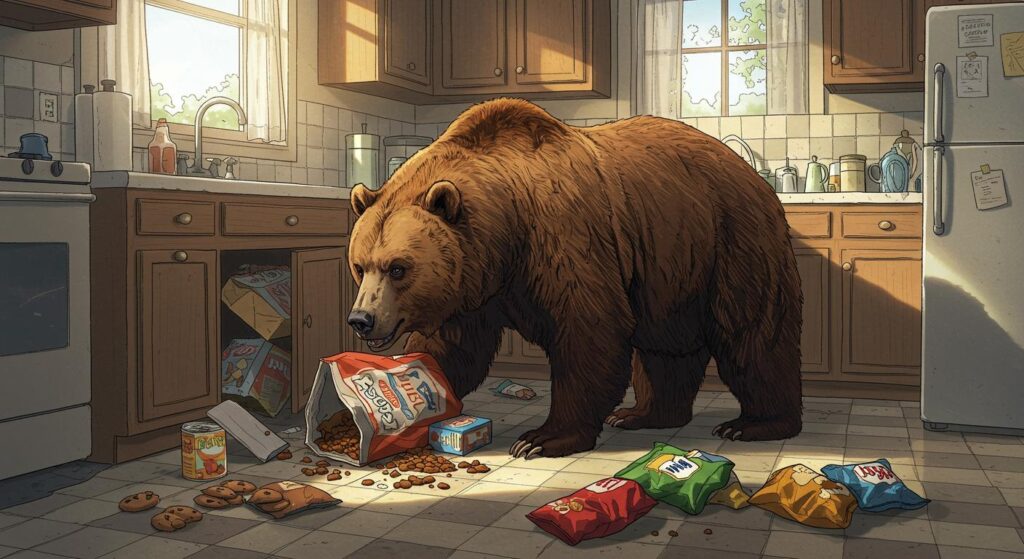
Why the bear costumes? Welch highlighted that preventing human imprinting is not just good practice, it’s essential. “We don’t want him touching our skin at all,” she told The Washington Post. She explained that everything from feeding to play—all within the confines of these costumes—is intended to ensure the cub doesn’t come to associate humans with comfort, safety, or food. According to Welch, “He never sees us as humans.” Officials cited in the outlet emphasized that wild bears with positive memories of humans tend to express enthusiasm for raiding trash cans and picnic baskets once released—habits only funny on old cartoons.
Master Classes in Bearhood
The curriculum for a cub in isolation appears, on examination, to involve more enrichment than many modern workplaces. Staff have set up both indoor and outdoor enclosures designed to replicate the cub’s natural world as closely as possible. Details described by the Post include structures made of real branches for climbing, leafy debris for foraging, and a rotation of stuffed bears that serve as comfort “mommas.” Rather than receiving solitary bottle feeds, the bear gets four daily play and feeding sessions—always in the company of these shuffling costumed figures. Bear-scented hay from a local sanctuary is rubbed on everything (and everyone) to drive the point home: you’re a bear, or at least among bears.
Marking developmental milestones, the cub has progressed from liquids to solid foods, playfully discovering mealworms, fruit, insects, and even kibble hidden among the leaves. As the outlet details, staff hide acorns in his enclosure and document his enthusiastic digging, stacking up achievements like climbing, nest-building, and self-directed play—important steps in preparing for that wild solo debut.
Welch remarked to The Guardian that “the cub is thriving,” having quadrupled in size to over 12 pounds after five weeks—progress both impressive and, one imagines, a bit nerve-wracking for anyone in a head-to-toe synthetic fur suit during feeding time.
A Rare, High-Stakes Custody
Described in The Guardian, seeing a cub this young alone is highly unusual. In the last half-decade, only four black bear cubs this young have entered rehab care anywhere in California—a statistic separately confirmed by the Post’s review of rescue records. Black bear mothers have a reputation for diligence, so this cub’s abandonment raises more questions than answers. What happened in those dense woods? That part remains a mystery.
The outlet also notes that caring for such a young wild animal is not only a novelty but a significant commitment of time, funding, and expertise—none of which is provided by the state. The San Diego Humane Society depends entirely on donations to fund these hands-on, paws-on efforts.
Eventually, California’s Department of Fish and Wildlife will determine the cub’s release site. Officials explained that biologists take into account factors such as the cub’s rescue location, local bear population, and risks of human-wildlife conflict. Upon reaching roughly 130–150 pounds, he’ll be fitted with a GPS collar for post-release tracking, with the goal of ensuring his transition back to nature is as seamless as possible.
The Daily Work of Disappearing Into the Background
In a note highlighted by WMMS, the “odd choreography” of being bear caretakers includes plenty of entertainment for the staff. One might wonder how it feels to exchange the traditional uniform for pawed gloves and a fur hood, especially when tasked with enforcing boundaries against a rapidly growing, and apparently very playful, cub.
Welch remarked that, while the bear is small, staff closely monitor interactions, always ready with stuffed animals and distraction tactics if he gets a bit too comfortable around his caregivers. “Sometimes you can just show him a tree branch and shake the leaves a little bit and his whole focus will be on that,” she noted to the Post.
Suiting Up for Survival
The peculiar spectacle of wildlife staff method-acting as bear mothers captures something both uniquely human and animal: the lengths we’ll go, fueled by patience and a little borrowed absurdity, to set a life back on its original path. One has to wonder, does the bear buy the act? By every behavioral measure, it seems so. And perhaps, with luck and a lot of adapted hay, the only thing he’ll remember of his human “family” is that mother bears are giant, somewhat lumpy, and remarkably devoted.
In the end, is there a better metaphor for modern conservation than a group of humans sweating in bear suits, trying to render themselves invisible so that a wild thing can stay wild? The answer, like the cub himself, may take a while to wander into view.