If I had a dollar for every time a story about penguin droppings led to a heartfelt meditation on the interconnectedness of Earth’s climate systems, I’d be up to… well, one dollar. But sometimes that’s all it takes to see the world a bit differently.
The Cool Truth About Penguin Poo
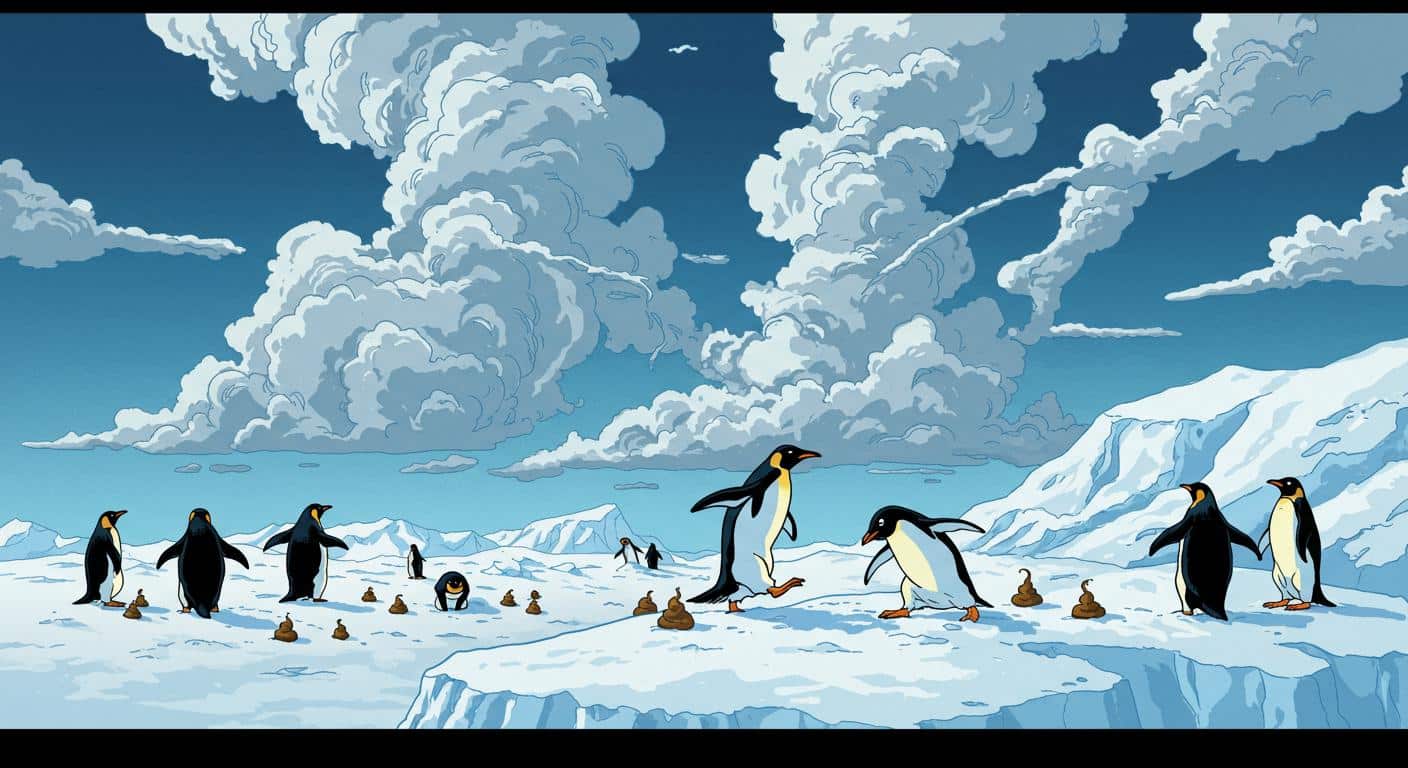
Adélie penguins, it turns out, are doing more than sporting chic plumage and charming documentary filmmakers. As reported by Euronews Green, these animals may be instrumental in keeping Antarctica cooler through a process involving, of all things, their guano. Researchers from the University of Helsinki spent two months on the Antarctic Peninsula near a colony of 60,000 Adélie penguins, carefully measuring atmospheric changes. They observed that when winds blew across the penguin colony, ammonia levels soared to more than 1,000 times higher than background measurements. This ammonia, as the team discovered, lingered in the environment and kept producing effects even after the colony had migrated away, with a persistent “fog bank” observed for hours following a pronounced spike in aerosols. The outlet also notes that the broader implications are serious: shrinking penguin populations could weaken this impact, and thus possibly hasten regional warming.
How Penguins (and Their Guano) Cook Up Clouds
The underlying chemistry is a bit of Antarctic magic. In a detail explained by New Scientist, ammonia from penguin droppings reacts with sulfur-containing gases—specifically those produced by phytoplankton hovering just offshore. This chemical pairing leads to the rapid formation of aerosol particles, which then act as nuclei for water vapor, sparking more cloud formation. Antarctica, deprived of typical aerosol sources like dust, trees, or traffic, depends on this process more than most places.
As Matthew Boyer, lead researcher at the University of Helsinki, told ABC News (as quoted in Euronews Green) and repeated in several outlets, “There is a deep connection between ecosystem processes – being the ocean phytoplankton activity as well as penguins – and atmospheric processes that can have an impact on the local climate.” These links are not just academic; atmospheric measurements logged ammonia bursts tied to penguin guano, and subsequent sampling revealed enhanced cloud-forming particles directly linked to that uniquely pungent source.
Grist also recounts that even after penguins had left the area post-breeding, ammonia concentrations in the air remained significantly higher for weeks. The researchers, in their paper published in Communications Earth & Environment, observed that a particularly dense fog formed specifically after these ammonia surges. Tamara Russell, a marine ornithologist at Scripps Institution of Oceanography not involved in the study, explained that understanding which penguin species produce the most ammonia could help refine climate models, since the ongoing dynamics of penguin populations—some growing, some declining—are now inextricably tied to the fate of Antarctic cloud cover.
Limits, Loops, and Leverage: The Broader (and Bizarre) Picture
Of course, this new appreciation for penguin poop isn’t a cause for unlimited optimism. As Grist and New Scientist both underline, the researchers have not been able to directly quantify how much this effect cools Antarctica—further study is required to measure the true impact on local and global climate. Boyer’s team hypothesizes that the increased cloud cover likely helps cool the region by reflecting sunlight away, but the magnitude of this effect is still an open question.
There’s also the unsettling likelihood of a feedback loop at play. As described in the Grist article, warming oceans and shrinking ice threaten penguin populations. Fewer penguins mean less guano, leading to lower ammonia emissions, fewer clouds, and—inevitably—more warming and still more stress on the penguins, in a cycle that could accelerate regional climate change. Peter Roopnarine of the California Academy of Sciences points out that, if this feedback exists, it could intensify changes already underway both in penguins and the vast, icy environment they inhabit.
Interestingly, the notion of droppings as climate moderators isn’t confined to Antarctica. New Scientist references related findings from the Arctic, where puffin colonies’ excretions were estimated to produce enough ammonia to offset a third of the region’s warming from carbon dioxide during the summer months. While penguins and puffins may never meet, their combined contributions to planetary cooling are surprisingly significant—proving that sometimes, it pays to have a messy neighbor.
What’s at Stake—and Who’s Doing the Work?
In a succinct summary, theJasmineBrand distills the finding to its core: “Protecting species like penguins may be crucial—not just for biodiversity, but for the planet’s future.” Yet, as with most under-appreciated climate actors, penguins are neither aware nor awed by their contribution.
Returning to the bigger picture, Euronews Green notes that the web of natural climate solutions is only growing stranger and more innovative—from Kenyan beehive fences that peacefully deter elephants, to “electric wallpaper” heating British homes, to French “wind trees” quietly powering city streets. But as climate solutions go, penguin guano isn’t something anyone would have predicted, nor is it easily replaced.
If there’s a theme to it all, it’s that the world is irreducibly peculiar, and sometimes its most essential climate engineers are small, oblivious, and wearing formalwear by default. What else are we missing in the underappreciated workings of planetary health? For now, amid the dizzying calculations of climate models and dire projections, it’s oddly reassuring to know some clouds are, quite literally, a silver lining traced back to a penguin’s last meal.