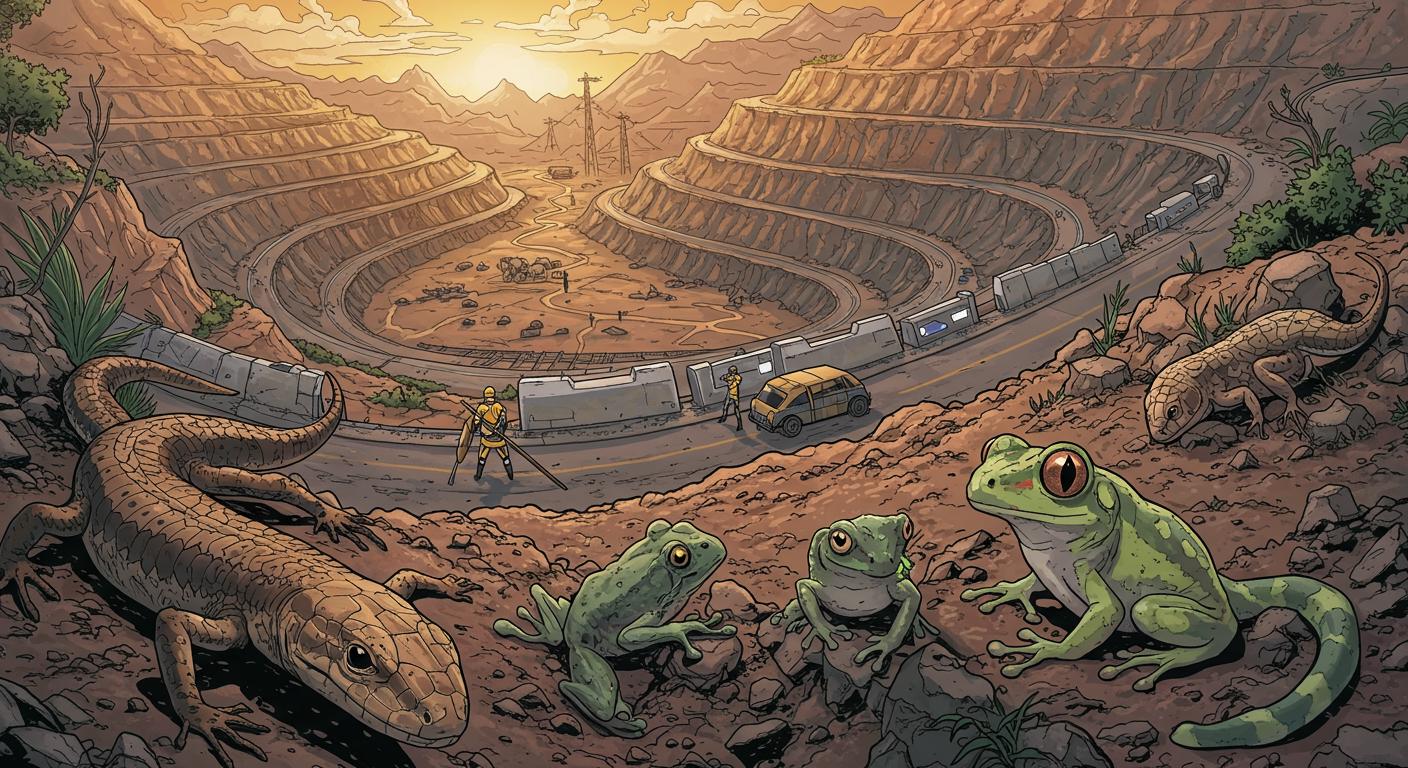
Somewhere in the dense forests of New Zealand, an endangered Archey’s frog is—depending on whom you ask—either living on borrowed time or being offered a lease extension thanks to a new pest management plan. But as Newsroom reports, the stakes have little to do with individual frogs and more to do with how a nation chooses to balance the value of native critters against asphalt, gold seams, and ministerial bravado.
Law Change: From Judicial Headache to Developer Green Light
Until recently, road builders, miners, and developers in New Zealand nervously sidestepped a legal minefield each time a lizard scuttled into a digger’s path. Newsroom details how, under the Wildlife Act, elaborate mitigation efforts were routine—such as the $85,000 paid to contractors tasked with finding and rehoming grass skinks near a New Plymouth highway and the $1.1 million set aside by the NZ Transport Agency to protect snail and lizard species during motorway construction.
This process—where the Department of Conservation could retroactively authorize wildlife deaths if mitigation steps were followed—was upended after the Environmental Law Initiative challenged it in court. Newsroom outlines how Justice Jason McHerron’s ruling pointed out flaws in the longstanding practice, suggesting perhaps sanctuaries for endangered frogs shouldn’t be bulldozed for “progress” without stricter accountability. Rather than sparking a drawn-out debate over priorities, the government acted swiftly to overturn the judgment, a move aimed at getting projects like the OceanaGold mine expansion near Waihi back on track.
Shane Jones, the Resources Minister, appears unmoved by concerns that mining detonations may disrupt the risky love lives of these frogs. As Newsroom recounts, after being flown by helicopter over the OceanaGold mining site, Jones went on record as saying that arguments about frog mating being disturbed by underground vibrations were not “good enough” reasons to halt key infrastructure.
Of Donors, Decisions, and the Intrinsic Value of Critters
Political context is hard to ignore. Newsroom also points out that the introduction of this legislative amendment happened immediately after the publication of political party donations, which featured at least $132,680 in contributions from mining and quarrying interests to Jones’s party, New Zealand First. This included $84,680 from Melrose Private Capital, $12,000 from McCallum Bros, and $14,000 from Cosgrove & Partners—whose client list happens to include OceanaGold. Not that Jones feels any need to blush: he told Newsroom, in what registers somewhere between an aside and a flex, that “the donations from the mining industry do not have any impact whatsoever on the changes to the Wildlife Act,” dismissing suggestions of influence as “green witch-doctory.”
Still, these entanglements add a certain flavor to the debate. Daniel Minhinnick, an environment and planning partner at Russell McVeagh, told Newsroom that the High Court decision caused wide concern across construction and infrastructure sectors, jeopardizing not just private interests but government-led projects. For many, the legal uncertainty was more distressing than the risk of inconveniencing a lizard or two.
Among the details that almost slip by, Newsroom recalls the particularly animated argument over how many Archey’s frogs, precisely, inhabit these contested lands. Department of Conservation scientists once estimated the population at a mere 5,000, while OceanaGold’s researchers claimed there might be as many as 50 million. An independent panel was ultimately brought in and, according to the reporting, settled on a figure above 100,000. If nothing else, that’s a lot of miniature roadblocks.
Progress, or a Toad in the Road?
Newsroom describes how the new law will retroactively validate the “taking or killing” of wildlife during projects already granted authorization, so long as the developers follow their permits and any conditions applied. The idea is that, theoretically, any wildlife populations affected will be “maintained or improved elsewhere,” but the practicalities of these ecological ledgers tend toward the slippery.
OceanaGold, for its part, has pitched intensive pest control across more than 600 hectares to offset impact. Newsroom quotes senior vice president Alison Paul promising ongoing efforts to protect frogs from predators, linking these programs to collaboration with local iwi and broader conservation ambitions. It feels a bit like a smartly dressed version of environmental musical chairs: so long as something hops away happy, the project can proceed.
An Amphibian’s-Eye View of Modernity
In the end, as the commentary peppering the Newsroom story attests, the debate is only tangentially about Archey’s frogs—or even skinks and geckos. The real question is whether society is satisfied treating such oddball species as acceptable casualties of the “growth apostle’s” agenda, or whether we prefer to pause—however briefly—to wonder what, exactly, we’re steamrolling along the way.
The idea that multi-million dollar mines and miles of highway could hinge on the fate of creatures smaller than your thumb is a study in proportionality and, perhaps, priorities. If even the tiniest adversaries can hold up the gears of progress, however briefly, maybe there’s still some function in our systems—judicial or otherwise—that forces us to ask: What are we actually building, and at whose expense?