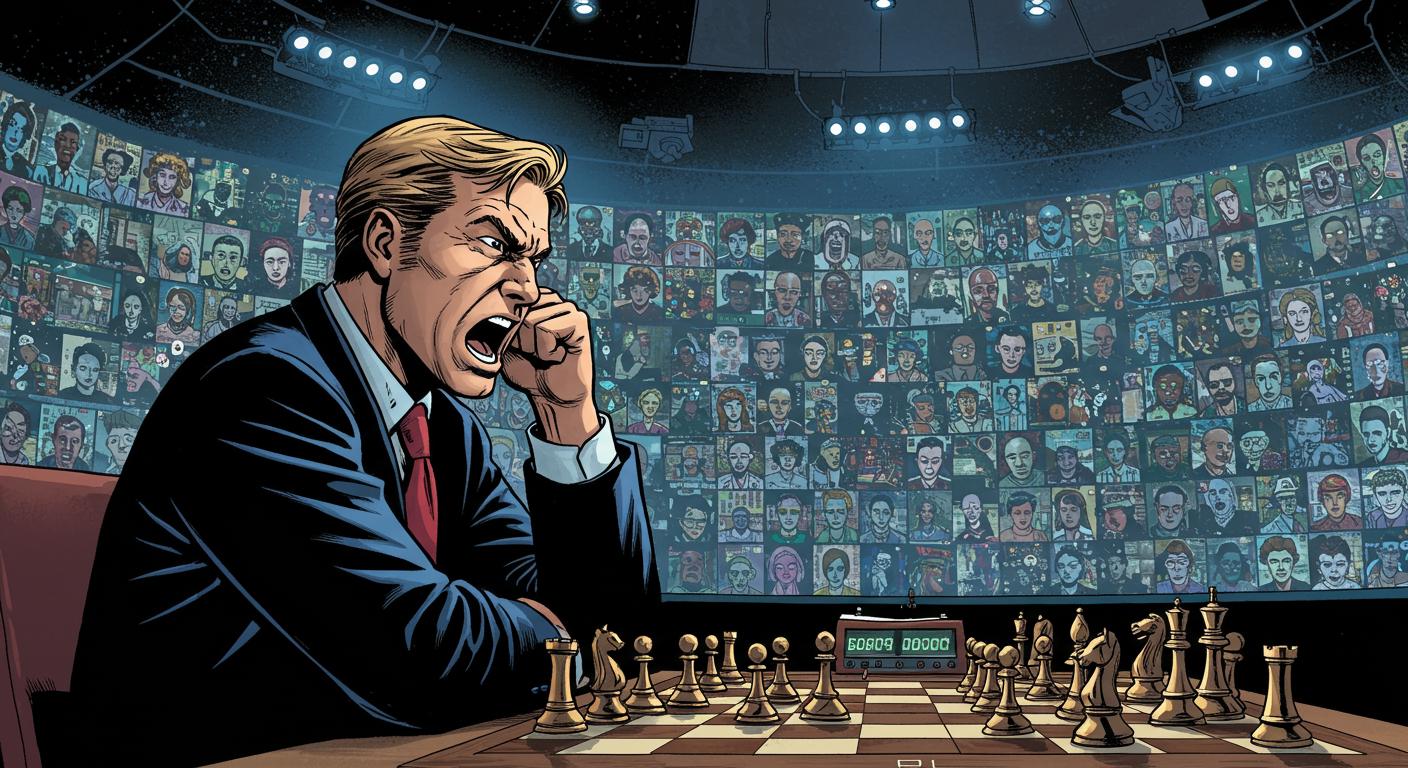
Magnus Carlsen, the chess grandmaster who reliably out-calculates everyone whose name doesn’t end in “Stockfish,” is currently engaged in what can only be described as the world’s lengthiest (and perhaps loneliest) crowd duel: a single online chess match against 140,000 people. As described in Sky News reporting, this figure is about the population of Hartford, Connecticut, or—if you prefer—a medium-sized city packed entirely with people voting on pawn moves.
When the Opening Isn’t the Only Weird Bit
This mega-match departs from traditional chess on several levels. The game is played in a “freestyle” or Chess960-like format where, as highlighted in the outlet’s coverage, rooks, knights, bishops, queen, and king are randomly arranged on the back rank, leaving pawns in their usual slots. The idea is to inspire creativity and sidestep rote memorization—an appealing prospect for anyone who finds the standard openings about as thrilling as tax season.
Team World (the collective mass of 140,000 online players) votes on each move, pooling their chess decision-making power in 24-hour cycles. Carlsen, working alone at his own computer, does the same—with considerably less committee wrangling. According to details cited in Sky News, the grandmaster himself believes the epic match “is just heading towards the draw.” Carlsen reflected that he “felt that I was a little bit better, early in the opening, then maybe I didn’t play that precisely. Honestly, since then, they haven’t given me a single chance.” With Team World steering the match toward perpetual check, there’s a unique symmetry emerging. How often does one see democracy and chess intersect, especially in a way that frustrates even the world’s best?
Giants, Crowds, and Dress Codes (Of Course)
Chessboard showdowns pitting a single master against thousands aren’t exactly new. Drawing from Sky News’ review of past events, Garry Kasparov famously played against over 50,000 online participants in 1999 and eventually claimed victory after four months. In a more recent example, Indian grandmaster Viswanathan Anand bested a crowd of nearly 70,000 last year on Chess.com—incidentally, the same platform that’s now hosting Carlsen’s standoff.
It adds a new wrinkle, then, that Carlsen seems destined for a draw against a record-breaking group. At some point, does the wisdom of crowds actually exceed the tactical sharpness of a single, superhuman competitor? Or, perhaps, as the numbers grow, the world’s collective stubbornness simply becomes more difficult to force into checkmate.
Meanwhile, Carlsen’s eccentricities are far from overshadowed by the crowd. The Sky News article recounts that, besides dominating the chess rankings since 2011 and achieving an all-time high rating of 2882, Carlsen made waves last year for refusing to change out of his jeans at a New York tournament—leading to a fine and, ultimately, a loosening of the dress code. There’s a certain charm to a sports superstar whose most controversial play involves denim.
What’s the Takeaway?
As the match appears to drift towards a draw—barring a last-minute tactical mutiny from Team World’s tens of thousands—one curious truth emerges. A single master, armed with decades of study and instinct, can still be held at bay by a teeming multitude of casual enthusiasts, grandmasters-in-training, and random internet voters. Is this due to collective intelligence, statistical inertia, or just the law of very large numbers?
Somewhere amidst shuffling bishops, perpetual checks, and a fashionably dressed world champion, the line between brilliance and consensus looks blurrier than ever. Even in chess—and perhaps in life—individual genius sometimes meets its match in collective determination.
At the very least, it’s proof that, given enough voters, even Magnus Carlsen has to settle for a stalemate. And, reassuringly, he’ll do it in jeans.