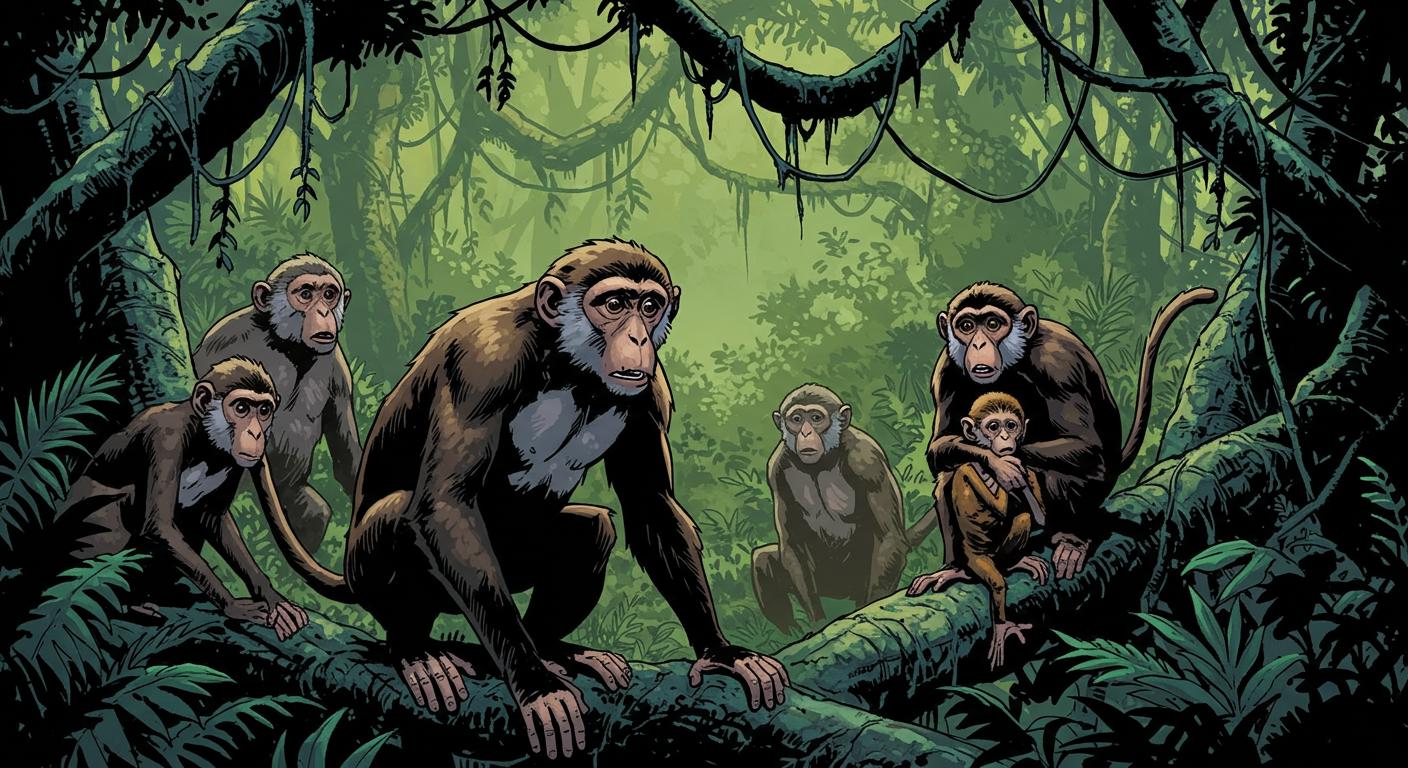
There are certain stories you stumble across that initially sound like the setup for a dubious internet hoax—baby monkey kidnappings for fun, anyone?—but then you remember: in the natural world, strangeness is the rule, not the exception. So, when NPR reported on a series of bizarre events unfolding on a little Panamanian island, my librarian brain flicked several mental sticky notes under: “File under 1) Primate Weirdness, 2) The Dark Side of Boredom, 3) Yet Another Argument Against Anthropomorphism.”
Chaos Agents and Copycats
Here’s the unsettling long and short of it: adolescent and juvenile capuchin monkeys on Jicarón island have recently taken up the hobby—yes, hobby—of kidnapping baby howler monkeys, apparently out of sheer boredom. In a still captured by a wildlife camera and described by NPR, infants only a couple of days old can be seen clinging not to their mothers, but to the backs of capuchins, looking decidedly out of place.
As detailed by NPR, capuchins—those clever, tool-using, havoc-loving standouts of the primate world—are known “chaos agents,” according to Brendan Barrett, an animal culture specialist observing the phenomenon. Barrett told the outlet the monkeys “roam through the forest ripping up and manipulating everything in sight” and exhibit behaviors similar to both chimpanzees and humans. “They do interesting, strange things,” Barrett said. But ‘interesting’ now seems to include, as NPR carefully outlines, “spurring a rash of unexplained infant kidnappings,” with tragic consequences for the unwilling participants.
The culprit behind this trend appears to be a single immature male capuchin, nicknamed Joker. After Joker spent early 2022 wandering around with absconded howler babies for company—four different infants, as noted by Zoë Goldsborough, who reviewed the footage—other young males caught on. The footage, meticulously reviewed by Goldsborough of the same research team, reveals a string of copycat incidents—at least seven babies over several months, each toted for stretches ranging from two to nine days. NPR notes that while Joker seemed to take a “caring and affectionate stance,” his imitators appeared largely indifferent or even annoyed by their living accessories.
Pointless Pursuits or Primate Parallels?
The whole spectacle reads at times like a grim parody of “monkey see, monkey do.” While animals sometimes adopt the young of other species who are lost or abandoned, researchers cited by NPR stress that this isn’t nurturing—adult howler monkeys not only called desperately to their infants, they even attempted rescues, only to be driven off by the capuchins. The young capuchins’ interest was not uniform: Joker oddly affectionate, the others far less so. The rest of the troop? NPR quotes Barrett describing their indifference: “There’s not tremendous social interest. You know, they’re not acting in the way that someone would act if I was carrying around like, you know, a baby lion on my shoulders.”
For the baby howlers, the outcomes are predictably dire—dehydration and starvation loom, since they’re completely dependent on their mothers. Barrett expresses hope that this “trend” fizzles before the local howler population faces lasting damage, especially considering the slow pace at which these monkeys reproduce. You have to wonder: will the howler monkeys respond with new strategies, or will they be forced into a grim evolutionary foot race with their bored neighbors?
Animal Culture or Cruelty of Curiosity?
Why does this happen at all? According to the researchers cited in NPR, the kidnap fad highlights the perils of too much free time in an environment with no natural predators and abundant food. Goldsborough suggests the easy living may breed both innovation and mischief: “We know that in humans… boredom is incredibly conducive to creativity and innovation.” Therefore, grabbing howler monkey babies may simply become “something to do to pass the time,” as Barrett phrases it, “in a kind of a boring environment where it’s relatively safe to come up with these potentially risky innovations.”
There are precedents here—inexplicable animal fads spotted and highlighted by NPR. Chimpanzees, for example, have been seen wearing blades of grass in their ears, apparently as a primate fashion trend. Orcas have topped their heads with dead salmon as impromptu hats. The difference here, as NPR explains, is that the capuchin fad has real costs: harm instead of harmless whimsy.
Johns Hopkins cognition researcher Christopher Krupenye adds, via NPR, that capuchins are renowned cultural innovators. Not only do they use tools, but they’ve also been documented adopting entirely arbitrary traditions—a “community had a tradition where individuals would put a groupmate’s fingers in their own eyes.” Krupenye, who was not involved in the kidnapping study, adds that the camera trap footage is a “huge asset to this research program” and advocates for more direct observation to learn precisely how the abductions occur.
Has Monkey Mayhem Found Its Jump-the-Shark Moment?
There’s a temptation—one NPR’s reporting implicitly invites—to look for larger patterns or metaphors. Is this animal culture gone awry, or just one more reminder of the deeply alien logic with which non-human intelligence operates? Is innovation always a virtue, or can too much downtime create monsters? The capuchins of Jicarón, left to their own devices, have managed both literal and figurative monkey business—and the outcome is a story that walks a very fine line between the hilarious and the horrific.
Ultimately, what stands out isn’t just the uncanny mimicry of a very human-seeming fad or the poignancy of howler parents calling for their lost young. It’s the inescapable sense that life, even in the supposed backwaters of a remote island, is a perpetual rehearsal for both genius and mayhem. Is this the cost of having the spark of innovation—be it in monkeys or ourselves? Or are we simply unqualified to judge the amusements of creatures whose inner motives are, for now, beyond true comprehension?
As the NPR report makes clear, sometimes, monkey business is a lot darker than anyone bargained for.