
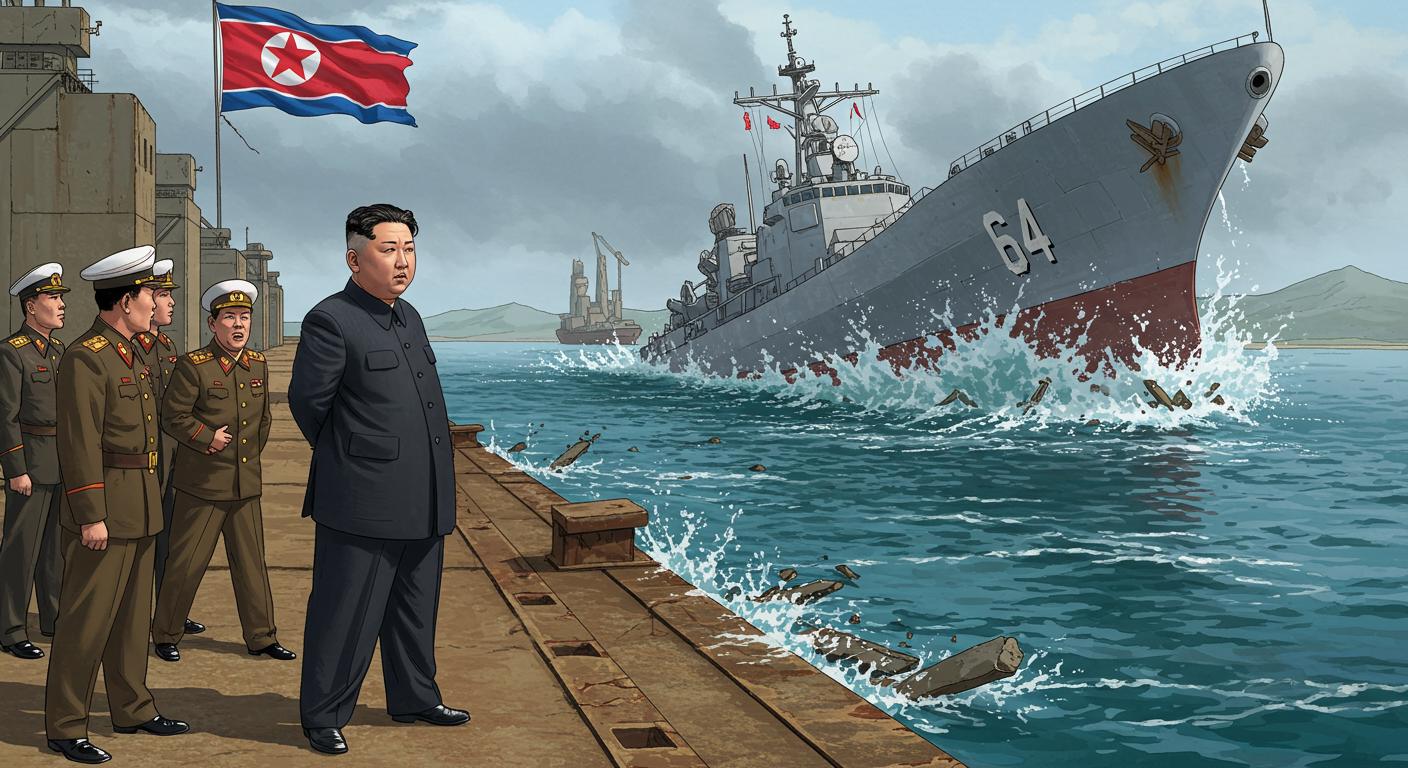
There are few events as tightly choreographed as a North Korean military unveiling, where spectacle and secrecy march in lockstep. On Wednesday, however, the show took an unplanned turn. Instead of a triumphant display of naval modernization, Kim Jong Un—and, thanks to satellite coverage, much of the world—witnessed North Korea’s latest and largest destroyer slide awkwardly sideways into the water during its launch at Chongjin shipyard. As CNN reports, the result wasn’t so much “cutting-edge” as “crumpled hull,” with a furious Kim demanding accountability in a rare public admission of failure.
The Ceremony That Sputtered
According to both CNN and the Business Times Online, the 5,000-ton vessel—so new it hadn’t even been named—experienced an alarming mishap: the stern slipped too soon into the water, crushing parts of the hull, while the bow was left embarrassingly stuck on the shipway. State media, often keen to show only flawless success, had little choice but to acknowledge the “serious accident.” Satellite imagery ultimately removed any hope of quietly moving on, showing the destroyer marooned on its side.
Kim didn’t mince words. KCNA, North Korea’s official news agency, and the Business Times both highlighted that he called the event a “criminal act” and blamed “absolute carelessness” by organizations such as the Munitions Industry Department, Kim Chaek University of Technology, and the central ship design bureau. If you’re working in either of those places, it’s not a good month.
Physics, Deadlines, and Dry Docks
Sal Mercogliano, a maritime professor whose comments appear in CNN and the Business Times, provided the grim assessment that a misaligned launch of this type “will tear the hull apart.” Retired naval officer Carl Schuster, also cited by both outlets, warned that the stresses from such a botched launch could “warp the hull, induce cracks and possibly snap the keel,” depending on where the weight settled.
How bad is the damage, really? KCNA downplayed the extent, with a Friday statement (as summarized by CNN) insisting there were no holes in the hull, describing only scratches and a “certain amount of seawater” in the stern section. Yet naval specialists, quoted in the CNN piece and the Center for Strategic and International Studies’ Beyond Parallel blog, expressed strong skepticism, suggesting the ship may not be recoverable any time soon—and might even be a total loss.
Meanwhile, Kim’s directive was unequivocal: restore the destroyer before the late June plenary session of the ruling Workers’ Party, as reported in both CNN and Business Times accounts. This amounts to a repair timeline of about ten days, according to KCNA. Retired South Korean Admiral Kim Duk-ki, whose analysis appears in both outlets, described this as wishful thinking. The admiral pointed out North Korea’s apparent lack of a dry dock—a facility central to repairing large ships—which could render even basic restoration “four to five months” away. Do you get the sense there’s a recurring infrastructure problem here?
South Korean analyst and lawmaker Yu Yong-weon told Business Times that hasty repairs could introduce new failures, and the decision to launch before all technical hurdles were solved may have been the real mistake. In a related detail, satellite imagery analyzed by 38 North (as referenced in Business Times Online) suggested North Korea used a side-launch method out of necessity: an economical but risk-prone choice given the Chongjin shipyard’s limited space.
Substance, or Simply Show?
Beyond the embarrassment, why does any of this matter? For starters, North Korea’s navy has always lagged behind its other branches, relying on creaky Soviet-era hand-me-downs. Over the past two months, though, state media has tried to flip the script. In April, the Choe Hyon, touted as a “new generation” destroyer, was showcased with much ceremony, and analysts cited by both CNN and Business Times viewed this ramped-up construction as an attempt to project modern force amid what Pyongyang calls external threats.
Yet, as CNN notes and maritime expert Mercogliano underscored in both articles, it remains unclear whether North Korea’s new warships are actually functional—or simply floating props. Notably, there are no images released of these ships in actual operation, fueling doubts about whether even the engines are installed. Yang Wuk of the Asan Institute, speaking to Business Times, framed the incident as not merely embarrassing, but significantly damaging to North Korea’s ambitions to rapidly scale its naval program.
A formal investigation has begun, and as KCNA mentioned (reiterated in both news sources), senior officials facing censure is likely on the docket at the next high-level party meeting.
The Pageantry Problem
It’s hard not to see a streak of irony here. As CNN emphasized, North Korea’s meticulously managed mythos of invincibility collided—quite publicly—with the realities of physics and infrastructure. Sometimes, spectacle and symbolism simply can’t float on their own.
Will this episode mark a change in North Korea’s naval aspirations, or is it just another misfire in a long line of stage-managed shows? How long can the regime keep up the choreography, especially when outside eyes—satellites, analysts, even casual internet sleuths—are watching every step (and every slip)? One wonders if next time, before the curtain rises, Pyongyang will double-check the stage directions.