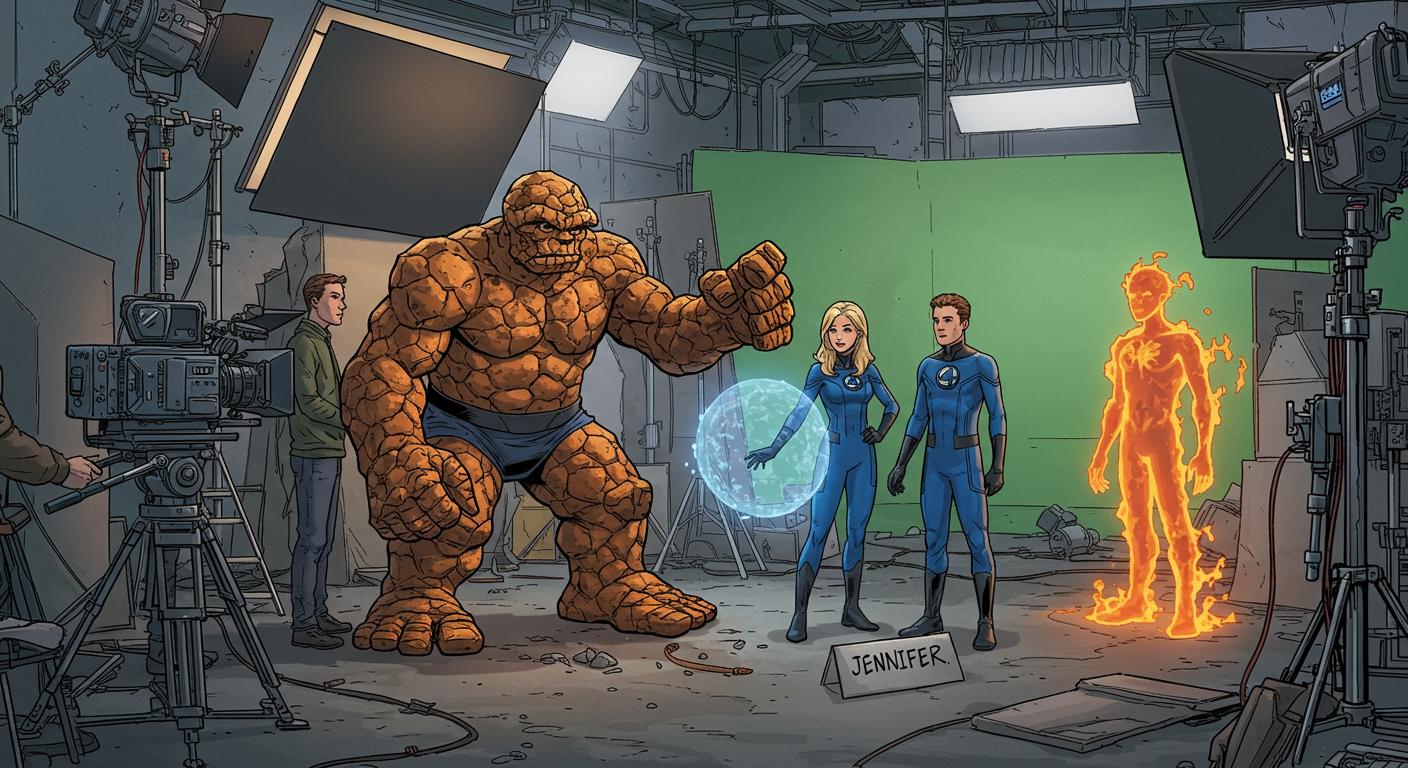
There’s a special kind of satisfaction in discovering the odd, practical solutions at the heart of blockbuster filmmaking. Case in point: on the set of The Fantastic Four: First Steps, director Matt Shakman and his crew enlisted an unlikely supporting actor: an actual desert rock named Jennifer. As detailed in Empire’s behind-the-scenes report and echoed in ComicBookMovie’s breakdown, Jennifer the Rock was no prop bit player—she was the go-to visual reference for every single shot of the MCU’s newest iteration of The Thing.
The Thing, Now With 100% More Actual Rock
It’s well-established that the journey to bring Ben Grimm to life has traveled through a variety of textures. As Empire summarizes, Michael Chiklis donned a practical suit in the earlier films, while the 2015 reboot went fully digital (with mixed results—ComicBookMovie notes much of Ben’s iconic presence got lost in translation that time around). For Matt Shakman’s take, the plan involved layering a performance-captured Ebon Moss-Bachrach and a practical costume for extra reference. But in a move that straddles inspired resourcefulness and Auguste Rodin energy, the crew quite literally mined the desert for a chunk of stone that best embodied the Ever-Lovin’ Blue-Eyed Thing.
According to Shakman, “We went out to the desert and found a rock that looked exactly how we thought The Thing should look, and we filmed it in every single shot that The Thing appears in in the movie, under every lighting environment.” This wasn’t some Hollywood euphemism; Jennifer was present for all the mood lighting, basking in the faux-moon glow and desert sunlight like any other professional. As ComicBookMovie details, this process allowed animators to anchor The Thing’s look in the irregularities of real stone, providing a tactile realism that bridges the gap between CG and the practical—somewhat ironic, given how much superhero cinema has generally favored pixel over pebble.
You have to wonder: did Jennifer have a favorite side, or perhaps a union-mandated handler to prevent sun damage between takes? These are the showbiz stories no Oscar montage ever covers.
The Human Element (and Rocky Puns Abound)
Ebon Moss-Bachrach, new to MCU grandeur after roles in The Bear and Andor, was the first member of Marvel’s First Family cast for Shakman’s reboot. “It’s a little bit heady to think about all the hundreds of people that are helping animate this character,” Empire quotes Moss-Bachrach, reflecting a certain humility about the relay race from his acting to digital wizardry and finally to Jennifer’s grizzled gravitas. Moss-Bachrach also grounds his performance in the personal—highlighted in both outlets—as Ben’s Lower East Side roots connect directly to comic legend Jack Kirby and the family stories at the core of the character: “A lot of this character was a homage to his father, and that, to me, is very meaningful.”
The MCU’s shift from rubber suits to performance-capture isn’t so much abandoning the tactile as reimagining it. With every odd detail—right down to the deliberate use of a rock for lighting consistency—the filmmakers seem determined to prevent The Thing from becoming just another digital blur amid cosmic chaos. In a detail that will likely make techies and trivia fans alike nod in appreciation, the use of Jennifer as an on-set reference is both cost-effective and… well, kind of lovable.
A Rock for the Ages (and the B-Roll)
Stepping back, there’s something perfectly, almost stubbornly human about this entire approach. Why risk the uncanny valley when you can simply cart around a hefty piece of geology? The industry’s relentless arms race for next-level realism often returns, full circle, to the world’s oldest practical effects: find something that looks just right, and stick it in front of a camera. As ComicBookMovie points out, this blend of hi-tech and low-fi may set a new standard for digital effects teams facing the ever-tougher assignment of making the fantastical look authentic on screen.
Will Jennifer get a credit? Should she? And could we be just one step away from seeing prop rocks turn up at conventions, trotted out for autograph sessions by winking production designers? It’s tempting to imagine a Marvel Studios prop department, faced with yet another cosmic threat, flipping through quarry catalogs for next year’s superhero inspiration.
In Praise of Stand-Ins (and the Weird Workarounds We Love)
Ultimately, Jennifer’s time in the Klieg lights is a testament to the creative, collaborative, and occasionally oddball ingenuity behind the scenes of today’s blockbusters. The film may include interdimensional threats and planet-sized antagonists, but it’s the down-to-earth details—a literal rock presence on set—that create the foundation for something memorable.
In a world where it’s easy to assume that everything is pixels and magic, finding out that your favorite superhero movie owes a debt to a sun-bleached boulder feels refreshingly un-Hollywood. Who’s to say what other supporting players are lurking behind the scenes—is there a bag of sand that deserves an Emmy? Might Jennifer inspire a new wave of prop-driven authenticity across the industry? Sometimes, it seems, the most remarkable thing is just how much of the strange and practical slips by unnoticed, shaping our most unreal stories with the help of something as real—and stubbornly silent—as a rock.