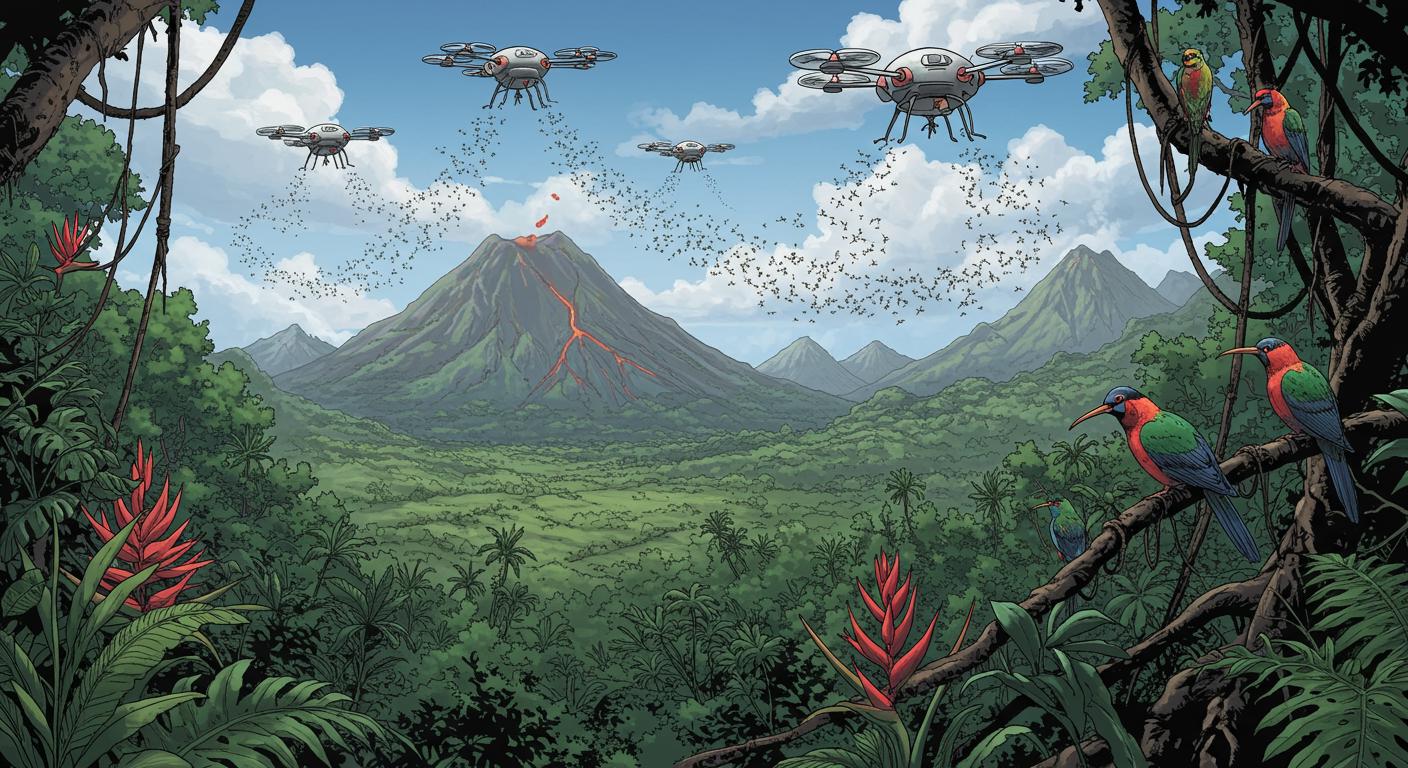
It’s not every day you come across a conservation tale with the makings of a sci-fi screenplay: drones, genetically altered insects, and the fight to save a cast of brilliantly colored songbirds. Yet, as described in a recent Smithsonian Magazine report, this is precisely the strategy scientists are now deploying in the forests of Hawaii. The method? Unleashing swarms of lab-bred male mosquitoes, dropped in biodegradable pods from the bellies of drones, all to stymie a different swarm—the invasive, malaria-carrying mosquitoes pushing Hawaii’s unique bird species to extinction.
Birth Control by Mosquito (and by Drone)
Let’s start with what might seem, at first blush, a candidate for the “solutions stranger than the problem” file. Hawaii’s honeycreepers, those iconic, nectar-loving songbirds, have been suffering catastrophic losses due to avian malaria, a disease spread by mosquitoes that aren’t even native to the islands. As summarized in Smithsonian Magazine, over fifty honeycreeper species once thrived in Hawaii’s forests; today, just seventeen persist, with some species barely clinging to existence. For example, Smithsonian notes that the ‘akikiki, or Kauai creeper, was declared functionally extinct in the wild last summer—a sobering milestone.
So what’s the plan? Smithsonian explains that scientists are taking aim at the mosquitoes themselves by breeding male southern house mosquitoes in labs and infecting them with Wolbachia, a naturally occurring bacteria that renders their offspring unviable. When these males mate with local females, the eggs simply never hatch—reproductive sabotage on a massive scale. There’s a kind of understated elegance to this approach: let a legion of sterile suitors outnumber the competition, and let genetics do the rest.
The “Birds, Not Mosquitoes” coalition, rallying together state, federal, private, and nonprofit forces, has reportedly released more than 40 million of these uniquely engineered males across Maui and Kauai since November 2023. As Smithsonian recounts, some of these program details draw on information provided by Vox and the Honolulu Star-Advertiser; notably, all of the released mosquitoes are the non-biting, strictly male variety—less a plague, more an army of hapless Romeos.
Drones: The New Conservationists
While helicopters have performed most mosquito drops so far, Smithsonian highlights an intriguing development: the arrival of eight-foot-long drones carrying pods filled with mosquitoes. Admittedly, each drone delivers fewer mosquitoes (23,000 per run, compared to the helicopter’s 250,000), but drones offer clear advantages. The magazine notes that they’re safer, require no onboard pilots, and can be dispatched with little notice—ideal for responding to Hawaii’s famously mercurial weather.
Delving into operational details, Smithsonian references a report by the Honolulu Star-Advertiser, describing how the mosquitoes are packed inside small, biodegradable paper pods and kept cool in a temperature-controlled drone compartment. Drone pilot Adam Knox, managing the project for the American Bird Conservancy, explained to Forbes (as relayed by Smithsonian) that the pods are released to the forest floor, where they protect their tiny occupants until they’re ready for takeoff. The pods then disintegrate, leaving no trace but a fresh swarm of would-be suitors. One imagines this is probably the least menacing aerial drop to ever hit a Hawaiian forest.
The Mosquitoes Who Should Not Be There
For a bit of ecological irony, Smithsonian reviews the origins of the crisis. Mosquitoes are, in fact, invasive pests in Hawaii, arriving thanks to a leaking whaling vessel in 1826—a kind of accidental stowaway scenario that altered an entire ecosystem. Now, Hawaii boasts eight species, two of which are of particular concern to wildlife biologists: the southern house mosquito (Culex quinquefasciatus), vector for avian malaria, and the Asian tiger mosquito (Aedes albopictus), which carries avian pox. Both usually stick to warm, low elevations, but Smithsonian, referencing concerns from collaborating scientists, points out that rising temperatures due to climate change may soon allow these insects to reach mountain strongholds where the remaining honeycreepers endure.
So, in a twist typical for modern ecology, a human-introduced problem is being met with a human-engineered (and drone-facilitated) solution. Will flocks of bachelor mosquitoes delivered by unmanned vehicles become the new norm for species rescue? The very notion raises questions about how far we’ll go to undo, or at least contain, past bio-blunders.
On the Precipice
Even with this creative counterattack on mosquitoes, the outlook for Hawaii’s birds remains precarious. Smithsonian mentions the dire straits of the kiwikiu (Maui parrotbill) and ‘ākohekohe (crested honeycreeper), both critically endangered. In an earlier NPR interview, forest bird program coordinator Chris Warren remarked that failing to attempt a solution would be a greater tragedy than extinction itself—a sentiment Smithsonian underscores as central to the project’s urgency. At the heart of this intervention, you find a method that feels simultaneously high-tech and oddly personal: saving a species by ferrying a battalion of sterile mosquitoes into the forest undergrowth.
The magazine further explains that this mosquito-control tactic, known as the “incompatible insect technique,” has been deployed in places like Florida, California, Mexico, and China. Notably, though, in those locations the method primarily aims to reduce vectors for human disease, whereas in Hawaii, the birds are the priority. It’s a small shift that speaks volumes about changing values in conservation—and perhaps a sign that sometimes, the neediest can be the smallest and most overlooked.
Dead Ends and Detours
Of course, Smithsonian also addresses the additional battles Hawaii’s feathered denizens still confront: habitat loss, invasive predators such as rats, and pressures from human settlement. Yet, the lethal efficiency of a single infected mosquito bite has become the frontline issue, overshadowing many of these secondary threats.
As strange as it feels, progress in this realm is measured by absence—not in the return of vanished songs, but in fewer mosquito bites, fewer deaths, and, with luck, fewer extinctions. The mental image lingers: a nocturnal chorus not of birdsong but of drone blades and softly falling pods—a kind of hopeful, futuristic hush underlying the grave stakes. If this experiment succeeds, will we soon find ourselves orchestrating drone airlifts for other species in peril—or does this simply mean we’ve become more adept at cleanup than prevention? The forest, for now, waits—and so do we.