It’s not every day that you encounter the phrase “mass cannibalism” in a news release—and even less so when it’s describing chickens. Yet, according to the Associated Press, several South African poultry farms recently became the unlikely stage for a grisly spectacle even the Brothers Grimm might have rejected as a little much.
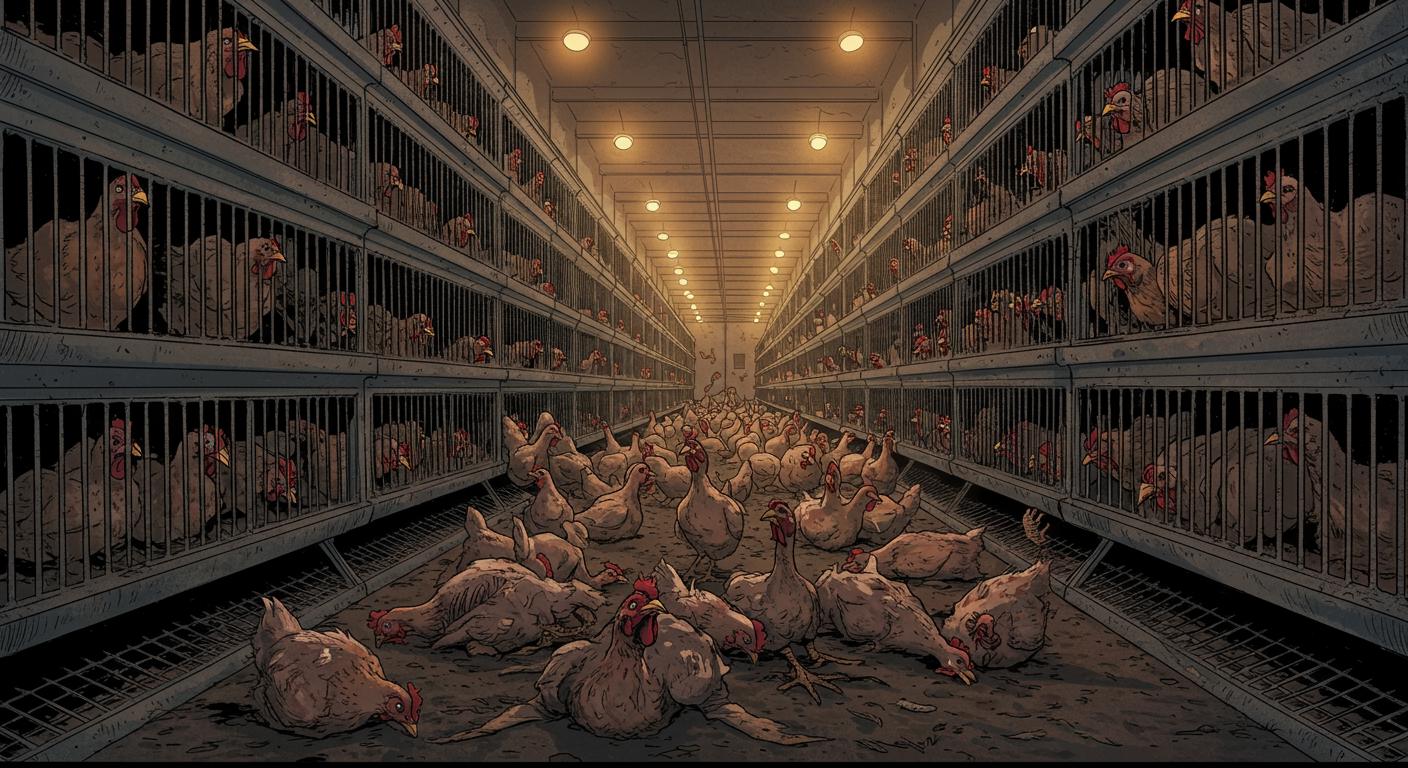
The National Council of Societies for the Prevention of Cruelty to Animals (NSPCA) found itself tasked with the thoroughly unglamorous job of euthanizing over 350,000 chickens by hand after discovering birds so hungry they had begun preying on each other. Investigators arriving on the scene found skeletal chickens clustered together and, in the NSPCA’s words relayed via AP reporting, “feeding lines stripped bare.” Surveying the aftermath at multiple sites owned by Daybreak Foods—a major state-owned poultry supplier—was, as the outlet documents, a challenge not just of logistics but of fortitude.
From Farm to Fiasco
The crisis didn’t unravel overnight. Timeline details cited in AP’s coverage point out that the NSPCA was alerted on April 30, but by the time officers reached the first farm, the birds had gone more than a week without food. “Chickens eating one another” isn’t just a disturbing visual; it’s the endgame of total neglect. And, owing to the scale of “mass cannibalism,” no one can quite say how many chickens were claimed by starvation or by their own companions before help arrived.
According to statements provided to the Daily Maverick and referenced in the AP report, Daybreak Foods spokesperson Nokwazi Ngcongo explained that financial turmoil left the company unable to procure feed. In an extra layer of bureaucratic irony, Daybreak Foods is owned by the Public Investment Corp—a South African state asset manager—which means the birds ultimately fell victim to a crisis of budget rather than any act of nature or disease. Culling became inevitable, as the birds were described by officials as being too underweight to be processed in a slaughterhouse.
In a detail highlighted by the AP piece, Nazareth Appalsamy, head of NSPCA’s farm animal protection unit, noted that about 75 animal protection officers were involved in the culling efforts, an emotionally exhausting task that dragged on for several days, wrapping up only after each chicken unable to recover was euthanized individually. The NSPCA managed to save more than 500,000 other birds across the affected sites, though one wonders how many would carry the invisible scars of nearly becoming dinner for their peers.
The Unseen Cost of Agricultural Collapse
Grouped details from the AP story lay bare the magnitude: hundreds of thousands culled, hundreds of thousands more narrowly spared, and the NSPCA now vowing to pursue legal action against Daybreak Foods for what it frames as an abandonment of animal welfare responsibilities. The South African government, meanwhile, has entered what it terms “talks” with Daybreak leadership about its financial instability—a phrase that, in this context, doesn’t exactly inspire confidence.
What’s particularly chilling, when looking at the sequence of events as reconstructed from the AP coverage, is how far things spiraled before outside intervention occurred. Feed deliveries apparently halted, multiple farms found in disarray, yet emergency response only triggered when the most grotesque symptoms emerged. Can a major agricultural operator’s collapse truly go unnoticed until it devolves into, quite literally, chicken cannibalism?
Chickens, Capital, and Cannibalism
One can’t help but note, as earlier reported by AP, that this isn’t just a cautionary tale—it’s a case study in disaster by neglect. When routine oversight fails, financial insolvency can take lives not counted in creditors’ ledgers. The real cost here has been measured by the animal welfare officers handed one of the bleakest jobs imaginable, forced to mitigate a crisis they did not cause.
Is it enough to say this should serve as warning for how quickly animal welfare can be abandoned at scale? Or is the whole affair destined to be just another surreal footnote in the bizarre annals of modern agriculture? Perhaps, after this, the riddle isn’t “why did the chicken cross the road?” but rather, “why did it take chickens turning on each other for someone to notice?”
Whatever the answer, the chickens of Delmas have ensured their place in the darkly fascinating chapters of collective memory. And for once, the most unbelievable part of the story is that it happened at all.