
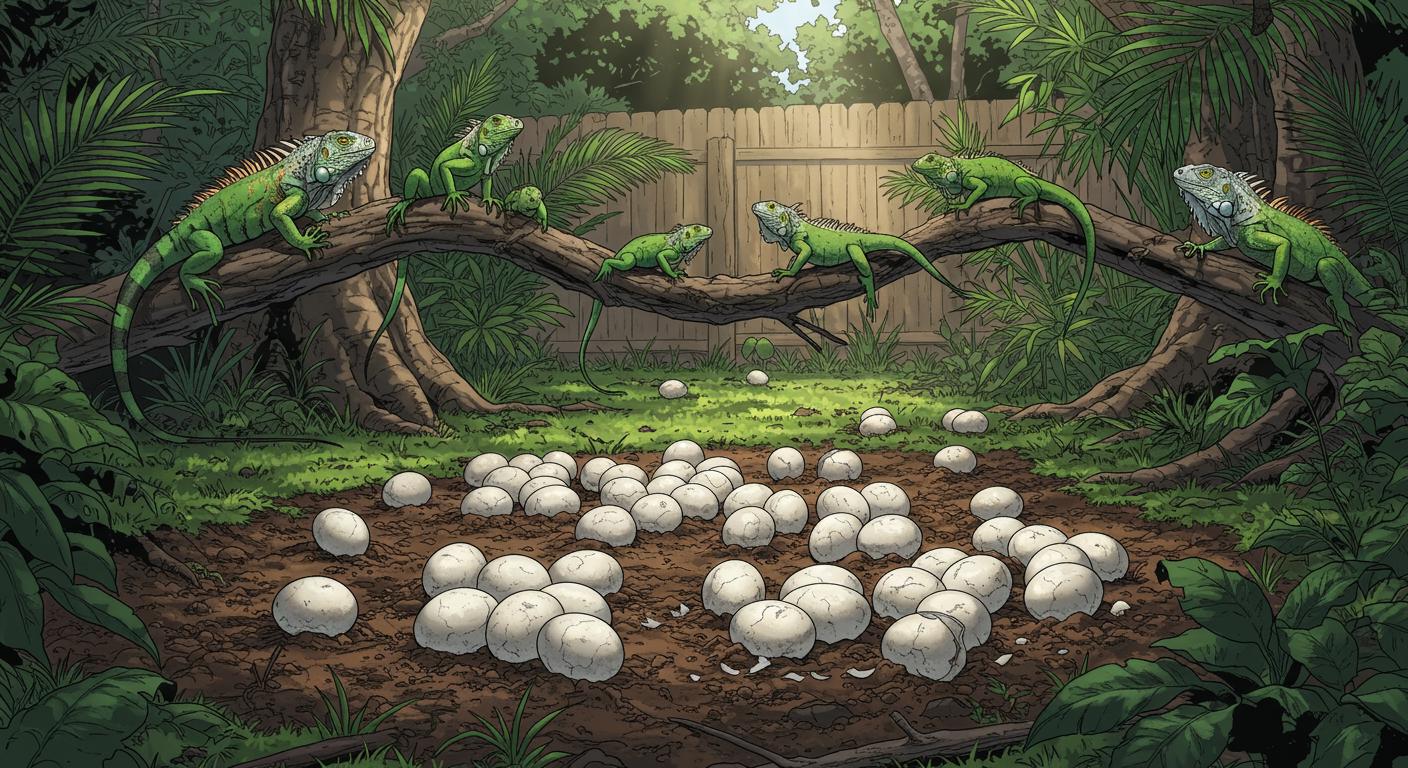
Florida has always been on intimate terms with the unexpected, but a recent find in Palmetto Bay may set a new bar, even for the Sunshine State. When a Miami-area homeowner noticed signs of burrowing in the yard, they contacted the specialists at Humane Iguana Control, igniting what both UPI and Fox News document as a high-water mark for reptilian egg extraction: ninety-eight iguana eggs recovered from a single residential plot. If that sounds more like an ecological open house than a typical pest problem, that’s because it tended toward the spectacular even by Floridian standards.
The Burrow Beneath the Grass
Humane Iguana Control’s Michael Ronquillo explained to both outlets that three female iguanas had converged on the property, each laying her own clutch in a network of interconnected burrows. The conditions—soft soil, a bit of shade, and proximity to water—created an irresistible nesting site, leading to what Ronquillo described as the most eggs his team had ever pulled from one location. The hunt for precedent left them empty-handed; neither Humane Iguana Control nor the local news could point to a prior South Florida find with numbers anywhere near this scale.
Had this reptilian nursery escaped notice, the outcome would have been anything but subtle. As described in Fox News, iguana eggs average a hatch rate north of 90 percent, setting the stage for a localized population boom so swift that “the entire neighborhood would’ve had a serious problem in just a few months.” Left unchecked, it seems likely Palmetto Bay’s yards might have become something of a lizard commuter belt.
When Invasive Species Go from Odd to Ominous
UPI highlights that iguanas aren’t native to Florida; their roots lie in the pet trade and a history of accidental import. Over time, as Fox News outlines, their ability to out-dig, out-climb, and out-reproduce smaller competitors—plus a climate free from natural checks—has made them a formidable, if unintentionally imported, ecological force. Iguanas are now officially classified as a public nuisance thanks to an impressive resume: undermining dams (one West Palm Beach incident racked up $1.8 million in repair bills), weakening sidewalks, and hollowing out the foundations of seawalls and homes.
The risks extend into the less headline-grabbing, more everyday messes: fouled pools, soiled playgrounds, and the unpleasant realization that the “flutter” in your bushes has claws and a whip-like tail instead of wings. Ronquillo described to Fox News how their calls for help often come from schools or parks, where kids play beneath trees only to discover the local iguana population is using the foliage as an outdoor restroom.
The Logistics of Egg Wrangler Life
For those with a rush of homeownerly initiative at the thought of iguana burrows, Humane Iguana Control offers a word of caution. Rather than covering over tunnels—a move that can compact soil, obscure burrow networks, and complicate egg removal—they suggest marking the holes and enlisting experts. Ronquillo noted to Fox News how successful extraction relies on understanding both the architecture of iguana tunnels and the lizard’s uncooperative temperament. With tails capable of 30 mph whips and claws sharpened to ER-admission standards, this is one area where do-it-yourself heroics rarely end as intended.
Breeding season technically peaks from February through May, though outliers crop up throughout the year, keeping both residents and removers on their toes. Humane Iguana Control underscored on social media, as recounted by UPI, that rooting out this clutch didn’t just spare the neighborhood an immediate infestation—it reduced health risks, protected property, and left one initially shocked but ultimately grateful homeowner breathing easier above intact sod.
Reflections From Florida’s Subterranean Front
Invasive species stories are usually slow burns, but every once in a while, a statistic stops you in your tracks. Nearly one hundred eggs from three determined iguanas, neatly hidden beneath someone’s lawn, is a reminder that some of nature’s most ambitious dramas unfold quietly underfoot. UPI notes the rarity of such a trove pulled at once, highlighting the thin line between the merely odd and the ecologically overwhelming.
There’s a kind of understated comedy to it as well—the suburban tranquility, interrupted not by a malfunctioning sprinkler or errant mole, but by an incipient army of hatchlings poised for release. It makes one wonder what else is percolating beneath the average patch of Florida grass. Just how many stories like this begin with a vague suspicion—followed by the realization that the world is, in fact, stranger than anyone gives it credit for? Florida’s yards, as ever, keep their secrets well until, one day, the topsoil gives way and the latest local record wiggles into view.