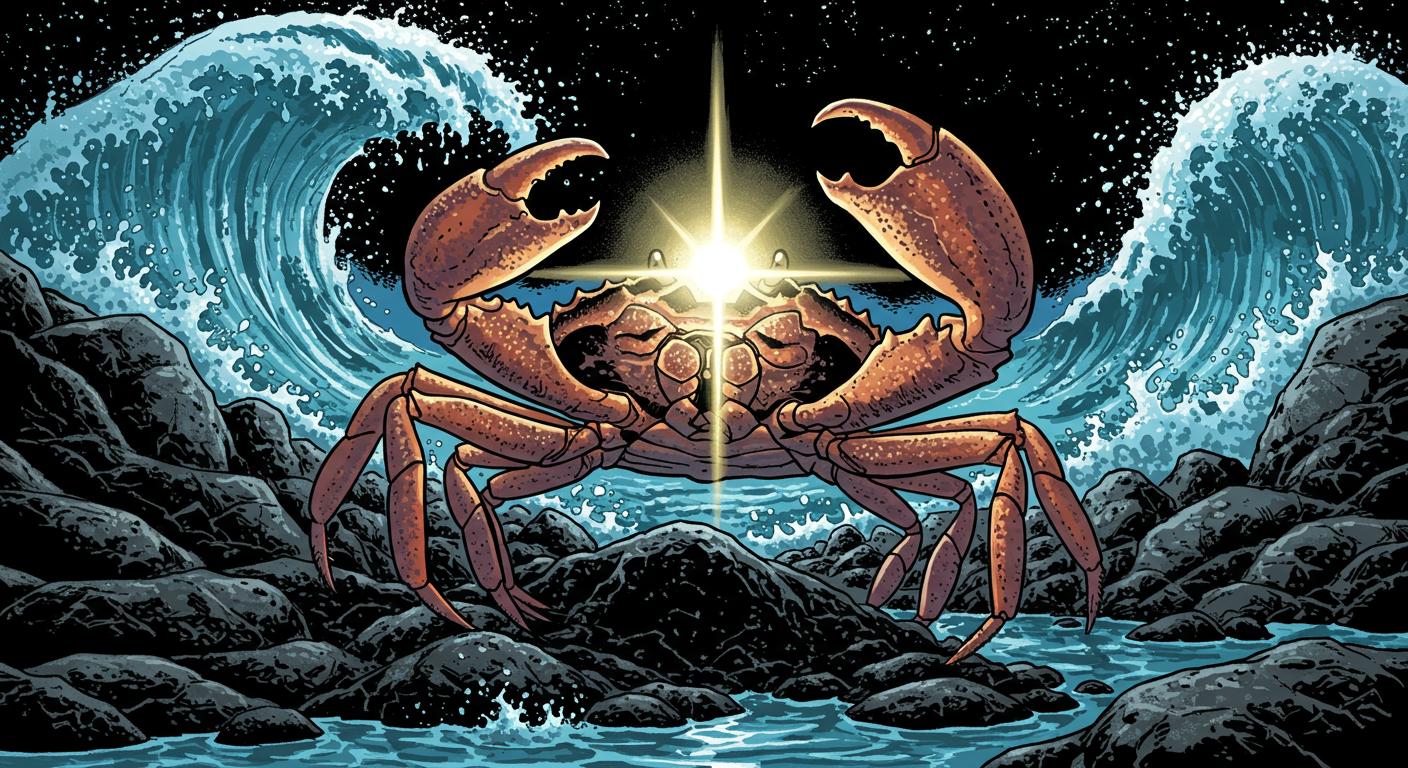
There are plenty of creatures in the world with built-in surprises, but a crab wandering through the mangroves with its own forehead headlamp isn’t something you see—well, unless you’re in the right part of Southeast Asia. Parasesarma eumolpe, as recently detailed in Ecency’s report, is a modest scavenger living among the roots and shadows, quietly going about the business of glowing between its eyes.
Mangrove Glow: Crab Signal or Fashion Statement?
Bioluminescence is old news for ocean fans. Deep-water anglerfish and jellyfish have been perfecting their light shows for eons. What puts Parasesarma eumolpe in its own category is location. This crab makes its home where sunlight filters in strange patterns, not in the deep’s perpetual night. Described in Ecency, these crabs exhibit a gentle blue glow—brighter in males than females—that runs as a band across their foreheads. In the gloomy, tangle-heavy environment of Malaysian and Singaporean mangroves, this built-in lamp stands out.
Researchers have long traced the source of the glow to the crabs’ scavenging habits. As the outlet documents, their diets are loaded with carotenoids from decaying leaves and organic debris. Crabs deprived of this colorful menu quickly dim, confirming the connection between what they eat and what literally lights up their faces.
The male-female glow disparity isn’t just a quirky footnote. Noted in the original reporting, the difference suggests there’s some form of biological message being sent—be it about mating, territory, or the crustacean equivalent of “look at me.”
How to Talk to a Crab: Lights, Signals, and Concave Surfaces
So, is this headlamp practical, or just crab couture? Researchers set out to answer that, as Ecency outlines, by immobilizing some crabs in chilled water (no crabs harmed; just a temporary spa treatment) and observing the responses of others nearby. The results were—well, illuminating. Crabs seemed more attracted to individuals with glows closely resembling their own. In one detail highlighted by the outlet, this points strongly to a system of visual signaling, where light operates as a kind of “hello” in a language only other crabs can read.
Interestingly, the light bands themselves are concave—a clever natural tweak—much like the reflector in a flashlight. This design focuses and intensifies the glow, ensuring the signal cuts through the patchy, filtered light of the mangrove habitat. Here’s a form of communication that’s both subtle and sophisticated, yet achieved with biology’s own hardware.
It raises the question: if other animals use facial movement or sound, why not light? After all, every environment comes with its own challenges, and this is a solution designed for a place where seeing and being seen is half the battle.
Evolution’s Quiet Innovation
The fact that Parasesarma eumolpe occupies shallow waters makes its adaptation all the more curious. As Ecency’s coverage explains, most bioluminescent creatures don’t hang out where the sun still reaches. The crabs’ glow, seemingly dialed in for maximum effect in shifting mangrove light, highlights an evolutionary process that’s less about brute survival and more about nuance—like establishing dominance, warning off rivals, or catching the eye of the right mate.
Earlier in the report, it’s mentioned that male crabs bear the brightest bands. This may serve as a badge in contests with other males, or simply a visual cue to females navigating the labyrinth of mangrove roots. The social life of a glowing crab, one suspects, is a touch more complicated than meets the eye.
Rethinking Light: From Crab Signals to Human Design?
For those keeping tabs on the strange intersections of animal adaptation and human invention, there’s a certain resonance in these discoveries. Ecency closes with the notion that perhaps humans might someday borrow a page from crab biology—adapting light signaling for use in tech that operates where visibility is tricky, or in ways we haven’t even imagined yet. It does spark an odd kind of optimism: what else are we missing in the dark, simply because we’re not tuned to the right wavelength?
One can’t help but wonder—did evolution invent the original headlamp for a reason, or is it simply another chapter in nature’s ongoing experiment with visibility? In the tangle of mangrove roots, the answer is glowing quietly, whether we’re watching or not. The more we look, the stranger—and more ingenious—it all becomes.