If you’ve ever found yourself quietly taking pride in humanity’s invention of various personal hygiene products, take a moment to consider the humble chimpanzee. As described in The Guardian’s report on recent University of Oxford research, our closest living relatives may have scooped us in the innovation department—at least when it comes to creative uses of local foliage.
Hygiene: Civilization or Just Opportunity?
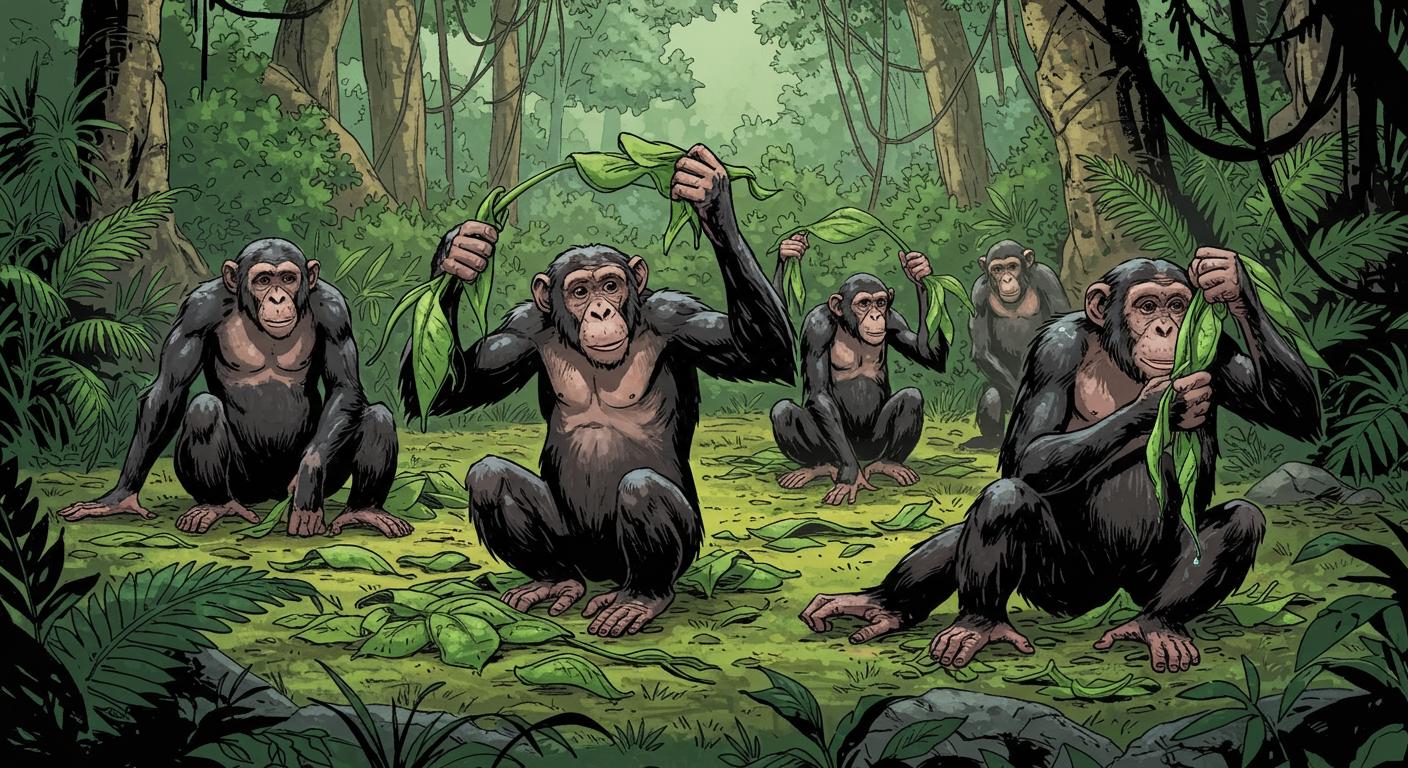
Detailed in the journal Frontiers in Ecology and Evolution and highlighted in The Guardian, the study tracks the habits of the Sonso and Waibira chimpanzee communities in Uganda’s Budongo Forest. Over several months—and, in the case of the Sonso group, spanning three decades of observations—researchers catalogued behaviors that range from the practical to the surprisingly considerate. Among their more memorable findings: chimpanzees use leaves not only to wipe themselves after defecation but also to tend to post-coital cleanup. Apparently, there’s no situation where a well-placed leaf can’t lend a hand.
In a sequence of observations the outlet details, researchers recorded 23 cases of chimp self-treatment for wounds, including licking, dabbing with leaves, finger pressing, and, for those who prefer a spa experience, pressing chewed leaves directly onto the injury. Some of these botanical selections, as the study notes, just so happen to have known antimicrobial or healing properties in local human medicine—though whether the chimps passed their herbalism exams is a matter for further research.
Social (and Sometimes Intimate) Support
It isn’t just do-it-yourself first aid, either. The researchers, as cited in The Guardian, also witnessed chimps removing snares from themselves and others, tending unrelated community members’ wounds, and, in what could be called a new frontier of social etiquette, cleaning the genitals of fellow apes after sex. Particularly, one case involved a chimp assisting in post-coital hygiene by wiping a peer’s penis with a leaf—perhaps the chimp equivalent of a considerate roommate, or at the very least, a collaborator in cleanliness.
Reflecting on these patterns, Dr. Elodie Freymann—one of the study’s authors—remarked that our longstanding belief in human exclusivity when it comes to healthcare is, well, a bit optimistic. As she points out in the outlet’s account, seeing animals care for their own wounds and each other “chips away” at the old notion that such empathy and altruism are purely human territory. The study’s recurring theme is that helping behavior and hygienic savvy are not just evolutionary accidents on the primate family tree—they’re fairly rooted traditions.
What Makes a Healer?
Earlier in The Guardian’s coverage, it’s mentioned that orangutans have also demonstrated wound care with medicinal plants, and chimpanzees elsewhere have been seen using insects therapeutically. Dr. Caroline Schuppli, who wasn’t involved in the study but is quoted for context, suggests that these behaviors signal cognitive capacities deeply shared between humans and chimps. This means our healthcare roots—minus the latex gloves and hospital lighting—may go back much further than humanity’s first prescription pad.
The research raises questions that feel delightfully unsettling: if chimps engage in what amounts to first aid, and even personal grooming after mating, how much of what we proudly call “culture” is actually just a glossier version of old instincts? Do forest debates break out over the optimal leaf for a tough stain, or does personal preference rule in the Budongo undergrowth?
Leaves: The Unheralded MVP
In a detail highlighted by The Guardian, the study stops short of cataloging favorite leaf types, but the breadth of applications borders on the impressive. Toilet paper, antiseptic salve, genital wipe—the selection truly covers all the bases. There’s an odd comfort in knowing our ancient relatives are as fussy about clean-up as we pretend not to be in polite company. One almost wonders if they’ve discovered the three-leaf method (or is that just the stuff of urban legend?).
Closing Reflections on Boundary Blurring
Taken together, the report paints a portrait less of quirky animal improvisation and more of a spectrum, with human healthcare quietly sharing a roots system with chimpanzee self-care and altruism. The outlet also notes that, as more examples of these behaviors emerge, the already porous boundary between us and them looks increasingly artificial.
Is it possible that, far out in the Budongo Forest, a chimp looks at a leaf and contemplates the next great leap in personal care? Given what’s already observed, perhaps the real question isn’t if, but when. Has the line between “civilized” and “wild” ever really been all that crisp—or just easier to wipe away than we’d like to admit?