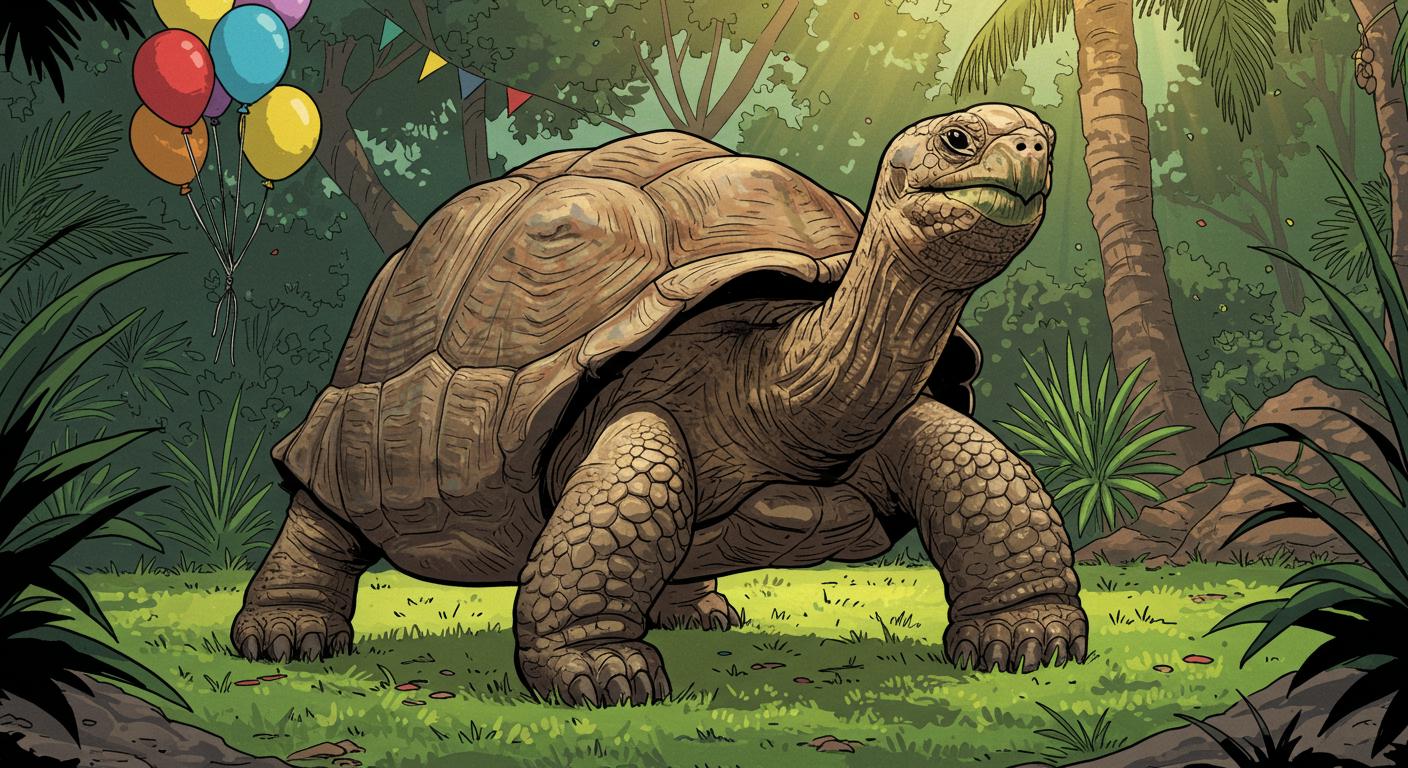
Occasionally, history serves up reminders that life doesn’t follow our tidy timelines—and sometimes those reminders come with a domed shell and a surprising amount of patience. Over the weekend, The Associated Press shared the tale of Goliath, Zoo Miami’s venerable Galapagos tortoise, who marked his 135th year on Earth and, in a remarkable twist, celebrated his very first Father’s Day as an official dad.
One for the Archives: A Hatchling Centuries in the Making
How often does one get to file a “first” after more than a century of steady plodding? According to records maintained by Zoo Miami and detailed by AP, Goliath was originally hatched on Santa Cruz Island in the Galapagos sometime between 1885 and 1890. The chronicles show he arrived at the Bronx Zoo in 1929, then settled in at Miami in 1981—an intrepid, if rambling, sort of resume. Despite numerous attempts at fatherhood (and likely sidelong glances from zookeepers growing gradually more invested in his romantic pursuits), Goliath never managed to produce offspring. Until now.
Zoo officials told the AP that this month, out of a clutch of eight eggs laid back in January, a single hatchling emerged on June 4th—the first Galapagos tortoise ever successfully hatched at Zoo Miami and, more personally, Goliath’s maiden voyage into fatherhood. His partner in this slow-motion success story, Sweet Pea, is also a certifiable elder at an estimated 85 to 100 years old. The odds, it seems, were not exactly stacked in the manner of a tortoise pyramid.
Ron Magill, the zoo’s spokesperson, expressed his admiration, suggesting that Goliath’s improbable paternity is a testament to stubborn optimism—living proof, as Magill remarked, “that where there is a will, there is a way and to never give up.”
Conservation in Slow Motion
Beneath the surface charm of this milestone lies the sobering reality that Galapagos tortoises, once counted by the thousands, fell victim to human exploitation and invasive species prior to the previous century. The AP report highlights that ongoing threats—climate change and shrinking habitats—continue to loom. That only one of eight eggs hatched, despite the rigorous care and protection of a modern zoo, says something about the delicate art and science of conservation. How many centuries does it take for us to help undo what took decades of disruption?
For Goliath, the process was the very definition of slow-burn drama. Years of uneventful breeding passed, interrupted only by the occasional shuffle to a sunnier corner or yet another hopeful introduction. The records reviewed by AP indicate that, despite past pairings with multiple females, this is his first successful offspring. What, one wonders, is the tortoise equivalent of a victory lap?
On Fatherhood (and Its Limits)
Tortoises, as noted by the AP, are not hands-on parents. In the wild, hatchlings are left to their own devices from day one, navigating an ancient world armed chiefly with a sturdy shell and an admirable sense of self-sufficiency. At Zoo Miami, the young arrival remains safely ensconced in a separate enclosure, while Goliath and Sweet Pea continue their stately routines. If there’s any extended family bonding, it’s happening at a glacial pace—both literally and figuratively.
Officials confirmed to the AP that both Goliath and Sweet Pea appear to be thriving, even if their parental involvement is essentially ceremonial. One could imagine, in a flight of librarian’s fancy, a distant future in which a great-great-great-hatchling pores over century-old records and wonders, “Was Grandpa Goliath always this slow, or was it just his dance moves?”
Persistence, Patience, and Peculiar Timing
The entire episode feels like it could have been lifted from an archivist’s daydream—a centenarian animal, long past the point most would expect any new tricks, clutching a well-earned Father’s Day headline. The AP’s coverage subtly asks us to consider: is there any other Miami resident, human or otherwise, having quite so unexpectedly eventful a Sunday this year?
At the intersection of extinction risk and improbable hope, Goliath’s story is a reminder that the long game sometimes pays off, and not always on our schedule. What simple, persistent goals are we quietly overlooking, convinced the window has long since closed? And what (perhaps equally slow) surprises are waiting for us around the next sun-warmed corner?