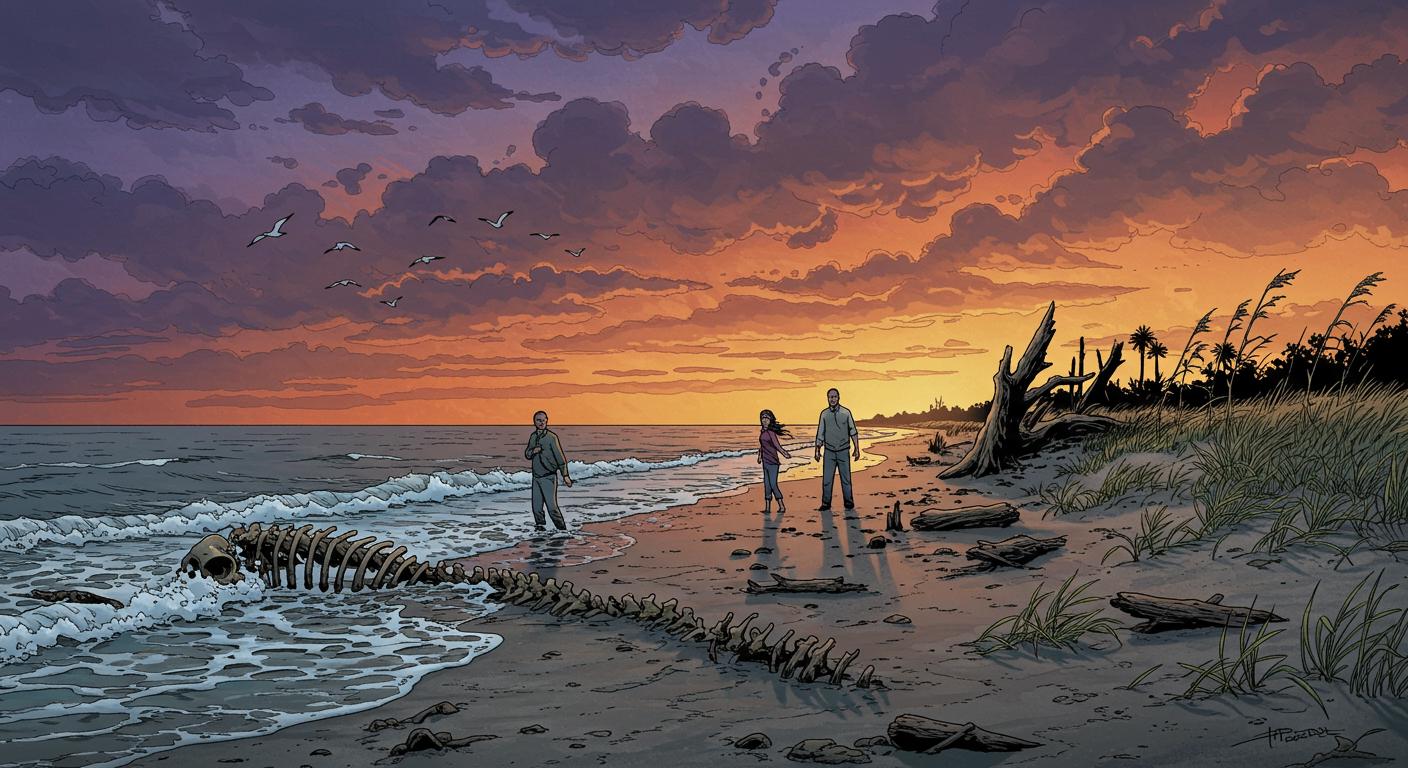
There’s something about beaches that makes people think in terms of sunburns and souvenir shells—not, say, disinterred 19th-century bones. Yet on South Carolina’s Edisto Island, a routine stroll morphed into a page out of a gothic potboiler when a group of unsuspecting tourists happened upon skeletal remains—remains which, as CBS News reports, may well be evidence of a “long forgotten” burial site eroding up from history’s sandy basement.
Skeletons in the Sand (Literally)
Let’s set the scene: Jeremy Cay, a coastal patch of Edisto Island, is exactly the kind of windswept beach where people expect driftwood and maybe the odd bleached horseshoe crab—not human skulls. But as CBS News describes, that’s precisely what greeted this particular group of beachcombers. What began as a casual “fossil” hunt quickly shifted into something far less ordinary as they realized the fragments belonged to a once-living person. Local law enforcement soon converged on the beach, cordoning off what had instantly become an open-air cold case from another century.
According to the Colleton County Sheriff’s Office, initial findings point to a burial site from Edingsville Beach—a now-vanished 19th-century community catering to the summering wealthy, complete with churches and a schoolhouse. Erosion and storms have a way of rearranging history, and between a Civil War exodus and catastrophic hurricanes in the late 1800s, this “South’s Hamptons” faded back into marsh and myth. The practical outcome, as outlined by CBS News, is that bones occasionally surface among the sea oats, an unintentional time capsule cracked open by wind and tide.
Piecing Together the Past
CBS News relays that Colleton County coroner Rich Harvey told Newsweek the recently unearthed remains included a skull and separated bones, which might date as far back as the Revolutionary or Civil War era. This is not Edisto’s first run-in with its own buried past: as CBS News also notes, a Pennsylvania tourist in 2015 who, while presumably on a casual walk, discovered bones instead. That same year, a former ranger turned up a skull with teeth, which forensic specialists traced to roughly 1865-1870. Hardly the sort of coastal souvenirs advertised in travel brochures.
Jeremy Cay doesn’t just produce old bones, either. CBS News, citing an essay shared by the Jeremy Cay Homeowner’s Association, points out storms regularly wash up period china, broken tools, and fragments of bygone houses—turning the beach into a low-key pop-up museum with an unusually ghoulish admission policy.
What Does It Mean When the Past Won’t Stay Buried?
Perhaps the most fascinating—or unsettling—aspect is just how commonplace these discoveries are on beaches up and down the coast. For example, CBS News references a recent case in which skeletal remains found on New Jersey beaches were identified as those of a 19th-century schooner captain. Just how many of these stories are waiting beneath our feet, quiet until the next big surge?
For now, forensic analysis is underway at the Medical University of South Carolina, where experts are attempting to untangle this person’s past and how they came to rest here. As authorities—working in concert across the sheriff’s and coroner’s offices—dig into the still-unfolding mystery, you can’t help but marvel at the intersection of local history and modern surprise. Beaches: not just for sunscreen and mystery novels, but for the gradual resurfacing of mysteries themselves.
It almost makes you wonder what other remnants of the supposedly “forgotten” await rediscovery—perched somewhere between the tides and the thin, receding line we like to call the present. Next time you spot something odd poking through the sand, would you keep walking, or pause to squint at history peeking out from the past?